C/2025 R3 (PanSTARRS)
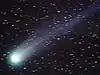
 Comet C/2025 R3 (PanSTARRS) imaged on 8 April 2026 | |
| Discovery[1] | |
|---|---|
| Discovered by | Pan-STARRS |
| Discovery date | 8 September 2025 |
| Designations | |
| CK25R030[2] | |
| Orbital characteristics[3][4] | |
| Epoch | 27 December 2025 (JD 2461036.5) |
| Observation arc | 216 days |
| Earliest precovery date | 7 September 2025 |
| Number of observations | 707 |
| Aphelion | ≈6300 AU (inbound)[3] ejection (outbound) |
| Perihelion | 0.499 AU (75 million km) |
| Semi-major axis | ≈3100 AU (inbound) |
| Eccentricity | 0.99984 (inbound)[3] 1.00025 (outbound) |
| Orbital period | ≈170000 years (inbound) ejection (outbound) |
| Inclination | 124.73° |
| 38.69° | |
| Argument of periapsis | 162.23° |
| Mean anomaly | -0.0022° |
| Last perihelion | 19 April 2026 |
| TJupiter | -0.498 |
| Earth MOID | 0.487 AU |
| Jupiter MOID | 1.45 AU |
| Physical characteristics | |
| Comet total magnitude (M1) | 12.0±0.7 |
| 1.5 (2026-04-26)[5][a] | |
C/2025 R3 (PanSTARRS) is a hyperbolic Oort cloud comet and passed perihelion on 19 April 2026 when it was 0.499 AU (75 million km) from the Sun.[6] Around perihelion it reached about an apparent magnitude of +3.[5][7][8] By May 5–6 it was barely visible to the naked eye as it was located very low and close to the twilight sky. The comet was discovered by PanSTARRS in images obtained on 8 September 2025.[1] By 20 March 2026 it became visible in 10x50 binoculars.[9] As of May, the comet had faded, moved into the southern skies and required binoculars or a camera to locate. By the end of July it had faded to magnitude 17 as it headed out of the Solar System, never to be seen again.
Observational history
Discovery
The comet was spotted in images obtained by the 1.8-m Ritchey-Chretien telescope at Haleakala, Hawaii, as part of the PanSTARRS survey, at an apparent magnitude of about 20. The head of the comet appeared diffuse, about 2.5 arcseconds across, and there was no tail visible.[1] A broad tail 10 arcseconds long was visible in follow-up images by the Canada-France-Hawaii Telescope. On 11 September the comet was 3.60 AU (539 million km) from the Sun.[2]
Follow-up observations
In January the comet was around magnitude 17,[10] but afterwards the comet started to brighten quickly.[6] In mid March it had brighened to about magnitude 9.[5] On 20 March 2026 the comet was detected visually in 10x50 binoculars by Alan Hale.[9] On 21 March the tail of the comet was about one degree long.[11] On April 4 the comet had an apparent magnitude of about 6 and its coma 3 arcminutes across under moonlight and the comet near the horizon.[6]
On 7 April 2026 was 33 degrees from the Sun, its maximum elongation between the two solar conjunctions.[12] On 8 April, its ion tail was at least 7 degrees long, but little dust tail was visible. At that time the comet was moving slowly at the western half of the Pegasus Square, but its motion was accelerating as the elongation started to reduce.[10] On 11 April the comet was spotted with naked eye, with an estimated magnitude of 5.1.[5]
It reached perihelion, at 0.499 AU (74.6 million km; 46.4 million mi), on 19 April 2026 when it was 20 degrees from the Sun.[8] It then moved between the Sun and Earth and the brightness of the dust tail was significantly enhanced by forward scattering.[7] It reached solar conjunction on 25 April 2026 around 05:23 UT when it was 3.5 degrees from the Sun.[13] The comet passed 0.489 AU (73.2 million km) from Earth on 26 April 2026.[14][8]
It entered SOHO's LASCO C3 FOV on 23 April and CCOR-1 on 24 April.
Orbit
Data from JPL-HORIZONS show that its future (outbound) trajectory indicates that the comet will be ejected from the Solar System.[3] Backward integration of its orbit in the last 3 million years show that there is a 91% probability that it may have an extrasolar origin, although an origin within our Solar System, particularly the Oort cloud, are not completely ruled out.[15] If confirmed, this makes it the second known extrasolar comet candidate within the Solar System after C/2018 V1 (Machholz–Fujikawa–Iwamoto).[16]
The comet passed within 1.58 AU (236 million km) from Uranus on 23 November 2019.[6]
Physical characteristics
Radio observations conducted by the Five-hundred-meter Aperture Spherical Telescope (FAST) on 7–8 April 2026 detected 18-cm emission lines of hydroxyl (OH) from its coma, prompting follow-up observations to be conducted.[17] Spectroscopic analysis from the Asiago Astrophysical Observatory further detected the presence H-alpha and H2O+ emission lines from the comet on 15 April 2026.[18]
Gallery
 On 16 April, seen from near Taos, New Mexico.
 On 25 April, as it crossed the view of the CCOR-1 coronagraph.

 On 12 April, photographed from Citrus Springs, Florida, USA. A Starlink trail is visible crossing the comet's ion tail.
See also
- C/2025 R2 (SWAN)
- C/2026 A1 (MAPS), a Kreutz sungrazer that was expected to become visible to the naked eye a few weeks before C/2025 R3, before disintegrating on 4 April 2026.
Notes
- ↑ Since the surface brightness of a diffuse coma+nucleus is harder to detect than a point-like star of the same magnitude, a comet realistically needs to reach an apparent magnitude of ≈4.5 to be visible to the naked eye under a rural dark sky. Magnitude 6 is a good target for 40mm binoculars and magnitude 8 is a good target for 70mm binoculars.
References
- 1 2 3 Y. Ramanjooloo; R. Weryk; R. Wainscoat; et al. (18 September 2025). D. W. Green (ed.). "Comet C/2025 R3 (PanSTARRS)" (TXT). Central Bureau for Astronomical Telegrams. 5607: 1. Bibcode:2025CBET.5607....1R.
- 1 2 Y. Ramanjooloo; A. Nastasi; A. Aletti; A. Novichonok; R. Weryk (18 September 2025). "Comet C/2025 R3 (PanSTARRS)". Minor Planet Electronic Circulars. 2025-S104.
- 1 2 3 4 Horizons output. "Barycentric Osculating Orbital Elements for PanSTARRS (C/2025 R3)". Archived from the original on 4 March 2026. Retrieved 15 April 2026. (Solution using the Solar System's barycenter (Sun+Jupiter). Select Ephemeris Type:Elements and Center:@0)
Inbound period (PR) = 6.40E+07 / 365.25 days = 175200 years - ↑ "C/2025 R3 (PanSTARRS) – JPL Small-Body Database Lookup". ssd.jpl.nasa.gov. Jet Propulsion Laboratory. Archived from the original on 14 March 2026. Retrieved 15 April 2026.
- 1 2 3 4 "COBS Observation list: C/2025 R3". Črni Vrh Observatory. Retrieved 6 May 2026. Comet C/2025 R3 (PanSTARRS) Lightcurve
- 1 2 3 4 J. J. Gonzalez; W. Hasubick; V. Gonano; S. Nakano (6 April 2026). D. W. Green (ed.). "Comet C/2025 R3 (PanSTARRS)" (TXT). Central Bureau for Astronomical Telegrams. 5680: 1.
- 1 2 J. Carter (2 January 2026). "Will Comet C/2025 R3 (PanSTARRS) be the 'great comet' of 2026?". Space.com. Retrieved 5 March 2026.
- 1 2 3 G. van Buitenen. "C/2025 R3 (PanSTARRS)". astro.vanbuitenen.nl. Retrieved 3 March 2026.
- 1 2 Alan Hale. "C/2025 R3 visual (comet-ml)". Retrieved 20 March 2026.
- 1 2 James, Nick (8 April 2026). "Comet C/2025 R3 (PanSTARRS) is worth observing in the morning sky – British Astronomical Association". British Astronomical Association. Retrieved 12 April 2026.
- ↑ Olason, Mike (22 March 2026). "Comet C/2025 R3 (PANSTARRS)". Sky & Telescope. Retrieved 24 March 2026.
- ↑ "Sun-Observer-Target angle (local maximum) for PanSTARRS (C/2025 R3) on 2026-Apr-07". JPL Horizons. Retrieved 3 March 2026.
- ↑ "Solar conjunction (Sun-Observer-Target angle) for PanSTARRS (C/2025 R3) on 2026-Apr-25". JPL Horizons. Retrieved 8 March 2026.
- ↑ "Earth approach on 2026-Apr-26". JPL Horizons. Archived from the original on 5 March 2026. Retrieved 18 March 2026.
- ↑ C. de la Fuente Marcos; R. de la Fuente Marcos (2026). "Comet C/2025 R3 (PanSTARRS) Dynamics: Impending Interstellar Itinerary, Obscure Origin". Research Notes of the American Astronomical Society. 10 (6): 166. Bibcode:2026RNAAS..10..166D. doi:10.3847/2515-5172/ae7f1e.
- ↑ C. de la Fuente Marcos; R. de la Fuente Marcos (2019). "Comet C/2018 V1 (Machholz–Fujikawa–Iwamoto): dislodged from the Oort Cloud or coming from interstellar space?" (PDF). Monthly Notices of the Royal Astronomical Society. 489 (1): 951–961. arXiv:1908.02666. Bibcode:2019MNRAS.489..951D. doi:10.1093/mnras/stz2229.
- ↑ D. Jiang; L. Qian; Z. Pan; et al. (8 April 2026). "The detection of OH 18 cm lines in C/2025 R3 with FAST". The Astronomer's Telegram. 17744: 1. Bibcode:2026ATel17744....1D.
- ↑ F. Manzini; A. C. Mura; P. Ochner; et al. (15 April 2026). "Detection of the H-alpha and H
2O+ emission lines in spectra of Comet C/2025 R3 (PanSTARRS)". The Astronomer's Telegram. 17754: 1. Bibcode:2026ATel17754....1M.
External links
- C/2025 R3 at the JPL Small-Body Database
- C/2025 R3 at Seiichi Yoshida's website
- Comet Chasing @ Youtube: Chasing the Comets of April
- HDR Astrophotography: Comet tails simulations by Nicolas Lefaudeux
Astronomy Pictures of the Day
- NASA Astronomy Picture of the Day: Comet R3 (PanSTARRS) Brightens (12 April 2026)
- NASA Astronomy Picture of the Day: The Long Wispy Tail of Comet R3 (PanSTARRS) (14 April 2026)
- NASA Astronomy Picture of the Day: PanSTARRS and Planets (18 April 2026)
- NASA Astronomy Picture of the Day: Comet R3 PanSTARRS over a Himalayan Valley (20 April 2026)
- NASA Astronomy Picture of the Day: Comet R3 PanSTARRS Behind Satellite Trails (27 April 2026)
- NASA Astronomy Picture of the Day: Comet R3 PanSTARRS Before Rigel (8 May 2026)
- NASA Astronomy Picture of the Day: Comet R3 PanSTARRS and Orion (10 May 2026)
- NASA Astronomy Picture of the Day: The Conjunction of Comet R3 PanSTARRS and the Orion Nebula (12 May 2026)
- NASA Astronomy Picture of the Day: Comet R3 PanSTARRS Through Time (8 June 2026)

2026 in space | |||
|---|---|---|---|
| |||
| Space probe and telescope launches  |
|    | |
| Impact events | |||
| Selected NEOs |
| ||
| Discoveries |
| ||
| Comets | |||
| Space exploration |
| ||
