75D/Kohoutek
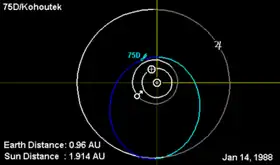 Orbit of Comet 75D/Kohoutek | |
| Discovery | |
|---|---|
| Discovered by | Luboš Kohoutek |
| Discovery site | Hamburg-Bergedorf Observatory |
| Discovery date | 9 February 1975 |
| Designations | |
| D/1975 C1, D/1980 P1 | |
| |
| Orbital characteristics[1][2] | |
| Epoch | 25 February 2023 (JD 2460000.5) |
| Observation arc | 13.27 years (Not observed in 38 years)[2] |
| Number of observations | 104 |
| Aphelion | 5.3 AU |
| Perihelion | 1.77 AU |
| Semi-major axis | 3.54 AU |
| Eccentricity | 0.499 |
| Orbital period | 6.7 years |
| Inclination | 5.92° |
| 269.6° | |
| Argument of periapsis | 175.5° |
| Mean anomaly | 106.6° |
| Last perihelion | 7 March 2021?[3] (last seen 1988) |
| Next perihelion | 2 November 2027?[4][3][5] (assumed) |
| TJupiter | 2.894 |
| Earth MOID | 0.8 AU |
| Physical characteristics[1] | |
Mean radius | 1.7 km (1.1 mi)[6] |
| Comet total magnitude (M1) | 10.5 |
| Comet nuclear magnitude (M2) | 14.5 |
| 14.0 (1975 apparition) | |
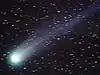
75D/Kohoutek is a periodic comet discovered in February 1975, by Luboš Kohoutek. Even on the discovery plate the comet was only apparent magnitude 14.[7] The comet was last observed in 1988 and has not been observed in 38 years.
Not to be confused with the much better-known C/1973 E1 (Kohoutek), 75D is a repeat visitor to the inner Solar System, with a period of about seven years. It was placed on the discovery orbit when it passed 0.143 AU (21.4 million km) from Jupiter on 28 July 1972.[7][1] Apparitions have been dim, with the brightest being in 1988 at about apparent magnitude 13.[7] It was not seen in 1994, 2000, 2007, 2014, or 2021. The comet has been estimated to be 4.6 km (2.9 mi) in diameter.[1]
This comet was last observed by Mauna Kea on 19 May 1988.[2] The Minor Planet Center has given the comet a "D/" designation as the comet is believed to be lost.[2][8]
In August 2026 the comet is calculated to come to opposition in the constellation of Aquarius at around apparent magnitude 19.5.[9] In late January 2028 it may come to opposition in the constellation of Cancer at around apparent magnitude 16.[10]
See also
References
- 1 2 3 4 "75D/Kohoutek – JPL Small-Body Database Lookup". Jet Propulsion Laboratory. Retrieved 16 March 2025.
- 1 2 3 4 "75D/Kohoutek Orbit". Minor Planet Center. Retrieved 30 October 2014.
- 1 2 S. Yoshida (31 October 2021). "75D/Kohoutek". www.aerith.net. Retrieved 16 March 2025.
- ↑ "Horizons Batch for 75D/Kohoutek (90000826) on 2027-Nov-02" (Perihelion occurs when rdot flips from negative to positive). JPL Horizons. Retrieved 2026-04-05. (JPL#J873/16/Soln.date: 2000-Sep-07)
- ↑ K. Kinoshita (1998-03-09). "75D/Kohoutek past, present and future orbital elements". Comet Orbit. Retrieved 2026-04-10.
- ↑ M. J. S. Belton (2014). "The Size-distribution of Scattered Disk TNOs from that of JFCs between 0.2 and 15-km effective radius". Icarus. 231 (1): 168–182. arXiv:1312.1424. Bibcode:2014Icar..231..168B. doi:10.1016/j.icarus.2013.12.001.
- 1 2 3 G. W. Kronk. "75P/Kohoutek". Cometography.com. Archived from the original on 25 August 2009. Retrieved 30 October 2014.
- ↑ "Cometary Designation System". Minor Planet Center. Retrieved 17 June 2015.
- ↑ "Horizons Batch for 75D/Kohoutek (90000826) in August 2026". JPL Horizons. Retrieved 2026-04-05.
- ↑ "Horizons Batch for 75D/Kohoutek (90000826) in January 2028". JPL Horizons. Retrieved 2026-04-08.