29P/Schwassmann–Wachmann
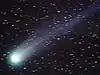
 29P/Schwassmann–Wachmann imaged by Gemini Observatory in 2021 | |
| Discovery | |
|---|---|
| Discovered by | Arnold Schwassmann Arno Arthur Wachmann |
| Discovery site | Hamburg Observatory |
| Discovery date | November 15, 1927 |
| Designations | |
| P/1902 E1; P/1927 V1 | |
| 1908 IV; 1927 II; 1941 VI; 1957 IV; 1974 II; 1989 XV | |
| Orbital characteristics[1] | |
| Epoch | January 1, 2023 (JD 2459945.5) |
| Observation arc | 13.83 years |
| Earliest precovery date | 4 March 1902 |
| Number of observations | 622 |
| Aphelion | 6.318 AU (30 September 2026)[2] |
| Perihelion | 5.777 AU |
| Semi-major axis | 6.047 AU |
| Eccentricity | 0.0447 |
| Orbital period | 14.87 years |
| Max. orbital speed | 12.7 km/s |
| Inclination | 9.364° |
| 312.39° | |
| Argument of periapsis | 50.913° |
| Last perihelion | March 7, 2019[3] |
| Next perihelion | February 18, 2035[4] |
| TJupiter | 2.986 |
| Earth MOID | 4.781 AU |
| Jupiter MOID | 0.792 AU |
| Physical characteristics[5] | |
| Dimensions | 60.4 ± 7.4 km (37.5 ± 4.6 mi) |
| 58 days[6][7] | |
| 0.033 | |
| Comet total magnitude (M1) | 10.1 |
| ~14[8] | |
Comet 29P/Schwassmann–Wachmann, also known as Schwassmann–Wachmann 1, was discovered on November 15, 1927, by Arnold Schwassmann and Arno Arthur Wachmann at the Hamburg Observatory in Bergedorf, Germany.[9] It is a large comet 60 km in diameter and is known for being observable throughout the whole orbit and having frequent outbursts where it brightens by 2-3 magnitudes. The most recent outbursts were in February 2026, April 2026, and May 2026. The comet will come to solar conjunction on 26 September 2026,[10] and will come to aphelion on 30 September 2026.[2] It crossed the celestial equator in late 2025 and is headed further into southern skies until April 2029 when it will have a declination of −31.[11]
Discovery
It was discovered photographically, when the comet was in outburst and the magnitude was about 13.[9] Precovery images of the comet from March 4, 1902, were found in 1931 and showed the comet at 12th magnitude.[9]
Orbit and physical properties
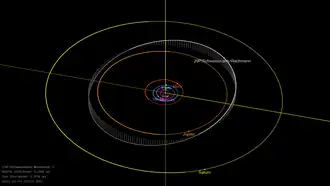
The comet reached its most recent perihelion on March 7, 2019.[1] It spends its entire orbit just beyond Jupiter at 5.8–6.3 AU from the Sun where the comet remains active with a coma as it is close to the snow line. It will reach aphelion on 30 September 2026.[2]
The comet is a member of a class of objects called "centaurs", of which at least 1000 are known.[12] These are small icy bodies with orbits between those of Jupiter and Neptune. The centaurs have been recently perturbed inward from the Kuiper belt, a disk of trans-Neptunian objects occupying a region extending from the orbit of Neptune to approximately 50 AU from the Sun. Frequent perturbations by Jupiter[1] will likely accumulate and cause the comet to migrate either inward or outward by the year 4000.[13] A number of centaurs appear to be dynamically and perhaps even physically related to 29P; such objects may traverse the coma of 29P when in outburst.[14]
The comet nucleus is estimated to be 60.4±7.4 kilometers in diameter.[1][5] As of 2026, the comet has a rotation period of about 58 days.[6][7]
Outbursts
The comet is unusual in that while normally hovering at around 16th magnitude, it suddenly undergoes an outburst. This causes the comet to brighten by 1 to 5 magnitudes.[15] This happens with a frequency of 7.3 outbursts per year,[15] fading within a week or two. The magnitude of the comet has been known to vary from 18th magnitude to 10th magnitude, a more than thousand-fold increase in brightness, during its brightest outbursts. Between 2014 and 2026, there have been 120 outbursts observed or about 10 outbursts per year.[6] Outbursts are very sudden, rising to maximum in about 2 hours, which is indicative of their cryovolcanic origin; and with the times of outburst modulated by an underlying 58-day periodicity possibly suggesting that its large nucleus is an extremely slow rotator.[7]


During 2025, there were 8 notable outbursts occurring as four pairs of twin events: January 2/6, February 1/2, May 13/25, and December 4/11. The December outburst reached about magnitude 13.[18]
In 2026, there was an outburst on February 9/15 to magnitude 12.6V.[19] On April 15 there was outburst from magnitude 16 to 13.[20] Another outburst occurred on May 29.[6]
References
- 1 2 3 4 "29P/Schwassmann–Wachmann 1 – JPL Small-Body Database Lookup". ssd.jpl.nasa.gov. Jet Propulsion Laboratory. Retrieved May 5, 2009.
- 1 2 3 "Horizons Batch for 29P/Schwassmann–Wachmann 1 (90000395) on 2026-Sep-30" (Aphelion occurs when rdot flips from positive to negative). JPL Horizons. Retrieved September 29, 2025.
- ↑ 29P past, present and future orbital elements
- ↑ "Horizons Batch for 29P/Schwassmann–Wachmann 1 (90000395) on 2035-Feb-18" (Perihelion occurs when rdot flips from negative to positive). JPL Horizons. Archived from the original on June 17, 2022. Retrieved October 1, 2021.
- 1 2 C. A. Schambeau; Y. R. Fernández; C. M. Lisse; N. Samarasinha; L. M. Woodney (2015). "A new analysis of Spitzer observations of Comet 29P/Schwassmann–Wachmann 1". Icarus. 260: 60–72. arXiv:1506.07037. Bibcode:2015Icar..260...60S. doi:10.1016/j.icarus.2015.06.038. S2CID 119298410.
- 1 2 3 4 Richard Miles (May 31, 2026). "New outburst and confirmation of ~58-day rotation period". Retrieved June 1, 2026.
- 1 2 3 Miles, Richard (July 1, 2016). "Discrete sources of cryovolcanism on the nucleus of Comet 29P/Schwassmann–Wachmann and their origin". Icarus. 272: 387–413. Bibcode:2016Icar..272..387M. doi:10.1016/j.icarus.2015.11.011.
- ↑ Yoshida: 29P (2012–2026)
- 1 2 3 Kronk, Gary W. (2001–2005). "29P/Schwassmann–Wachmann 1". Archived from the original on October 22, 2008. Retrieved October 13, 2008. (Cometography Home Page)
- ↑ "Solar conjunction for 29P (90000395) in September 2026". JPL Horizons. Retrieved June 12, 2026.
- ↑ "Maximum Southern Declination in April 2029". JPL Horizons. Retrieved February 14, 2026.
- ↑ "JPL Small-Body Database Search: orbital class (CEN)". Jet Propulsion Laboratory. Archived from the original on September 17, 2020. Retrieved June 1, 2026.
- ↑ "Twelve clones of 29P/Schwassmann–Wachmann diverging by the year 4000". Archived from the original on June 23, 2015. Retrieved April 30, 2009. (Solex 10) Archived December 20, 2008, at the Wayback Machine
- ↑ de la Fuente Marcos, C.; de la Fuente Marcos, R.; Licandro, J.; Serra-Ricart, M.; Martino, S.; de Leon, J.; Chaudry, F.; Alarcón, M. R. (May 13, 2021). "The active centaur 2020 MK4". Astronomy & Astrophysics. 649 (1): A85 (15 pages). arXiv:2104.01668. Bibcode:2021A&A...649A..85D. doi:10.1051/0004-6361/202039117. S2CID 233024896.
- 1 2 Trigo-Rodríguez; Melendo; García-Hernández; Davidsson; Sánchez (2008). "A continuous follow-up of Centaurs, and dormant comets: looking for cometary activity" (PDF). European Planetary Science Congress. Retrieved October 13, 2008.
- ↑ Trigo-Rodriguez et al., Outburst activity in comets, I. Continuous monitoring of comet 29P/Schwassmann–Wachmann 1
- ↑ Trigo-Rodriguez et al., Outburst activity in comets, II. A multi-band photometric monitoring of comet 29P/Schwassmann–Wachmann 1 arXiv:1009.2381
- ↑ 29P: Twin strong outbursts (11 Dec 2025)
- ↑ Amongst the 5 brightest eruptions (10 February 2026)
- ↑ Latest event appears to be timed at 2026 04 15.35 (15 Apr 2026)
External links
- 29P/Schwassmann–Wachmann at the JPL Small-Body Database
- 29P/Schwassmann–Wachmann 1 – Seiichi Yoshida @ aerith.net
- 29P/Schwassmann–Wachmann – cobs.si
- 29P monitoring campaign – British Astronomical Association COMET MISSION 29P website
- 29P at Las Cumbres Observatory (8 Feb 2010 12:23, 60 seconds)
- 29P (Joseph Brimacombe April 18, 2013)