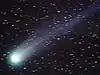
28P/Neujmin
 Sketch of Comet Neujmin 1 as seen by Edward E. Barnard from the Yerkes Observatory on 9 September 1913. | |
| Discovery | |
|---|---|
| Discovered by | Grigory Neujmin |
| Discovery date | 3 September 1913 |
| Designations | |
| P/1913 R2, P/1931 S1 | |
| |
| Orbital characteristics[1][2] | |
| Epoch | 17 October 2024 (JD 2460600.5) |
| Observation arc | 112.48 years |
| Number of observations | 1,281 |
| Aphelion | 12.38 AU |
| Perihelion | 1.585 AU |
| Semi-major axis | 6.983 AU |
| Eccentricity | 0.77297 |
| Orbital period | 18.45 years |
| Inclination | 14.299° |
| 346.39° | |
| Argument of periapsis | 347.47° |
| Mean anomaly | 70.299° |
| Last perihelion | 11 March 2021[3] |
| Next perihelion | 23 July 2039[4] |
| TJupiter | 2.168 |
| Earth MOID | 0.571 AU (85.4 million km) |
| Jupiter MOID | 0.958 AU (143.3 million km) |
| Physical characteristics | |
| Dimensions | 19.4 km (12.1 mi)[5] |
| 12.75±0.03 hours[6] | |
| 0.025[7] | |
| Comet total magnitude (M1) | 13.2[1] |
28P/Neujmin, also known as Neujmin 1, is a large 21-km periodic comet that orbits the Sun once every 18 years. With a perihelion distance (closest approach to the Sun) of 1.6 AU (240 million km), this comet does not get closer than about 0.571 AU (85.4 million km) from Earth.[1]
Orbital and physical characteristics
Initial estimates of the size of its nucleus in 2001 is estimated to be 21.4 km (13.3 mi) in diameter with a low albedo of 0.025.[6][7] A follow-up study in 2003 revised this figure to 19.4 km (12.1 mi).[5] Since 28P has such a large nucleus, it became brighter than the 20th magnitude in early 2019, roughly 2 years before coming to perihelion. When it came to opposition in May 2020, when it was still 3.5 AU (520 million km) from the Sun, it had an apparent magnitude around 16.9. But during the 2021 perihelion passage the comet was on the opposite side of the Sun as the Earth. The comet is not known for bright outbursts of activity.
Archival data from the Subaru Telescope in 2021 revealed that while the measured colors of Neujmin 1's nucleus resembles those of D-type asteroids, its surface microstructure likely differs from them.[8]
References
- 1 2 3 "28P/Neujmin 1 – JPL Small-Body Database Lookup". ssd.jpl.nasa.gov. Jet Propulsion Laboratory. Retrieved 25 February 2010.
- ↑ "28P/Neujmin Orbit". Minor Planet Center. Retrieved 12 September 2021.
- ↑ S. Nakano (1 May 2001). "28P/Neujmin 1 (NK 798)". OAA Computing and Minor Planet Sections. Retrieved 26 February 2010.
- ↑ "Horizons Batch for 28P/Neujmin 1 (90000388) on 2039-Jul-23" (Perihelion occurs when rdot flips from negative to positive). JPL Horizons. Retrieved 2 May 2023. (JPL#74/Soln.date: 2023-Mar-29)
- 1 2 D. C. Jewitt; S. S. Sheppard; Y. R. Fernández (2003). "143P/Kowal–Mrkos and the Shapes of Cometary Nuclei". The Astronomical Journal. 125 (6): 3366–3377. Bibcode:2003AJ....125.3366J. doi:10.1086/374947. S2CID 53614673.
- 1 2 3 C. E. Delahodde; K. J. Meech; O. R. Hainaut; E. Dotto (2001). "Detailed phase function of comet 28P/Neujmin 1". Astronomy & Astrophysics. 376 (2): 672–685. Bibcode:2001A&A...376..672D. doi:10.1051/0004-6361:20011028.
- 1 2 H. Campins; Y. R. Fernandez (2002). "Observational Constraints On Surface Characteristics Of Comet Nuclei" (PDF). Earth, Moon, & Planets. 89 (1): 117–134. Bibcode:2002EM&P...89..117C. doi:10.1023/A:1021590203207.
- 1 2 3 T. Ootsubo; H. Kawakita; T. Takata; et al. (2026). "Opposition effect of comet 28P/Neujmin observed with Subaru Hyper Suprime-Cam". Publications of the Astronomical Society of Japan. arXiv:2608.11082.
External links
- 28P/Neujmin at the JPL Small-Body Database
- 28P/Neujmin at Gary W. Kronk's Cometography
- 28P/Neujmin at Seiichi Yoshida's website