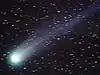
161P/Hartley–IRAS
| Discovery[1] | |
|---|---|
| Discovered by | Malcolm Hartley IRAS |
| Discovery date | 4–10 November 1983 |
| Designations | |
| P/1983 V1 P/2004 V2 | |
| 1984 III, 1983v[2] | |
| Orbital characteristics[3][4] | |
| Epoch | 9 June 2026 (JD 2461200.5) |
| Observation arc | 42.77 years[a] |
| Number of observations | 425 |
| Aphelion | 14.178 AU |
| Perihelion | 1.265 AU |
| Semi-major axis | 7.722 AU |
| Eccentricity | 0.83616 |
| Orbital period | 21.457 years |
| Inclination | 95.791° |
| 1.475° | |
| Argument of periapsis | 47.068° |
| Mean anomaly | 352.14° |
| Last perihelion | 20 June 2005 |
| Next perihelion | 27 November 2026[5] |
| TJupiter | 0.540 |
| Earth MOID | 0.448 AU |
| Jupiter MOID | 0.115 AU |
| Physical characteristics | |
| Comet total magnitude (M1) | 11.5 |
| Comet nuclear magnitude (M2) | 15.0 |
| 7.8 (1983 apparition) | |
161P/Hartley–IRAS is a Halley-type comet with an orbital period of 21 years. This is the sixth and final comet discovered by the infrared space telescope IRAS,[6] and the third of twelve comets discovered overall by Australian astronomer, Malcolm Hartley.[b]
Observational history
1983 apparition and discovery
Malcolm Hartley first detected the trail of this comet on a photographic plate exposed from the Siding Spring Observatory on 4 November 1983.[7] At the time it was a 15th-magnitude object within the constellation Capricornus.[c] However, before he can obtain a confirmation plate, John K. Davies and Simon F. Green reported that the Infrared Astronomical Satellite (IRAS) detected a comet on 10 November 1983, where Kenneth S. Russell later confirmed that it was the same object as Hartley's comet by 23 November.[7] The discovery was publicly announced on 25 November 1983.[1]
Follow-up observations were conducted by Brian A. Skiff, James B. Gibson, Richard E. McCrosky and others in December 1983, reporting a weak condensation and a short tail.[8] John E. Bortle reported that the comet reached peak brightness at magnitude 7.8 on 24 February 1984,[9] indicating that it produced an outburst that brightened it by two magnitudes.[7] It faded gradually in the coming months, and by 27 May 1984, Hartley–IRAS had a total visual magnitude of 12.2.[10] The comet was last observed on 4 June 1984.[7]
2005 apparition
Robert H. McNaught recovered Comet Hartley–IRAS on 3 November 2004, ahead of its next perihelion on 20 June 2005.[11] The comet was subsequently given an official numerical designation (161P) by the Minor Planet Center on 24 November 2004.[12] It reached magnitude 11.3 on 16 June 2005.[13]
2026 apparition
The comet was recovered from the Siding Spring Observatory by Hirohisa Sato on 18 July 2026 at nearly 2–3 times fainter than predicted from its previous apparition in 2005.[14] As of August 2026, the comet is around apparent magnitude 15.[15][16] It reaches opposition on 27 September 2026.[17] The closest approach to Earth will be on 2 October 2026 at a distance of 0.505 AU (75.5 million km).[16] At perihelion on 27 November 2026 the solar elongation will be 61 degrees at a magnitude of approximately 11.[16]
Physical characteristics
On March 1984, Stephen M. Larson measured the spectroscopy of the comet, detecting emissions of OH, NH, CN, C3 and C2 from its coma, where it was noted to be comparable to that of 27P/Crommelin.[18]
Orbit
Brian G. Marsden confirmed Hartley–IRAS as a periodic comet on December 1983,[19] where he suspected that the comet may have been near Jupiter sometime in 1957,[20] although this was later refuted by Shuichi Nakano and Kazuo Kinoshita in 1984 and 1998, respectively.[7] As of August 2026, this comet currently completes a 21.4-year orbit around the Sun, reaching perihelion at a distance of 1.27 AU (190 million km) and aphelion of around 14.2 AU (2.12 billion km).[4] It has retrograde, near-polar orbit around the Sun,[21] with only a few close encounters with Jupiter between 1921 and 2171.[3][d] Orbital calculations show that while the comet has a nominal Lyapunov time of around 650 years,[21] non-gravitational accelerations caused by its cometary activity will likely perturb its orbit enough to make close encounters with the inner planets (particularly Venus, Earth, and Mars) in the next 5,000 years or so.[21]
Notes
- ↑ Observation arc from the Minor Planet Center database covering dates from 4 November 1983 until 13 August 2026.
- ↑ Malcolm Hartley previously recovered 79P/du Toit–Hartley and 80P/Peters–Hartley in February and July 1982 respectively, both of which he is credited as co-discoverer.
- ↑ Reported initial position upon discovery was: α = 21h 53.6m , δ = –21° 18′[7]
- ↑ Comet Hartley–IRAS encountered Jupiter in 1921 (0.385 AU), and will make further close flybys by 2028 (0.397 AU) and 2171 (0.645 AU) respectively.
References
- 1 2 J. K. Davies; S. F. Green; K. S. Russell; M. Hartley (25 November 1983). B. G. Marsden (ed.). "Comet Hartley–IRAS (1983v)". IAU Circular. 3894 (1). Bibcode:1983IAUC.3894....1D.
- ↑ "Comet Names and Designations". International Comet Quarterly. Retrieved 7 July 2026.
- 1 2 "161P/Hartley–IRAS – JPL Small-Body Database Lookup". ssd.jpl.nasa.gov. Jet Propulsion Laboratory. Retrieved 26 July 2012.
- 1 2 "161P/Hartley–IRAS Orbit". Minor Planet Center. Retrieved 18 June 2014.
- ↑ "Horizons Batch for 161P/Hartley–IRAS on 2026-Nov-27" (Perihelion occurs when rdot flips from negative to positive). JPL Horizons. Retrieved 22 June 2022. (JPL#60 Soln.date: 2021-Apr-15)
- ↑ B. G. Marsden (1986). "Comets in 1983". Quarterly Journal of the Royal Astronomical Society. 27: 102–113. Bibcode:1986QJRAS..27..102M.
- 1 2 3 4 5 6 G. W. Kronk; M. Meyer; D. A. J. Seargent (2017). Cometography: A Catalog of Comets. Vol. 6: 1983–1994. Cambridge: Cambridge University Press. pp. 56–60. ISBN 978-0-521-87216-4.
- ↑ K. S. Russell; J. B. Gibson; B. A. Skiff; et al. (5 December 1983). B. G. Marsden (ed.). "Comet Hartley–IRAS (1983v)". IAU Circular. 3896 (2). Bibcode:1983IAUC.3896....2R.
- ↑ J. C. Marlin; C. S. Morris; J. E. Bortle (24 February 1984). B. G. Marsden (ed.). "Periodic Comet Hartley–IRAS (1983v)". IAU Circular. 3918 (1).
- ↑ C. S. Morris (14 June 1984). D. W. Green (ed.). "Periodic Comet Hartley–IRAS (1983v)". IAU Circular. 3952 (4). Bibcode:1984IAUC.3952....4M.
- ↑ R. H. McNaught (5 November 2004). D. W. Green (ed.). "Comet P/2004 V2 (Hartley–IRAS)". IAU Circular. 8428 (1). Bibcode:2004IAUC.8428....1M.
- ↑ D. W. Green (24 November 2004). "Comets 161P/Hartley–IRAS and 162P/Siding Spring". IAU Circular. 8445 (6). Bibcode:2004IAUC.8445....6G.
- ↑ J. J. Gonzalez; N. Biver (1 July 2005). D. W. Green (ed.). "Comet 161P/Hartley–IRAS". IAU Circular. 8555 (4). Bibcode:2005IAUC.8555....4G.
- ↑ H. Sato; M. Masek; S. Nakano; et al. (18 July 2026). D. W. Green (ed.). "Comet 161P/Hartley–IRAS" (TXT). Central Bureau for Astronomical Telegrams. 5718: 1.
- ↑ "COBS Observation list: 161P". Crni Vrh Observatory. Retrieved 10 August 2026. Comet 161P Lightcurve
- 1 2 3 G. van Buitenen. "161P/Hartley–IRAS". astro.vanbuitenen.nl. Retrieved 14 April 2026.
- ↑ "Horizons Batch for 161P/Hartley–IRAS on 2026-Sep-27". JPL Horizons. Retrieved 13 August 2026.
- ↑ S. M. Larson; D. W. Green; J. E. Bortle (9 March 1984). B. G. Marsden (ed.). "Periodic Comet Hartley–IRAS (1983v)". IAU Circular. 3926 (2).
- ↑ B. G. Marsden (21 December 1983). "Periodic Comet Hartley–IRAS (1983v)". IAU Circular. 3903 (2). Bibcode:1983IAUC.3903....2M.
- ↑ N. G. Thomas; E. Bowell; E. Everhart; D. W. Green (9 December 1983). B. G. Marsden (ed.). "Comet Hartley–IRAS (1983v)". IAU Circular. 3898 (2). Bibcode:1983IAUC.3898....2T.
- 1 2 3 P. Kankiewicz; I. Włodarczyk (2021). "Impact of non-gravitational effects on chaotic properties of retrograde orbits" (PDF). Astronomy & Astrophysics. 646: 182–197. arXiv:2101.04364. Bibcode:2021A&A...646A.182K. doi:10.1051/0004-6361/202037738.
External links
- 161P/Hartley–IRAS at the JPL Small-Body Database
- 161P/Hartley–IRAS at Gary W. Kronk's Cometography
- 161P/Hartley–IRAS at Seiichi Yoshida's website
- 161P/Hartley–IRAS at Gideon van Buitenen's website
- 161P/Hartley–IRAS at the Comet Observations Database (COBS)
Minor Planet Electronic Circulars (MPEC)
- MPEC 2004-V25: Comet P/1983 V1 = 2004 V2 Hartley–IRAS (Bibcode: 2004MPEC....V...25M)
- MPEC 2004-W19: Comet P/1983 V1 = 2004 V2 Hartley–IRAS (Bibcode: 2004MPEC....W...19H)