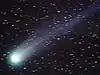
331P/Gibbs
 Fragments and dust trail of comet 331P/Gibbs as seen from the Hubble Space Telescope on 25 December 2015.[1] | |
| Discovery[2] | |
|---|---|
| Discovered by | Alex R. Gibbs |
| Discovery site | Mount Lemmon Survey |
| Discovery date | 22 March 2012 |
| Designations | |
| P/2012 F5 | |
| Gibbs 14[3] | |
| Orbital characteristics[4][5] | |
| Epoch | 21 November 2025 (JD 2461000.5) |
| Observation arc | 21.29 years |
| Earliest precovery date | 26 August 2004 |
| Number of observations | 213 |
| Aphelion | 3.127 AU |
| Perihelion | 2.878 AU |
| Semi-major axis | 3.003 AU |
| Eccentricity | 0.04142 |
| Orbital period | 5.203 years |
| Inclination | 9.741° |
| 216.74° | |
| Argument of periapsis | 185.75° |
| Mean anomaly | 353.49° |
| Last perihelion | 25 December 2025 |
| Next perihelion | 16 March 2031[6] |
| TJupiter | 3.228 |
| Earth MOID | 1.886 AU |
| Jupiter MOID | 2.087 AU |
| Physical characteristics[7] | |
Mean diameter | 1.77 km (1.10 mi) |
| 3.24±0.01 hours | |
| Comet total magnitude (M1) | 16.8 |
331P/Gibbs (P/2012 F5) is a small Encke-type comet and active asteroid, discovered by American astronomer Alex Gibbs.[2]
Description
It is a rare type of comet called a main-belt comet. Although most comets come from the Oort cloud or the Kuiper belt, main-belt comets are instead members of the asteroid belt that have a coma and tail. As of 2016, it is one of only 15 known main-belt comets.[8]
Precovery observations of 331P/Gibbs in Sloan Digital Sky Survey data were found dating to August 2004, in which the object was visible as a regular asteroid. Further observations in 2014 by the Keck Observatory showed that the comet was fractured into 5 pieces and rotating rapidly, with a rotation period of only 3.2 hours. Due to the YORP effect, 331P/Gibbs had begun to spin so quickly that, being a likely rubble pile, parts began to be thrown off, leaving a very long dust trail.[9] This is very similar to 311P/PANSTARRS, being the best-established cause for main-belt comets along with impacts between small asteroids (such as with 596 Scheila and 354P/LINEAR).
Orbit
The orbit of 331P/Gibbs is found within the dynamically cold region of the outer asteroid belt at distances between 2.88–3.13 AU (431–468 million km) from the Sun.[5] A 2014 study revealed that it is a member of a previously unknown extremely compact cluster of nine asteroids now known as the Gibbs cluster,[a] which was likely formed by a catastrophic collision event of their parent body more than 1.5 million years ago.[10] Its orbit in the outer main belt is dynamically stable over timescales of 1 billion years.[11]
Notes
- ↑ Members of this cluster include; 20674 (1999 VT1), 140429 (2001 TQ96), 177075 (2003 FR36), 249738 (2000 SB159), 257134 (2008 GY132), 321490 (2009 SH54), 341222 (2007 RT138), and 496996 (2002 TF325).[10]
References
- ↑ M. T. Hui; D. C. Jewitt (2022). "Fragment Dynamics in Active Asteroid 331P/Gibbs". The Astronomical Journal. 164 (6): 236. arXiv:2210.01432. Bibcode:2022AJ....164..236H. doi:10.3847/1538-3881/ac978d.
- 1 2 A. R. Gibbs; H. Sato; W. H. Ryan; et al. (March 2012). D. W. Green (ed.). "Comet P/2012 F5 (Gibbs)" (TXT). Central Bureau for Astronomical Telegrams. 3069: 1. Bibcode:2012CBET.3069....1G.
- ↑ "Periodic Comet Names and Designations". Planetary Data System: Small Body Node. NASA. Retrieved 4 July 2026.
- ↑ "331P/Gibbs – JPL Small-Body Database Lookup". ssd.jpl.nasa.gov. Jet Propulsion Laboratory. Retrieved 14 December 2015.
- 1 2 "331P/Gibbs Orbit". Minor Planet Center. Retrieved 26 February 2019.
- ↑ "Horizons Batch for 331P/Gibbs (90001305) on 2031-Mar-16" (Perihelion occurs when rdot flips from negative to positive). JPL Horizons. Retrieved 19 April 2026. (JPL#41 Soln.date: 2025-Dec-18)
- ↑ M. Drahus; W. Waniak; S. Tendulkar; et al. (2015). "Fast Rotation and Trailing Fragments of the Active Asteroid P/2012 F5 (Gibbs)". The Astrophysical Journal Letters. 802 (1): 8–14. arXiv:1503.05632. Bibcode:2015ApJ...802L...8D. doi:10.1088/2041-8205/802/1/L8.
- ↑ "JPL Small-Body Database Search Engine". Jet Propulsion Laboratory. NASA. Retrieved 10 December 2016.
- ↑ "Active asteroid spun so fast that it exploded". Astronomy Now. 23 March 2015. Retrieved 10 December 2016.
- 1 2 B. Novaković; H. H. Hsieh; A. Cellino; et al. (2014). "Discovery of a young asteroid cluster associated with P/2012 F5 (Gibbs)". Icarus. 231: 300–309. arXiv:1401.2966. Bibcode:2014Icar..231..300N. doi:10.1016/j.icarus.2013.12.019.
- ↑ R. Stevenson; E. A. Kramer; J. M. Bauer; et al. (2012). "Characterization of Active Main Belt Object P/2012 F5 (Gibbs): A Possible Impacted Asteroid". The Astrophysical Journal. 759 (2): 142–150. arXiv:1209.5450. Bibcode:2012ApJ...759..142S. doi:10.1088/0004-637X/759/2/142.
External links
- 331P/Gibbs at the JPL Small-Body Database
- 331P in SDSS (26 August 2004)
- 331P confirmation observations, Malina River Observatory (23 March 2012) Archived 5 December 2021 at the Wayback Machine
- 331P/Gibbs at Seiichi Yoshida's website
- 331P/Gibbs at Gideon van Buitenen's website