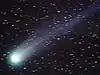
68P/Klemola
 Infrared image of Comet Klemola taken by NEOWISE on 23 August 2019 | |
| Discovery[1] | |
|---|---|
| Discovered by | Arnold R. Klemola |
| Discovery site | Yale-Columbia Southern Station, Argentina |
| Discovery date | 28 October 1965 |
| Designations | |
| |
| |
| Orbital characteristics[3][4] | |
| Epoch | 21 November 2025 (JD 2461000.5) |
| Observation arc | 55.19 years |
| Number of observations | 1,978 |
| Aphelion | 8.119 AU |
| Perihelion | 1.809 AU |
| Semi-major axis | 4.964 AU |
| Eccentricity | 0.63563 |
| Orbital period | 11.06 years |
| Inclination | 11.097° |
| 175.09° | |
| Argument of periapsis | 153.20° |
| Mean anomaly | 196.75° |
| Last perihelion | 9 November 2019 |
| Next perihelion | 4 November 2030[5] |
| TJupiter | 2.524 |
| Earth MOID | 0.758 AU |
| Jupiter MOID | 0.174 AU |
| Physical characteristics[3] | |
Mean radius | 2.5 km (1.6 mi)[6] |
| Comet total magnitude (M1) | 11.2 |
| Comet nuclear magnitude (M2) | 14.1 |
68P/Klemola or Klemola's Comet is a Jupiter-family comet that was discovered in 1965 by American astronomer Arnold Richard Klemola in Argentinian Yale-Columbia Southern Station.[7]
Observational history
It was observed at the next predicted apparition by Gérard Sause at the Observatoire de Haute Provence, France on 6 August 1976 with a brightness of magnitude 12. It was successfully observed in 1987 when J. Gibson of the Palomar Observatory, California, obtained images with the 1.5-meter reflector on 16 February. It appeared essentially stellar, with a faint magnitude of 19. It was observed again on 29 March 1997 by Carl W. Hergenrother at the F. L. Whipple Observatory, with perihelion on 1 May 1998.
68P came to opposition on 14 June 2019 and perihelion on 9 November 2019.[4] During this apparition, the comet exhibited intermediate level of activity relative to other known Jupiter-family comets like 78P/Gehrels.[8]
Orbit
Orbital reconstruction of the comet in 2024 revealed that 68P/Klemola entered the JFC region only a thousand years ago, and is still a relatively young comet as a result.[8]
References
- ↑ A. R. Klemola; B. G. Marsden (15 November 1965). O. Gingerich (ed.). "Possible Comet Klemola (1965j)". IAU Circular. 1940 (1).
- ↑ "MPC Explorer: (2019 JP114)". Minor Planet Center. Retrieved 30 June 2026.
- 1 2 "68P/Klemola – JPL Small-Body Database Lookup". ssd.jpl.nasa.gov. Jet Propulsion Laboratory. Retrieved 28 June 2026.
- 1 2 "68P/Klemola Orbit". Minor Planet Center. Retrieved 1 March 2019.
- ↑ "Horizons Batch for 68P/Klemola (90000702) on 2030-Nov-04" (Perihelion occurs when rdot flips from negative to positive). JPL Horizons. Archived from the original on 8 July 2023. Retrieved 6 July 2023. (JPL#K192/3 Soln.date: 2023-Apr-25)
- ↑ Y. R. Fernández; M. S. P. Kelley; P. L. Lamy; et al. (2013). "Thermal properties, sizes, and size distribution of Jupiter-family cometary nuclei". Icarus. 226 (1): 1138–1170. arXiv:1307.6191. Bibcode:2013Icar..226.1138F. doi:10.1016/j.icarus.2013.07.021.
- ↑ M. V. Zombeck (2007). Handbook of Space Astronomy and Astrophysics (3rd ed.). Cambridge University Press. p. 61. ISBN 978-0-521-78242-5.
- 1 2 R. Xu; J. Shi; Y. Ma; et al. (2024). "Activity Analysis on 68P/Klemola and 78P/Gehrels 2 in 2018–2020 Perihelion Passage". The Astronomical Journal. 167 (3): 111–124. Bibcode:2024AJ....167..111X. doi:10.3847/1538-3881/ad1ff2.
External links
- 68P/Klemola at the JPL Small-Body Database
- 68P/Klemola at Gary W. Kronk's Cometography
- 68P/Klemola at Seiichi Yoshida's website