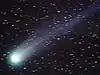
163P/NEAT
| Discovery[1] | |
|---|---|
| Discovered by | Near-Earth Asteroid Tracking (644) |
| Discovery site | Palomar Observatory |
| Discovery date | 5 November 2004 |
| Designations | |
| P/2004 V4 | |
| Orbital characteristics[2][3] | |
| Epoch | 21 November 2025 (JD 2461000.5) |
| Observation arc | 29.39 years |
| Earliest precovery date | 24 October 1990[4] |
| Number of observations | 384 |
| Aphelion | 5.465 AU |
| Perihelion | 2.055 AU |
| Semi-major axis | 3.760 AU |
| Eccentricity | 0.45348 |
| Orbital period | 7.29 years |
| Inclination | 12.724° |
| 102.07° | |
| Argument of periapsis | 349.67° |
| Mean anomaly | 310.26° |
| Last perihelion | 5 August 2019[5] |
| Next perihelion | 24 November 2026[6] |
| TJupiter | 2.858 |
| Earth MOID | 0.946 AU |
| Jupiter MOID | 0.094 AU |
| Physical characteristics[2] | |
Mean radius | 1.39 km (0.86 mi)[7] |
| Comet total magnitude (M1) | 11.8 |
| Comet nuclear magnitude (M2) | 16.5 |
163P/NEAT is a Jupiter-family comet roughly 3 km in diameter with a 7.3 year orbit around the Sun. It was discovered on 5 November 2004 by Near-Earth Asteroid Tracking (NEAT) using the 1.2 meter Samuel Oschin telescope at the Palomar Observatory.[1]
It will come to perihelion on 24 November 2026 when it will be 2.1 AU from the Sun, and is only expected to reach magnitude 18[8] placing it outside the range of most amateur astronomers.
Observational history
Precovery images of the comet were found by Maik Meyer in December 2004.[4] There were two images from 1997, two images from 1991, and three images from 1990.[9] It is subsequently given a permanent numerical designation (163P) on 18 January 2005.[10]
During the 2005 perihelion passage the comet brightened to an apparent magnitude of about 16.[11] Ahead of its 2012 apparition, the comet was observed three times on 3 November 2011 by the Palomar Transient Factory (PTF) survey while it was a 20th-magnitude object at a distance of 1.5 AU (220 million km) from the Sun.[12]
Orbit
Around 17 November 2114, the comet will pass about 0.117 AU (17.5 million km; 10.9 million mi) from Jupiter.[2]
Physical characteristics
Infrared observations obtained by the Spitzer Space Telescope between 2006 and 2007 revealed that the nucleus of 163P/NEAT is about 1.39 km (0.86 mi) in radius.[7]
References
- 1 2 K. J. Lawrence; R. H. McNaught (6 November 2004). D. W. Green (ed.). "Comet P/2004 V4 (NEAT)". IAU Circular. 8429 (2). Bibcode:2004IAUC.8429....2L.
- 1 2 3 "163P/NEAT – JPL Small-Body Database Lookup". ssd.jpl.nasa.gov. Jet Propulsion Laboratory. Retrieved 28 February 2012.
- ↑ "163P/NEAT Orbit". Minor Planet Center. Retrieved 18 June 2014.
- 1 2 M. Meyer (2004). "The Precovery of Comet 163P/2004 V4 (NEAT)". Catalogue of Comet Discoveries. Retrieved 28 February 2012.
- ↑ Syuichi Nakano (12 October 2011). "163P/NEAT (NK 2129)". OAA Computing and Minor Planet Sections. Retrieved 28 February 2012.
- ↑ "Horizons Batch for 163P/NEAT (90001108) on 2026-Nov-24" (Perihelion occurs when rdot flips from negative to positive). JPL Horizons. Retrieved 24 July 2026. (JPL#40 Soln.date: 2021-Sep-22)
- 1 2 Y. R. Fernández; M. S. P. Kelley; P. L. Lamy; et al. (2013). "Thermal properties, sizes, and size distribution of Jupiter-family cometary nuclei". Icarus. 226 (1): 1138–1170. arXiv:1307.6191. Bibcode:2013Icar..226.1138F. doi:10.1016/j.icarus.2013.07.021.
- ↑ G. van Buitenen. "163P/NEAT". astro.vanbuitenen.nl. Retrieved 24 July 2026.
- ↑ "MPEC 2004-X29 : COMET P/2004 V4 (NEAT)". IAU Minor Planet Center. 8 December 2004. Retrieved 28 February 2012.
- ↑ D. W. Green (18 January 2005). "Comet 163P/2004 V4 (NEAT)". IAU Circular. 8468 (4). Bibcode:2005IAUC.8468....4G.
- ↑ Seiichi Yoshida (23 April 2005). "163P/NEAT (2005)". Seiichi Yoshida's Comet Catalog. Retrieved 28 February 2012.
- ↑ A. Waszczak; E. O. Ofek; O. Aharonson; et al. (2013). "Main-belt comets in the Palomar Transient Factory survey – I. The Search for Extendedness" (PDF). Monthly Notices of the Royal Astronomical Society. 433 (4): 3115–3132. Bibcode:2013MNRAS.433.3115W. doi:10.1093/mnras/stt951.
External links
- 163P/NEAT at the JPL Small-Body Database
- 163P/NEAT at Seiichi Yoshida's website
- 163P/NEAT at Gideon van Buitenen's website
- 163P/NEAT at Kazuo Kinoshita's website