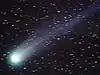
123P/West–Hartley
 | |
| Discovery | |
|---|---|
| Discovered by | Richard M. West Malcolm Hartley |
| Discovery site | European Southern Observatory |
| Discovery date | 11 May 1989 |
| Designations | |
| P/1989 E3, P/1995 S2 | |
| 1988 XVI, 1989k | |
| Orbital characteristics[2][3] | |
| Epoch | 7 October 2026 (JD 2461320.5) |
| Observation arc | 30.39 years |
| Number of observations | 4,399 |
| Aphelion | 5.616 AU |
| Perihelion | 2.159 AU |
| Semi-major axis | 3.887 AU |
| Eccentricity | 0.44469 |
| Orbital period | 7.665 years |
| Inclination | 15.281° |
| 45.848° | |
| Argument of periapsis | 103.88° |
| Mean anomaly | 1.945° |
| Last perihelion | 5 February 2019[4] |
| Next perihelion | 21 September 2026[4][5] |
| TJupiter | 2.832 |
| Earth MOID | 1.197 AU |
| Jupiter MOID | 0.704 AU |
| Physical characteristics[2][6][7] | |
Mean radius | 2.18±0.23 km |
| 3.7 hours | |
| Comet total magnitude (M1) | 8.2 |
| Comet nuclear magnitude (M2) | 13.8 |
| 17.5 (2026-04-03)[8] | |
Comet West–Hartley is a periodic comet roughly 4 km in diameter with a 7.67-year orbit around the Sun. The current orbit does not bring it closer than about 1.2 AU (180 million km) from Earth.[2] It will next come to perihelion on 21 September 2026, when the comet will have a solar elongation of 22 degrees.[5] It will come to opposition on 1 May 2027.[9]
Physical characteristics
The first attempts to measure the effective radius of its nucleus in 2000 were not successful due to too much scatter data in light curves obtained to provide reliable estimates.[10] Recent attempts to measure the comet's light curves between 2004 and 2015 revealed that the nucleus is about 2.18 km (1.35 mi) in radius, rotating once every 3.7 hours.[6]
References
- ↑ R. M. West; M. Hartley (30 May 1989). "Image of comet "P/West-Hartley (1989k)"". www.eso.org. European Southern Observatory. Retrieved 6 June 2025.
- 1 2 3 "123P/West–Hartley – JPL Small-Body Database Lookup". ssd.jpl.nasa.gov. Jet Propulsion Laboratory. Retrieved 21 November 2023.
- ↑ "123P/West–Hartley Orbit". Minor Planet Center. Retrieved 22 March 2016.
- 1 2 S. Yoshida (25 March 2025). "123P/West–Hartley". www.aerith.net. Retrieved 6 June 2025.
- 1 2 G. van Buitenen. "123P/West-Hartley". astro.vanbuitenen.nl. Retrieved 26 April 2026.
- 1 2 R. Kokotanekova; C. Snodgrass; P. Lacerda; S. F. Green; S. C. Lowry; et al. (2017). "Rotation of cometary nuclei: new light curves and an update of the ensemble properties of Jupiter-family comets" (PDF). Monthly Notices of the Royal Astronomical Society. 471 (3): 2974–3007. arXiv:1707.02133. Bibcode:2017MNRAS.471.2974K. doi:10.1093/mnras/stx1716.
- ↑ G. W. Kronk; M. Meyer; D. A. J. Seargent (2017). Cometography: A Catalog of Comets. Vol. 6: 1983–1993. Cambridge University Press. pp. 424–426. ISBN 978-0-521-87216-4.
- ↑ "COBS Observation list: 123P". Crni Vrh Observatory. Retrieved 26 April 2026. Comet 123P/West-Hartley Lightcurve
- ↑ "Opposition for 123P/West-Hartley (90001026) on 2027-May-01". JPL Horizons. Retrieved 6 May 2026.
- ↑ P. L. Lamy; I. Toth; Y. R. Fernández; H. A. Weaver (2004). "The Sizes, Shapes, Albedos, and Colors of Cometary Nuclei" (PDF). Comets II. pp. 223–264. JSTOR j.ctv1v7zdq5.22. Archived from the original (PDF) on 9 October 2022. Retrieved 6 June 2025.
External links
- 123P/West–Hartley at the JPL Small-Body Database
- 123P/West–Hartley at Gary W. Kronk's Cometography
- 123P/West–Hartley at Gideon van Buitenen's website
- 123P/West–Hartley at Seiichi Yoshida's website
- 123P/West–Hartley on 2026 Apr 06 at apmag 17.6