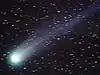
16P/Brooks
 Sketch of the fragmentation of Comet Brooks 2 on 4 August 1889 | |
| Discovery | |
|---|---|
| Discovered by | William Robert Brooks |
| Discovery site | Geneva, New York |
| Discovery date | 7 July 1889 |
| Designations | |
| P/1889 N1, P/1896 M1 | |
| |
| Orbital characteristics[2][3] | |
| Epoch | 21 November 2025 (JD 2461000.5) |
| Observation arc | 132.56 years |
| Number of observations | 922 |
| Aphelion | 5.440 AU |
| Perihelion | 1.885 AU |
| Semi-major axis | 3.663 AU |
| Eccentricity | 0.48453 |
| Orbital period | 7.009 years |
| Max. orbital speed |
|
| Inclination | 3.009° |
| 138.82° | |
| Argument of periapsis | 245.38° |
| Mean anomaly | 235.96° |
| Last perihelion | 18 April 2021 |
| Next perihelion | 21 April 2028[4] |
| TJupiter | 2.863 |
| Earth MOID | 0.459 AU |
| Jupiter MOID | 0.209 AU |
| Physical characteristics[2] | |
Mean radius | 1.59 km (0.99 mi)[5] |
| Comet total magnitude (M1) | 12.2 |
| Comet nuclear magnitude (M2) | 15.6 |
16P/Brooks, also known as Brooks 2, is a Jupiter-family comet discovered by William Robert Brooks on 7 July 1889, but failed to note any motion. He was able to confirm the discovery the next morning, having seen that the comet had moved north. On 1 August 1889, the famous comet hunter Edward Emerson Barnard discovered two fragments of the comet labeled "B" and "C" located 1 and 4.5 arc minutes away. On 2 August he found another four or five, but these were no longer visible the next day. On August 4, he observed two more objects, labeled "D" and "E". "E" disappeared by the next night and "D" was gone by the next week. Around mid-month, "B" grew large and faint, finally disappearing at the beginning of September. "C" managed to survive until mid-November 1889. The apparition ended on 13 January 1891. After the discovery apparition, the comet has always been over two magnitudes fainter.
1886
The comet's breakup is believed to have been caused by the passage of the comet within Jupiter's Roche limit around 20 July 1886,[6][7][a] when it spent two days within the orbit of Io.[b]
| Date & time of closest approach |
Jupiter distance (AU) |
Sun distance (AU) |
Velocity wrt Jupiter (km/s) |
Velocity wrt Sun (km/s) |
Reference |
|---|---|---|---|---|---|
| 1886-Jul-20 22:32 | 0.001 AU (150 thousand km; 93 thousand mi; 0.39 LD) | 5.457 AU (816 million km; 507 million mi) | 41.1 | 40.1 | Horizons |
The very close approach to Jupiter in 1886 resulted in the previous perihelion distance becoming the new aphelion distance.
| Epoch | Aphelion (AD) |
Perihelion (QR) |
Period |
|---|---|---|---|
| 1865 | 14 AU[c] | 5.5 AU | 31 years |
| 1889 | 5.4 AU | 1.95 AU | 7 years |
On 31 December 2016 the comet passed 0.333 AU (49.8 million km) from Jupiter and on 5 July 2053 ± 3 days it will pass about 0.26 AU (39 million km) from Jupiter.[2]
Notes
References
- ↑ "Periodic Comet Names and Designations". Planetary Data System: Small Body Node. NASA. Retrieved 17 August 2026.
- 1 2 3 "16P/Brooks – JPL Small-Body Database Lookup". ssd.jpl.nasa.gov. Jet Propulsion Laboratory. Retrieved 19 July 2023.
- ↑ "16P/Brooks Orbit". Minor Planet Center. Retrieved 16 June 2014.
- 1 2 "Horizons Batch for 16P/Brooks 2 (90000274) on 2028-Apr-21" (Perihelion occurs when rdot flips from negative to positive). JPL Horizons. Archived from the original on 15 June 2022. Retrieved 15 June 2022. (JPL#K212/6 Soln.date: 2022-Feb-04)
- ↑ G. Tancredi; J. A. Fernández; H. Rickman; J. Licandro (2006). "Nuclear magnitudes and the size distribution of Jupiter family comets". Icarus. 182 (2): 527–549. Bibcode:2006Icar..182..527T. doi:10.1016/j.icarus.2006.01.007.
- 1 2 "Horizons Batch for 16P/Brooks 2 (90000259) on 1886-Jul-20" (1889–1904 dataset). JPL Horizons. Archived from the original on 20 July 2023. Retrieved 19 July 2023.
- ↑ Kinoshita, Kazuo (1 August 2016). "16P/Brooks past, present and future orbital elements". Comet Orbit. Archived from the original on 10 July 2011. Retrieved 19 July 2023.
- ↑ Horizons output. "Osculating Orbital Elements for 16P/Brooks (90000258)". Retrieved 20 July 2023.
External links
- 16P/Brooks at the JPL Small-Body Database
- 16P/Brooks at Gary W. Kronk's Cometography
- 16P/Brooks at Seiichi Yoshida's website