246P/NEAT
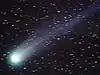
 246P/NEAT as imaged by the Zwicky Transient Facility on 8 June 2021 | |
| Discovery[1] | |
|---|---|
| Discovered by | Near-Earth Asteroid Tracking (NEAT) |
| Discovery site | Haleakalā Observatory |
| Discovery date | 28 March 2004 |
| Designations | |
| P/2004 F3, P/2010 V2 | |
| Orbital characteristics[2][3] | |
| Epoch | 17 October 2024 (JD 2460600.5) |
| Observation arc | 22.92 years[a] |
| Earliest precovery date | 6 January 2002 |
| Number of observations | 5,007 |
| Aphelion | 5.245 AU |
| Perihelion | 3.164 AU |
| Semi-major axis | 4.204 AU |
| Eccentricity | 0.28504 |
| Orbital period | 8.62 years |
| Inclination | 17.751° |
| 74.231° | |
| Argument of periapsis | 185.43° |
| Mean anomaly | 156.59° |
| Last perihelion | 16 February 2021 |
| Next perihelion | 28 October 2029[4] |
| TJupiter | 2.913 |
| Earth MOID | 1.865 AU |
| Jupiter MOID | 0.096 AU |
| Physical characteristics[2] | |
Mean radius | 1.01 km (0.63 mi)[5] |
| Comet total magnitude (M1) | 5.9 |
| Comet nuclear magnitude (M2) | 11.3 |
246P/NEAT is a Jupiter-family comet discovered on 28 March 2004 by the Near-Earth Asteroid Tracking (NEAT) survey using the 1.2 m (47 in) reflector at the Haleakalā Observatory.[1] It was given the permanent number 246P on 14 January 2011.[6]
Orbit
It is classified as a Quasi-Hilda comet.[7] Due to perturbations by Jupiter, the 2005, 2013 and 2021 perihelion passages will be closer to the Sun.[8] The comet is observable all through its orbit.[8]
Notes
- ↑ Observation arc from the Minor Planet Center database covering dates from 6 January 2002 until 7 December 2024.
References
- 1 2 F. Hormuth; J. Ticha; M. Tichy; P. Kusnirak; et al. (29 March 2004). D. W. Green (ed.). "Comet P/2004 F3 (NEAT)". IAU Circular. 8313 (2). Bibcode:2012IAUC.8313....2H.
- 1 2 "246P/NEAT – JPL Small-Body Database Lookup". ssd.jpl.nasa.gov. Jet Propulsion Laboratory. Retrieved 31 July 2012.
- ↑ "246P/NEAT Orbit". Minor Planet Center. Retrieved 20 June 2014.
- ↑ "Horizons Batch for 246P/NEAT on 2029-Oct-28" (Perihelion occurs when rdot flips from negative to positive). JPL Horizons. Retrieved 17 September 2021. (JPL#212/Soln.date: 2021-Sep-04)
- ↑ J. M. Bauer; T. Grav; Y. R. Fernández; et al. (2017). "Debiasing the NEOWISE Cryogenic Mission Comet Populations". The Astronomical Journal. 154 (2): 53–62. Bibcode:2017AJ....154...53B. doi:10.3847/1538-3881/aa72df.
- ↑ D. W. Green (14 January 2011). "Comet 246P/NEAT". IAU Circular. 9192 (2). Bibcode:2011IAUC.9192....2G.
- ↑ I. Toth (2006). "The quasi-Hilda subgroup of ecliptic comets - an update" (PDF). Astronomy & Astrophysics. 448 (3): 1191–1196. Bibcode:2006A&A...448.1191T. doi:10.1051/0004-6361:20053492.
- 1 2 S. Yoshida (13 November 2010). "246P/NEAT". www.aerith.net. Retrieved 31 July 2012.
External links
- 246P/NEAT at the JPL Small-Body Database
- 246P/NEAT – Seiichi Yoshida @ aerith.net
- Elements and Ephemeris for 246P/NEAT – Minor Planet Center
- 246P/NEAT at the Minor Planet Center's Database
- 246P/NEAT – Kazuo Kinoshita (2011 Dec. 22)