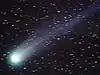
63P/Wild
 63P/Wild with JWST NIRCam at 4.3 μm, observed on 7 March 2026 | |
| Discovery[1] | |
|---|---|
| Discovered by | Paul Wild |
| Discovery site | Zimmerwald Observatory, Switzerland |
| Discovery date | 26 March 1960 |
| Designations | |
| P/1960 G1 P/1973 A2 | |
| Wild 1 1960b, 1973c 1960 I, 1973 VIII[2] | |
| Orbital characteristics[3] | |
| Epoch | 2025-11-21 (JD 2461000.5) |
| Observation arc | 66 years |
| Number of observations | 2,519 |
| Aphelion | 9.34 AU |
| Perihelion | 1.9746 AU |
| Semi-major axis | 5.657 AU |
| Eccentricity | 0.65096 |
| Orbital period | 13.45 years |
| Inclination | 19.616° |
| 357.77° | |
| Argument of periapsis | 168.74° |
| Last perihelion | 6 July 2026 |
| Next perihelion | 14 December 2039[4] |
| TJupiter | 2.411 |
| Earth MOID | 0.961 AU |
| Jupiter MOID | 1.308 AU |
| Physical characteristics[5][6] | |
| Dimensions | 2.9 km (1.8 mi) |
| 0.04 | |
| (V–R) = 0.50±0.05 | |
| Comet total magnitude (M1) | 7.3 |
| Comet nuclear magnitude (M2) | 14.3 |
| 15 (2026-05-19)[7] | |
63P/Wild is a periodic comet roughly 3 km in diameter with a 13.5-year orbit around the Sun. The comet reached perihelion on 6 July 2026.[8]
Observational history

It was first detected by Paul Wild at the Zimmerwald Observatory of the Astronomical Institute of Bern, Switzerland on a photographic plate exposed on 26 March 1960, who estimated its brightness at a magnitude of 14.3. Its elliptical orbit was then calculated to have an orbital period of 13.17 years.[9]
Its predicted reappearance in 1973 was observed by Elizabeth Roemer of the U.S. Naval Observatory, Flagstaff, Arizona at a magnitude of 17.5. Although not found in 1986 it was rediscovered in 1999 with a magnitude of around 12. The 2013 return was moderately favourable with magnitude again around 12.
The nucleus of the comet has a radius of 2.9 km (1.8 mi), assuming a geometric albedo of 0.04.[10]
See also
References
- ↑ J. M. Vinter Hansen (8 April 1960). "Comet Wild (1960b)". Central Bureau for Astronomical Telegrams. 1719.
- ↑ "Comet Names and Designations". International Comet Quarterly. Retrieved 31 December 2024.
- ↑ MPC
- ↑ "Horizons Batch for 63P/Wild 1 (90000675) on 2039-Dec-14" (Perihelion occurs when rdot flips from negative to positive). JPL Horizons. Retrieved 2026-04-15. (JPL#48, Soln.date: 2026-Apr-14)
- ↑ "63P/Wild – JPL Small-Body Database Lookup". ssd.jpl.nasa.gov. Jet Propulsion Laboratory. Retrieved 31 December 2024.
- ↑ M. M. Knight; R. Kokotanekova; N. H. Samarasinha (2023). "Physical and Surface Properties of Comet Nuclei from Remote Observations". arXiv:2304.09309 [astro-ph.EP].
- ↑ "COBS Observation list: 63P". Crni Vrh Observatory. Retrieved 2026-05-30. Comet 63P/Wild Lightcurve
- ↑ "Horizons Batch for 63P/Wild 1 (90000674) on 2026-Jul-06" (Perihelion occurs when rdot flips from negative to positive). JPL Horizons. Archived from the original on 2025-09-29. Retrieved 2025-09-29. (JPL#31, Soln.date: 2014-Feb-19)
- ↑ G. W. Kronk. "63P/Wild 1". Cometography.com. Retrieved 10 December 2014.
- ↑ P. L. Lamy; I. Toth; H. A. Weaver; M. F. A'Hearn; L. Jorda (2009). "Properties of the nuclei and comae of 13 ecliptic comets from Hubble Space Telescope snapshot observations" (PDF). Astronomy & Astrophysics. 508 (2): 1045–1056. Bibcode:2009A&A...508.1045L. doi:10.1051/0004-6361/200811462. S2CID 125249770.
External links
- 63P/Wild at the JPL Small-Body Database
- 63P/Wild 1 at Seiichi Yoshida's website
- 63P/Wild at Gideon van Buitenen's website