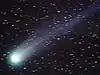
48P/Johnson
 Infrared image of Comet Johnson taken by the Spitzer Space Telescope on 18 July 2005 | |
| Discovery[1] | |
|---|---|
| Discovered by | Ernest Leonard Johnson |
| Discovery date | 25 August 1949 |
| Designations | |
| P/1949 Q1, P/1956 P1 | |
| |
| Orbital characteristics[2][3] | |
| Epoch | 28 April 2016 (JD 2457506.5) |
| Observation arc | 76.48 years[a] |
| Number of observations | 3,111 |
| Aphelion | 5.021 AU |
| Perihelion | 2.006 AU |
| Semi-major axis | 3.514 AU |
| Eccentricity | 0.42897 |
| Orbital period | 6.587 years |
| Inclination | 12.283° |
| 111.46° | |
| Argument of periapsis | 214.69° |
| Mean anomaly | 235.39° |
| Last perihelion | 2 March 2025 |
| Next perihelion | 29 September 2031[4] |
| TJupiter | 2.931 |
| Earth MOID | 1.007 AU |
| Jupiter MOID | 0.513 AU |
| Physical characteristics[5][6] | |
| Dimensions | 6.0 × 4.4 km (3.7 × 2.7 mi) |
Mean diameter | 5.74 km (3.57 mi) |
| 29 hours | |
| Comet total magnitude (M1) | 8.9 |
| Comet nuclear magnitude (M2) | 13.4 |
48P/Johnson is a periodic comet in the Solar System.
The comet's nucleus is estimated to be approximately 5.74 km (3.57 mi) in diameter, according to Lamy, Fernandez, and Weaver.[7] David C. Jewitt and Scott S. Sheppard, however, estimate the nucleus to have dimensions of 6.0 × 4.4 km (3.7 × 2.7 mi).[5]
Notes
- ↑ Observation arc from the Minor Planet Center database only covered dates from 24 September 1949 until 15 February 2026 (76.39 years). This figure includes its entire arc up to 25 August 1949.
References
- ↑ E. L. Johnson (29 August 1949). J. M. Vinter Hansen (ed.). "Comet Johnson (1949d)". IAU Circular. 1228 (1).
- ↑ "48P/Johnson – JPL Small-Body Database Lookup". ssd.jpl.nasa.gov. Jet Propulsion Laboratory. Retrieved 1 March 2010.
- ↑ "48P/Johnson Orbit". Minor Planet Center. Retrieved 22 July 2025.
- ↑ "Horizons Batch for 48P/Johnson (90000568) on 2031-Sep-29" (Perihelion occurs when rdot flips from negative to positive). JPL Horizons. Archived from the original on 28 September 2025. Retrieved 28 September 2025. (JPL#K253/21 Soln.date: 2025-Sep-22)
- 1 2 D. C. Jewitt; S. S. Sheppard (2004). "The nucleus of comet 48P/Johnson". The Astronomical Journal. 127 (3): 1784–1790. Bibcode:2004AJ....127.1784J. doi:10.1086/382097.
- ↑ B. E. A. Mueller; N. H. Samarasinha (2018). "Further Investigation of Changes in Cometary Rotation". The Astronomical Journal. 156 (3): 107–114. arXiv:1806.11158. Bibcode:2018AJ....156..107M. doi:10.3847/1538-3881/aad0a1.
- ↑ P. L. Lamy; I. Toth; Y. R. Fernández; H. A. Weaver (2004). "The Sizes, Shapes, Albedos, and Colors of Cometary Nuclei" (PDF). Comets II. pp. 223–264. JSTOR j.ctv1v7zdq5.22.
External links
- 48P/Johnson at the JPL Small-Body Database
- 48P at Kronk's Cometography
- 48P/Johnson – Seiichi Yoshida @ aerith.net
- Lightcurve (Artyom Novichonok)