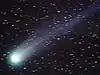
36P/Whipple
 Comet Whipple imaged from the Zwicky Transient Facility on 21 November 2020 | |
| Discovery | |
|---|---|
| Discovered by | Fred Lawrence Whipple |
| Discovery date | 15 October 1933 |
| Designations | |
| P/1925 QD, P/1933 U1, P/1940 R1 | |
| |
| Orbital characteristics[1][2] | |
| Epoch | 9 June 2026 (JD 2461200.5) |
| Observation arc | 96.54 years |
| Earliest precovery date | 21 August 1925 |
| Number of observations | 989 |
| Aphelion | 5.252 AU |
| Perihelion | 3.034 AU |
| Semi-major axis | 4.143 AU |
| Eccentricity | 0.26768 |
| Orbital period | 8.43 years |
| Inclination | 9.944° |
| 181.81° | |
| Argument of periapsis | 201.19° |
| Mean anomaly | 257.09° |
| Last perihelion | 31 May 2020 |
| Next perihelion | 4 November 2028[3] |
| TJupiter | 2.952 |
| Earth MOID | 2.095 AU |
| Jupiter MOID | 0.259 AU |
| Physical characteristics[4] | |
Mean radius | 2.55 km (1.58 mi) |
| 40 hours | |
| Comet total magnitude (M1) | 10.7 |
| Comet nuclear magnitude (M2) | 14.5 |
36P/Whipple is a Jupiter-family comet with an 8.43-year orbit around the Sun. It is also the lowest numbered quasi-Hilda comet.[5] It passed 0.25 AU (37 million km) from Jupiter in June 1922.[1]
Physical characteristics
The comet nucleus is initially estimated to be around 4.56 km (2.83 mi) in diameter.[6] However, more recent analysis in 2011 indicated a larger nucleus at 5.1 km (3.2 mi).[4] Its rotation period is determined to be around 40 hours long.[4]
References
- 1 2 "36P/Whipple – JPL Small-Body Database Lookup". ssd.jpl.nasa.gov. Jet Propulsion Laboratory. Retrieved 26 February 2010.
- ↑ "36P/Whipple Orbit". Minor Planet Center. Retrieved 7 February 2017.
- ↑ "Horizons Batch for 36P/Whipple (90000456) on 2028-Nov-04" (Perihelion occurs when rdot flips from negative to positive). JPL Horizons. Retrieved 27 June 2022. (JPL#23 Soln.date: 2022-Mar-09)
- 1 2 3 C. Snodgrass; A. Fitzsimmons; S. C. Lowry; P. Weissman (2011). "The size distribution of Jupiter Family comet nuclei" (PDF). Monthly Notices of the Royal Astronomical Society. 414 (1): 458–469. arXiv:1101.4228. Bibcode:2011MNRAS.414..458S. doi:10.1111/j.1365-2966.2011.18406.x.
- ↑ I. Toth (2006). "The quasi-Hilda subgroup of ecliptic comets - an update" (PDF). Astronomy and Astrophysics. 448 (3): 1191–1196. Bibcode:2006A&A...448.1191T. doi:10.1051/0004-6361:20053492.
- ↑ P. L. Lamy; I. Toth; Y. R. Fernández; H. A. Weaver (2004). "The Sizes, Shapes, Albedos, and Colors of Cometary Nuclei" (PDF). Comets II. University of Arizona Press. pp. 223–264. Bibcode:2004come.book..223L. doi:10.2307/j.ctv1v7zdq5.22. ISBN 978-0-8165-2450-1. JSTOR j.ctv1v7zdq5.22.
External links
- 36P/Whipple at the JPL Small-Body Database
- 36P/Whipple at Gary W. Kronk's Cometography
- 36P/Whipple at Seiichi Yoshida's website