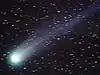
166P/NEAT
 | |
| Discovery | |
|---|---|
| Discovery site | Near Earth Asteroid Tracking (NEAT) |
| Discovery date | 15 October 2001 |
| Designations | |
| P/2001 T4 | |
| Orbital characteristics[1][2] | |
| Epoch | 21 November 2025 (JD 2461000.5) |
| Observation arc | 7.51 years |
| Earliest precovery date | 27 August 2001 |
| Number of observations | 177 |
| Aphelion | 19.142 AU |
| Perihelion | 8.555 AU |
| Semi-major axis | 13.849 AU |
| Eccentricity | 0.38222 |
| Orbital period | 51.537 years |
| Inclination | 15.386° |
| 64.335° | |
| Argument of periapsis | 321.99° |
| Mean anomaly | 163.94° |
| Last perihelion | 20 May 2002 |
| Next perihelion | 26 November 2053[3][4] |
| TJupiter | 3.284 |
| Earth MOID | 7.582 AU |
| Jupiter MOID | 3.693 AU |
| Physical characteristics | |
Mean radius | 14.32 km (8.90 mi)[5] |
| Comet total magnitude (M1) | 7.0 |
| Comet nuclear magnitude (M2) | 10.6 |
166P/NEAT is a Chiron-type comet and centaur in the outer Solar System. It was discovered by the Near Earth Asteroid Tracking (NEAT) project in 2001 and initially classified a comet with provisional designation P/2001 T4 (NEAT), as it was apparent from the discovery observations that the body exhibited a cometary coma. It is one of few known bodies with centaur-like orbits that display a coma, along with 60558 Echeclus, 2060 Chiron, 165P/LINEAR and 167P/CINEOS. It is also one of the reddest centaurs ever known.[7]
166P/NEAT has a perihelion distance of 8.56 AU (1.281 billion km).[1]
References
- 1 2 "166P/NEAT – JPL Small-Body Database Lookup". ssd.jpl.nasa.gov. Jet Propulsion Laboratory. Retrieved 14 September 2008.
- ↑ "166P/NEAT Orbit". Minor Planet Center. Retrieved 18 June 2014.
- ↑ Syuichi Nakano (30 June 2005). "166P/NEAT (2001 T4) (NK 1187)". OAA Computing and Minor Planet Sections. Retrieved 20 February 2012.
- ↑ "Horizons Batch for 166P/NEAT on 2053-Nov-26" (Perihelion occurs when rdot flips from negative to positive). JPL Horizons. Retrieved 6 July 2023. (JPL#51 Soln.date: 2021-Apr-15)
- 1 2 J. C. Shi; Y. H. Ma (2015). "CCD photometry of active Centaur 166P/2001 T4 (NEAT)" (PDF). Monthly Notices of the Royal Astronomical Society. 454 (4): 3635–3640. Bibcode:2015MNRAS.454.3635S. doi:10.1093/mnras/stv2274.
- 1 2 D. C. Jewitt (2015). "Color Systematics of Comets and Related Bodies". The Astronomical Journal. 150 (6): 201–219. arXiv:1510.07069. Bibcode:2015AJ....150..201J. doi:10.1088/0004-6256/150/6/201.
- ↑ J. M. Bauer; Y. R. Fernández; K. J. Meech (2003). "An Optical Survey of the Active Centaur C/NEAT (2001 T4)". Publications of the Astronomical Society of the Pacific. 115 (81): 981–989. Bibcode:2003PASP..115..981B. doi:10.1086/377012.
External links
- 166P/NEAT at the JPL Small-Body Database
- 166P/NEAT at Seiichi Yoshida's website