220P/McNaught
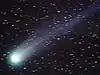
 220P/McNaught in a heavy IFN area. Captured on 12 August 2026, seven days after the second outburst. | |
| Discovery[1] | |
|---|---|
| Discovered by | Robert H. McNaught |
| Discovery site | Siding Spring Observatory |
| Discovery date | 20 May 2004 |
| Designations | |
| P/2004 K2, P/2009 H2 | |
| McNaught 1[2] | |
| Orbital characteristics[3] | |
| Epoch | 21 November 2025 (JD 2461000.5) |
| Observation arc | 22.25 years[a] |
| Number of observations | 1,599 |
| Aphelion | 4.68 AU |
| Perihelion | 1.559 AU |
| Semi-major axis | 3.12 AU |
| Eccentricity | 0.50036 |
| Orbital period | 5.51 years |
| Inclination | 8.1206° |
| 150.09° | |
| Argument of periapsis | 180.57° |
| Mean anomaly | 323.3° |
| Last perihelion | 14 June 2026 |
| Next perihelion | 18 December 2031[4] |
| TJupiter | 2.996 |
| Earth MOID | 0.540 AU (80.8 million km)[5] |
| Jupiter MOID | 0.712 AU (106.5 million km) |
| Comet total magnitude (M1) | 15.3±0.7 |
| Comet nuclear magnitude (M2) | 17.9±0.5 |
220P/McNaught, is a Jupiter-family comet with a 5.5-year orbit around the Sun. It is one of several comets discovered by Australian astronomer, Robert H. McNaught. It reached perihelion on 14 June 2026, two weeks after a large outburst in which the comet brightened as much as 8,000 times. In August 2026 there was a second outburst brightening by a factor of about 600.
Discovery

Robert McNaught discovered the comet in images obtained by the Uppsala Southern Schmidt Telescope in Siding Spring Observatory, Australia, on 20 May 2004. The comet in the CCD images had an estimated magnitude of 17.7. The discovery of the comet was confirmed by J. Young at Table Mountain Observatory on May 25. The comet had a coma 8–10 arcseconds across without central concentration and a narrow tail 20 to 30 arcseconds long.[1]
The comet was recovered by Spacewatch on 28 April 2009 and independently by G. Muler, J. M. Ruiz and R. Naves with the 0.30-m Schmidt-Cassegrain telescope at the Nazaret Observatory on May 1.[7] The comet had an apparent magnitude of 20.2.[8] The comet appeared stellar in the single 120s exposure by Spacewatch.[9] Afterwards, the comet was given the permanent number 220P.[10]
2026 outbursts

On 1 June 2026, Mike Kelley reported on the comet mailing list that 220P/McNaught had undergone a large outburst.[11] Using data from the Zwicky Transient Facility, he noted the comet brightened by about 7 magnitudes (from roughly magnitude 18 to 11), more than a 600-fold increase in brightness. The outburst occurred within a 13 hours and 32 minutes window between May 30 at 14:05 and May 31 at 03:37 UTC.[12] Other observations reported the comet reached a peak magnitude of 8.2, which would represent up to an 8,000-fold increase in brightness.[13] The comet on June 3 had a coma 6.5 arcminutes across and a tail about 2 arcminutes long, while deeper exposures revealed a fain ion tail about two degrees long on June 2. Visually, the coma was about 3 arcminutes across despite bright moonlight.[14] Follow-up measurements from the TRAPPIST-North Telescope (Z53) noted a significant drop in dust production rate after the outburst, which appeared to be enriched in C2 in relation to CN, likely indicating that a fragmentation event has occurred.[15] By mid-June the comet had faded to about magnitude 12.[13] On 5 August 2026 the comet outburst a second time by a factor of about 600 surging from magnitude 14 to magnitude 7.[16][17]
For comparison, in 2007, Comet 17P/Holmes brightened as much as a million-fold, jumping from magnitude 17 to about magnitude 2.8.[18]
| Comet | Date | Distance from Sun |
Change in magnitude and brightness |
|---|---|---|---|
| 220P/McNaught | 2026-05-30 | 1.6 AU | 9.5 magnitudes (7000x) |
| 17P/Holmes | 2007-10-23 | 2.4 AU | 14.2 magnitudes (500000x) |
| 41P/Tuttle–Giacobini–Kresák | 1973-05-26 | 3.9 AU | 10 magnitudes (10000x) |
| 289P/Blanpain | 2013-07-04 | 3.9 AU | 9 magnitudes (4000x) |
| 29P/Schwassmann–Wachmann | 10/year | 6.0 AU | 3 magnitudes (20x) |
These outbursts are caused by the sudden release of heated gases breaking through the crust and creating a massive dust plume that significantly increases the coma's column density and surface area.
Orbit
The comet takes 5.5 years to orbit the Sun. It has an Earth–Minimum orbit intersection distance (E–MOID) of 0.54 AU (81 million km)[5] and on 20 August 2048 will pass 0.598 AU (89.5 million km) from Earth.[19] Several close approaches to Jupiter between 1956 and 2170 are expected, the closest of which (0.62 AU) will occur on 2063.[5]
Notes
- ↑ Observation arc from the Minor Planet Center database covering dates from 20 May 2004 until 21 August 2026.
References
- 1 2 R. H. McNaught; J. Young; A. C. Gilmore; et al. (28 May 2004). D. W. Green (ed.). "Comet P/2004 K2 (McNaught)". IAU Circular. 8348 (1). Bibcode:2004IAUC.8348....1M.
- ↑ "Periodic Comet Names and Designations". Planetary Data System: Small Body Node. NASA. Retrieved 2 July 2026.
- ↑ "220P/McNaught Orbit". Minor Planet Center. Archived from the original on 7 June 2026. Retrieved 4 June 2026.
- ↑ "Horizons Batch for 220P/McNaught (90001183) on 2031-Dec-18" (Perihelion occurs when rdot flips from negative to positive). JPL Horizons. Retrieved 17 June 2026. (JPL#61 Soln.date: 2026-Jun-09)
- 1 2 3 "220P/McNaught – JPL Small-Body Database Lookup". ssd.jpl.nasa.gov. Jet Propulsion Laboratory. Retrieved 4 June 2026.
- 1 2 3 A. Kostov; T. Bonev (10 August 2026). "Magnitudes and colors of comet 220P/McNaught during outburst". The Astronomer's Telegram. 17956: 1. Bibcode:2026ATel17956....1K.
- ↑ T. H. Bressi; G. Muler; J. M. Ruiz; et al. (May 2009). D. W. Green (ed.). "Comet P/2009 H2 (McNaught)". IAU Circular. 9040 (2). Bibcode:2009IAUC.9040....2B.
- ↑ T. H. Bressi; G. Muler; J. M. Ruiz; et al. (3 May 2009). B. G. Marsden (ed.). "Comet P/2009 H2 (McNaught)" (TXT). Central Bureau for Astronomical Telegrams. 1790. Bibcode:2009CBET.1790....1B.
- ↑ J. L. Montani; T. H. Bressi (May 2009). D. W. Green (ed.). "Comet 220P/2009 H2 (McNaught)". IAU Circular. 9045 (2). Bibcode:2009IAUC.9045....2M.
- ↑ D. W. Green (May 2009). "Comets 218P/LINEAR, 219P/LINEAR, and 220P/McNaught". IAU Circular. 9043 (4). Bibcode:2009IAUC.9043....4G.
- ↑ M. S. P. Kelley (1 June 2026). "Large 220P/McNaught outburst". Groups.io. Retrieved 19 June 2026.
- ↑ M. S. P. Kelley; Q. Z. Ye; C. Holt; J. Purdum; C. Snodgrass (3 June 2026). Derek Fox (ed.). "Large Apparent Outburst of Comet 220P/McNaught". The Astronomer's Telegram. 17829: 1. Bibcode:2026ATel17829....1K.
- 1 2 "COBS Observation list: 220P". Crni Vrh Observatory. Archived from the original on 7 June 2026. Retrieved 30 May 2026. Comet 220P/McNaught Lightcurve
- ↑ D. W. Green (4 June 2026). "Comet 220P/McNaught" (TXT). Central Bureau for Astronomical Telegrams. 5698: 1.
- ↑ E. Jehin; J. Manfroid; S. Hmiddouch; K. Aravind (8 June 2026). "TRAPPIST production rates of comet 220P/McNaught in outburst". The Astronomer's Telegram. 17838: 1. Bibcode:2026ATel17838....1J.
- ↑ J. A. Henríquez Santana; J. J. Gonzales; K. Yoshimoto; et al. (7 August 2026). D. W. Green (ed.). "Comet 220P/McNaught" (TXT). Central Bureau for Astronomical Telegrams. 5722: 1.
- ↑ C. Gohd (12 August 2026). "Green comet caught soaring over Namibia". Space.com. Retrieved 19 August 2026.
- ↑ M. Gritsevich; M. Nissinen; A. Oksanen; et al. (2022). "Evolution of the dust trail of comet 17P/Holmes" (PDF). Monthly Notices of the Royal Astronomical Society. 513 (2): 2201–2214. arXiv:2203.11084. Bibcode:2022MNRAS.513.2201G. doi:10.1093/mnras/stac822. hdl:10995/117894.
- ↑ "Earth approach on 20 August 2048". JPL Horizons. Archived from the original on 7 June 2026. Retrieved 7 June 2026.
External links
- 220P/McNaught at the JPL Small-Body Database
- 220P/McNaught at Seiichi Yoshida's website
- 220P/McNaught at Gideon van Buitenen's website
- NASA Astronomy Picture of the Day: Comet 220P in Outburst (24 August 2026)

2026 in space | |||
|---|---|---|---|
| |||
| Space probe and telescope launches  |
|    | |
| Impact events | |||
| Selected NEOs |
| ||
| Discoveries |
| ||
| Comets | |||
| Space exploration |
| ||
