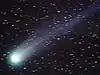
313P/Gibbs
| Discovery[1] | |
|---|---|
| Discovered by | Alex R. Gibbs |
| Discovery site | Catalina Sky Survey |
| Discovery date | 24 September 2014 |
| Designations | |
| P/2003 S10 P/2014 S4 | |
| Gibbs 16[2] | |
| Orbital characteristics[3][4] | |
| Epoch | 21 November 2025 (JD 2461000.5) |
| Observation arc | 22 years |
| Earliest precovery date | 22 September 2003[5] |
| Number of observations | 204 |
| Aphelion | 3.904 AU |
| Perihelion | 2.422 AU |
| Semi-major axis | 3.163 AU |
| Eccentricity | 0.23431 |
| Orbital period | 5.624 years |
| Inclination | 10.981° |
| 105.92° | |
| Argument of periapsis | 254.99° |
| Mean anomaly | 357.93° |
| Last perihelion | 2 December 2025 |
| Next perihelion | 2031 |
| TJupiter | 3.132 |
| Earth MOID | 1.429 AU |
| Jupiter MOID | 1.678 AU |
| Physical characteristics[6] | |
Mean radius | 0.85 km (0.53 mi) |
| 4 hours[7] | |
| 0.05 (assumed) | |
| Comet total magnitude (M1) | 17.1±0.03[8] |
313P/Gibbs (P/2014 S4) is an Encke-type comet and active asteroid, discovered by American astronomer Alex Gibbs. It is the third main-belt comet after 133P/Elst–Pizzaro and 238P/Read observed to show mass loss in different orbits.[9]
Observational history
Alex R. Gibbs reported the discovery of this comet as a nearly stellar object with a narrow tail from CCD images taken by the Catalina Sky Survey in 24 September 2014.[1] Shuichi Nakano later identified precovery images of the comet taken as early as September 2003 from the LONEOS and SDSS surveys.[5] It was recovered ahead of its 2020 apparition in August 2019,[10] exhibiting significant non-perihelion activity compared to 2014.[11] The comet was given an official numerical designation in 2017.[12]
Orbit
313P/Gibbs currently orbits at a distance between 2.42–3.9 AU (362–583 million km) from the Sun, within the outer portion of the main asteroid belt.[4] Computations of its orbit reveal that 313P is intrinsically chaotic, with a Lyapunov time of only 12000 years and being located near two three-body mean-motion resonances with Jupiter and Saturn, yet appears stable over 50 million years.[8] Astrometric data analysis shows that 313P is experiencing some transverse non-gravitational acceleration caused by recoil forces due to anisotropic mass loss.[13] It is a member of the Lixiaohua asteroid family,[14] a group of more than 700 asteroids estimated to be around 155 million years old.[15]
Physical characteristics
Nucleus size
Archival imagery from the Subaru Telescope taken in 2004 indicated an upper-limit size of the comet's nucleus to be around 1.00±0.15 km in radius, assuming a geometric albedo of 0.05.[8] Data obtained from the Hubble Space Telescope resulted in a lower-limit of around 0.5–0.7 km in radius.[16] Further observations from the Gemini Observatory in 2017 revised the size estimate to be around 0.85 km (0.53 mi) in radius.[6]
Cometary activity
From its three known apperances since 2003, 313P/Gibbs has consistently shown signs of activity, suggesting that it is likely to be generated from the sublimation of volatile material (ice) from its nucleus.[8] In both the 2003 and 2014 apparitions, dust emissions lasted for at least 3–4 months.[17] Impact driven activity was ruled out, as the mass-loss rate is consistent at 0.2–0.4 kg/s (0.44–0.88 lb/s). The persistent sublimation activity on 313P, along with other active asteroids (133P/Elst–Pizzaro, 238P/Read, and 358P/PanSTARRS), suggests an abundance of ice within the outer asteroid belt.[18] Its water-ice sublimation is non-uniform around perihelion, which is likely related to the seasonal modulation driven by the orientation of its rotational axis.[7]
References
- 1 2 A. R. Gibbs; H. Sato (September 2014). D. W. Green (ed.). "Comet P/2014 S4 (Gibbs)" (TXT). Central Bureau for Astronomical Telegrams. 3991: 1. Bibcode:2014CBET.3991....1G.
- ↑ "Periodic Comet Names and Designations". Planetary Data System: Small Body Node. NASA. Retrieved 4 July 2026.
- ↑ "313P/Gibbs – JPL Small-Body Database Lookup". ssd.jpl.nasa.gov. Jet Propulsion Laboratory. Retrieved 25 June 2026.
- 1 2 "313P/Gibbs Orbit". Minor Planet Center. Retrieved 25 June 2026.
- 1 2 S. Nakano; B. A. Skiff; M. E. Van Ness; et al. (September 2014). D. W. Green (ed.). "Comet P/2003 S10 = P/2014 S4 (Gibbs)" (TXT). Central Bureau for Astronomical Telegrams. 4003: 1. Bibcode:2014CBET.4003....1N.
- 1 2 H. H. Hsieh; M. Micheli; M. S. P. Kelley; et al. (2023). "Observational Characterization of Main-belt Comet and Candidate Main-belt Comet Nuclei". Planetary Science Journal. 4 (3): 43–65. arXiv:2302.11689. Bibcode:2023PSJ.....4...43H. doi:10.3847/PSJ/acbdfe.
- 1 2 W. Guo; Z. Cai; B. Liu; et al. (2025). "Orientation of the rotation axis and the location of water-ice sublimation activity of the main-belt comet 313P/Gibbs" (PDF). Astronomy & Astrophysics. 704: 124–134. Bibcode:2025A&A...704A.124G. doi:10.1051/0004-6361/202556433.
- 1 2 3 4 H. H. Hsieh; O. Hainaut; B. Novaković; et al. (2015). "Sublimation-Driven Activity in Main-Belt Comet 313P/Gibbs". The Astrophysical Journal Letters. 800 (1): 16–23. arXiv:1501.03873. Bibcode:2015ApJ...800L..16H. doi:10.1088/2041-8205/800/1/L16.
- ↑ M. T. Hui; D. C. Jewitt (2015). "Archival Observations of Active Asteroid 313P/Gibbs". The Astronomical Journal. 149 (4): 134–142. Bibcode:2015AJ....149..134H. doi:10.1088/0004-6256/149/4/134.
- ↑ H. H. Hsieh; J. Pittichova; P. Prado; et al. (September 2019). D. W. Green (ed.). "Comet 313P/Gibbs" (TXT). Central Bureau for Astronomical Telegrams. 4661: 1. Bibcode:2019CBET.4661....1H.
- ↑ H. Liang; J. C. Shi; Y. H. Ma (2025). "Secular Light Curve of Main-belt Comets". Acta Astronomica Sinica (in Chinese). 66 (2): 13. Bibcode:2025AcASn..66...13L. doi:10.15940/j.cnki.0001-5245.2025.02.002.
- ↑ D. W. Green (January 2017). "Numbering of Short-Period Comets" (TXT). Central Bureau for Astronomical Telegrams. 4343: 1. Bibcode:2017CBET.4343....1G.
- ↑ M. T. Hui; D. C. Jewitt (2017). "Non-gravitational Acceleration of the Active Asteroids". The Astronomical Journal. 153 (2): 80–89. arXiv:1612.06920. Bibcode:2017AJ....153...80H. doi:10.3847/1538-3881/153/2/80.
- ↑ M. N. De Prá; J. Licandro; N. Pinilla-Alonso; et al. (2020). "The spectroscopic properties of the Lixiaohua family, cradle of Main Belt Comets". Icarus. 338 113473. Bibcode:2020Icar..33813473D. doi:10.1016/j.icarus.2019.113473.
- ↑ B. Novaković; K. Tsiganis; Z. Knezevic. "Dynamical portrait of the Lixiaohua asteroid family" (PDF). Celestial Mechanics and Dynamical Astronomy. 107 (1–2): 35–49. Bibcode:2010CeMDA.107...35N. doi:10.1007/s10569-010-9263-9.
- ↑ D. C. Jewitt; J. Li; J. Agarwal; et al. (2015). "Nucleus and Mass Loss from Active Asteroid 313P/Gibbs". The Astronomical Journal. 150 (3): 76–88. arXiv:1507.01983. Bibcode:2015AJ....150...76J. doi:10.1088/0004-6256/150/3/76.
- ↑ F. J. Pozuelos; A. Cabrera-Lavers; J. Licandro; F. Moreno (2015). "On the Dust Environment of Main-Belt Comet 313P/Gibbs". The Astrophysical Journal. 806 (1): 102–108. arXiv:1505.01479. Bibcode:2015ApJ...806..102P. doi:10.1088/0004-637X/806/1/102.
- ↑ D. C. Jewitt; J. Agarwal; N. Peixinho; et al. (2015). "A New Active Asteroid 313P/Gibbs". The Astronomical Journal. 149 (2): 81–90. arXiv:1412.6582. Bibcode:2015AJ....149...81J. doi:10.1088/0004-6256/149/2/81.
External links
- 313P/Gibbs at the JPL Small-Body Database
- 313P/Gibbs at Gideon van Buitenen's website
- 313P/Gibbs at Seiichi Yoshida's website