Royal Academy Exhibition of 1901

The Royal Academy Exhibition of 1901 was the hundred and thirty third annual Summer Exhibition of the British Royal Academy of Arts which was held at Burlington House in London's Piccadilly from 6 May to 5 August 1901.[1] It was the first Summer Exhibition to be held since the Death of Queen Victoria in January. Victoria had been on the throne since 1837 and with her death the Edwardian era began. The Queen's passing was widely commemorated at the exhibition and the Annual Dinner was cancelled as a sign of mourning. A whole wall of the gallery was given over to one painting, the 1899 Portrait of Queen Victoria by Jean-Joseph Benjamin-Constant, done so at the request of the new monarch Edward VII.[1][2]
More than 14,000 artworks were submitted of which only 1,823 made it past the selection committee. It was notable for the absence of the sculptor Alfred Gilbert who had gone bankrupt that year. For this amongst other reasons, the exhibition was considered by The Times to be "by common consent a good deal below the standard of last year".[1] John William Waterhouse displayed his diploma work that he had presented to the Royal Academy A Mermaid.[3] Albert Goodwin's Ali Baba and the Forty Thieves was purchased by the Tate Gallery as part of the Chantrey Bequest.[4] The Flower Girl by James Jebusa Shannon was also through the Chantrey Bequest. As often, John Singer Sargent's portraits attracted critical attention. John Collier displayed a portrait of the Duke of York, the future George V. John Seymour Lucas exhibited Clouds That Gather Round the Setting Sun a history painting featuring the imminent downfall of Cardinal Wolsey in Tudor England.[5] The First Commission by Margaret Isabel Dicksee depicted a scene from the childhood of the painter Thomas Lawrence.
Gallery


 Portrait of Honorable Mrs Charles Russell by John Singer Sargent
 Mrs Cazalet and Children by John Singer Sargent
 Portrait of Ingram Bywater by John Singer Sargent
 The King's Rival by John Seymour Lucas
 Helena and Hermia by Edward Poynter
 Between the Tides by Walter Langley
 A Gleam Before the Storm by Benjamin Williams Leader
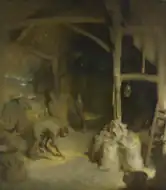 The Golden Barn by George Clausen
 The Garden of Eden by Hugh Goldwin Rivière
 Under the Roof of Blue Ionian Weather by Lawrence Alma-Tadema
 Nymphs Finding the Head of Orpheus by John William Waterhouse
 Boer War, Last Summer Things Were Greener by Byam Shaw
 To the Hills by Briton Riviere
 The Passing of a Great Queen by William Lionel Wyllie

 The Accolade by Edmund Blair Leighton
 The 22nd January 1901 by Stanhope Forbes
 Off to Skibbereen by Stanhope Forbes
 The Home Wind by Charles Napier Hemy
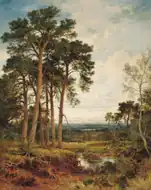 The Weald of Surrey by Benjamin Williams Leader
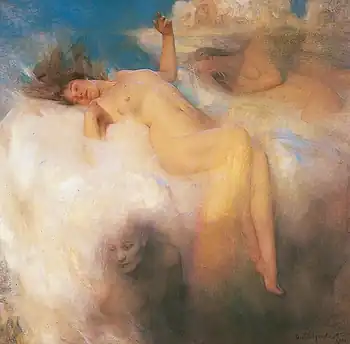
 Gathering Plums by Henry Herbert La Thangue
 Tristan and Isolde by Herbert James Draper
 The Spreading Tree by George Clausen
 Ali Baba and the Forty Thieves by Albert Goodwin
 Ephemeral Joy by Charles Edward Perugini
 Yseult by Frank Dicksee
 Portrait of the Duchess of Buckingham by Frank Dicksee
 Portrait of Henry McGrady by Hubert von Herkomer
 Portrait of John Donnelly by Henry Tanworth Wells
 Portrait of Benjamin Hingley by Arthur Stockdale Cope
 Portrait of Frederick Richards by Arthur Stockdale Cope
 Portrait of George Aitchison by Lawrence Alma-Tadema
 Portrait of Frederick Abel by Frank Bramley
 Portrait of Sir Charles Tennant by John Singer Sargent
 Portrait of Charles Loch by John Singer Sargent
References
- 1 2 3 "1901 The Policeman Painter". chronicle250.com. Retrieved 27 April 2026.
- ↑ "www.rct.uk/collection/403425/queen-victoria-1819-1901". rct.uk. Retrieved 27 April 2026.
- ↑ "www.royalacademy.org.uk/art-artists/work-of-art/a-mermaid". royalacademy.org.uk. Retrieved 27 April 2026.
- ↑ "'Ali Baba and the Forty Thieves', Albert Goodwin, 1901". Tate. Retrieved 27 April 2026.
- ↑ Crankshaw & Gross p.98
Bibliography
- Crankshaw, David J. & Gross, George W. C. (ed.) Reformation Reputations: The Power of the Individual in English Reformation History. Springer International Publishing, 2020.
- Lomax, James & Ormond, Richard. John Singer Sargent and the Edwardian Age. Leeds Art Galleries, 1979.