Royal Academy Exhibition of 1876

The Royal Academy Exhibition of 1876 was the hundred and eighth annual Summer Exhibition hosted by the British Royal Academy of Arts. It ran between 1 May and 7 August 1876 at Burlington House in London's Piccadilly. It showcased works from leading artists and architects of the Victorian era, and attracted over 320,000 visitors during its run.[1]
Charles West Cope displayed The Council of the Royal Academy Selecting Pictures for the Exhibition, 1875 which showed leading members of the Royal Academy judging which paintings should be shown at the previous year's exhibition, which was one of the most widely discussed works. The large number of portrait paintings on display were commented on, while The Art Journal praised Over the Hills and Far Away by John Everett Millais as "the grandest piece of landscape in this year's exhibition".[2]
The French artist James Tissot displayed On the Thames, which drew near unanimous criticism due to its portrayal of a man accompanied by potential female conquests on a boat in the Pool of London.[3] He also exhibited The Convalescent, painted in his own London garden. Henri Félix Emmanuel Philippoteaux showed The Charge of the Heavy Brigade depicting the Battle of Balaclava during the Crimean War.
Gallery

 An Audience at Agrippa's by Lawrence Alma-Tadema

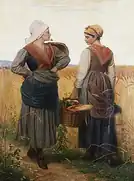 The Rivals by Charles Edward Perugini
.jpg) The Lover's Seat by William Powell Frith
 The Vicar of Wakefield by William Powell Frith
 A Zuyder Zee Fishing Haven by Edward William Cooke

 Hard Lines by James Clarke Hook

 À Bientôt by Valentine Cameron Prinsep

 Teresina by Frederic Leighton
 The Hollow Tree by John Linnell
 Coming Down to Dinner by John Callcott Horsley
 High Mass at a Fishing Village on the Zuyder Zee by George Clausen
 The New Curate by David Wilkie Wynfield
 The Old Gateway by John Seymour Lucas
 An Appeal for Mercy, 1793 by Marcus Stone
 Pallas Athena and the Herdsman's Dogs by Briton Riviere
 Darning Day by Eyre Crowe
 The Hop-Gardens of England by Cecil Gordon Lawson
 Richard II Resigning the Crown to Bolingbroke by John Gilbert
 Rebecca by William Charles Thomas Dobson
 King Lear Disinheriting Cordelia by John Rogers Herbert
 Gordale Scar by John William Inchbold
 Margaret by Philip Hermogenes Calderon
 His Reverence by Philip Hermogenes Calderon
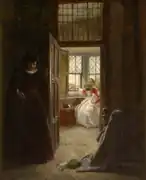 Under Lock and Key by John Callcott Horsley
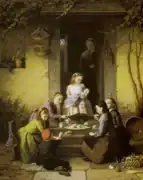 A Birthday Tea Party by Thomas Webster
 Launching the Lifeboat by Henry Moore
 The Widower by Luke Fildes
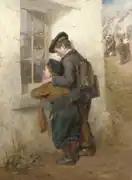 Looking Out For a Safe Investment by Erskine Nicol
 The Last Bit of Scandal by William Frederick Yeames
 Return Through the Valley of Death engraving based on the original painting by Thomas Jones Barker
 Her Majesty's Buckhounds by William Henry Hopkins
 The Morning of the Battle of Waterloo by Ernest Crofts
 Spindrift by John MacWhirter
 The Lady of the Woods by John MacWhirter
 Near Viareggio, Where Shelley's Body Was Found by William Blake Richmond
 Cleopatra by Lawrence Alma-Tadema
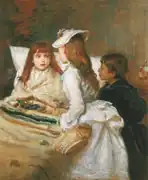 Getting Better by John Everett Millais
 On the Banks of the Nile, Upper Egypt by John Frederick Lewis
 Portrait of Earl Cairns by Lowes Cato Dickinson
 Portrait of Edmund Law Lushington by Lowes Cato Dickinson
 Portrait of Henry Wilkinson Cookson by Lowes Cato Dickinson
 Portrait of Robert Bulwer-Lytton by John Everett Millais
 Portrait of Berthe Schlesinger by John Everett Millais
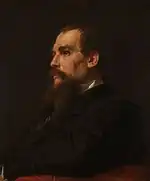 Portrait of Richard Francis Burton by Frederic Leighton
 Portrait of Lionel Smith Beale by Henry Tanworth Wells
 Portrait of the Earl of Milltown by Francis Grant
 Portrait of Ellen Terry by Johnston Forbes-Robertson
References
- ↑ https://chronicle250.com/1876
- ↑ https://chronicle250.com/1876
- ↑ Cusack p.187
Bibliography
- Cusack, Tricia (ed.) Art and Identity at the Water's Edge. Taylor & Francis, 2017.
- Marshall, Nancy Rose & Warner, Malcolm. James Tissot: Victorian Life, Modern Love. Yale University Press, 1999.