Royal Academy Exhibition of 1877

The Royal Academy Exhibition of 1877 was the hundred and ninth annual Summer Exhibition staged by the British Royal Academy of Arts. It was held at Burlington House in London from 7 May to 6 August and attracting over 300,000 visitors. It featured submissions from many of the leading artists and architects of the Victorian era, but came at a time when the Academy was facing a challenge from new art exhibitions such as the rival Grosvenor Gallery in Bond Street.[1]
Edwin Long's Orientalist painting An Egyptian Feast was one of the most discussed and popular works on display. Another work that attracted particular attention was the sculpture An Athlete Wrestling with a Python by Frederic Leighton, better known as a painter who would succeed Francis Grant as President of the Royal Academy the following year.[2]
John Everett Millais displayed The Yeoman of the Guard featuring a portrait of a veteran Beefeater.[3] The Dutch artist Lawrence Alma-Tadema exhibited The Seasons, a series of four paintings depicting the seasons.[4] George Dunlop Leslie showed The Lass of Richmond Hill, which he had recently presented as his diploma work on election to the Royal Academy. Edward Matthew Ward displayed the history paintings William III at Windsor and The Last Interview Between Napoleon and Queen Louisa of Prussia at Tilsit, a scene from the Napoleonic Wars.[5] The French artist Henri Félix Emmanuel Philippoteaux displayed The Battle of Alma, inspired by the Crimean War.
Gallery


 The Lass of Richmond Hill by George Dunlop Leslie
 Cowslips by George Dunlop Leslie
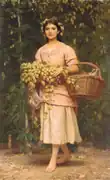 The Hop Picker by Charles Edward Perugini
 William III at Windsor by Edward Matthew Ward

 Hunted Down by John Pettie
 Harmony by Frank Bernard Dicksee
 Alice by Henry Tanworth Wells
 The Judgment of Paris by George Adolphus Storey
 Word From the Missing by James Clarke Hook
 The Gull Catcher by James Clarke Hook
 The Home of the Red Deer by Richard Ansdell
 Cromwell at Marston Moor by Ernest Crofts
 The Tumult in the House of Commons, 1629 by Andrew Carrick Gow
 The Father of the Regiment by George Bernard O'Neill
 Home They Brought Her Warrior Dead by Philip Hermogenes Calderon
 Silkworms by Eyre Crowe
 To the Death by John Pettie
 Cardinal Wolsey at Leicester Abbey by John Gilbert
 A Bit of Blue by Henry Stacy Marks
 Hope Deferred by Charles West Cope
 In Time of War by Thomas Faed
 A Runaway Horse by Thomas Faed
 The Dove by George Frederic Watts
 Critics on Costume, Fashions Change by John Callcott Horsley

 The Street and Mosque Al Ghouri in Cairo by John Frederick Lewis
 A Golden Daydream (1877) by Emily Mary Osborn
 The Fruit Seller by Philip Hermogenes Calderon
 A Reader by Albert Joseph Moore
 A Nautical Argument by Charles Napier Hemy
 Ironsides Returning from Sacking a Cavalier's House by Ernest Crofts
 On the Medway, Breezy March by John Buxton Knight
 Digging for Bait by Charles William Wyllie
 Going Home by Frank Holl
 Between Hope and Fear by Lawrence Alma-Tadema
 Sir Joshua Reynolds Visiting Goldsmith in His Study by John Faed
 A Legend of Saint Patrick by Briton Riviere
 Edric the Fisherman Presents a Fish as a Token from Saint Peter on the Consecration of Westminster Abbey by Andrew Benjamin Donaldson
 The Dragon's Cavern by Paul Falconer Poole
 Serf Emancipation by Edward Armitage
 Dartmoor Drift by Arthur James Stark
 The Misdeal by Frederick Daniel Hardy
 Still Waters Run Deep by Edward Henry Fahey
 The School Belles by Frederick Morgan
 A Sick Child brought into the Temple of Aesculapius by John William Waterhouse
 Captain Absolute's Introduction to Lydia Languish by William Maw Egley
 The Queen of the Swords, oil sketch by William Quiller Orchardson
 A Lady of the Seventeenth Century by John Pettie
 Der Bittgang by Hubert von Herkomer
 Yes by John Everett Millais
 Study at a Reading Desk by Frederic Leighton
 Portrait of Risaldar Muhammed Afzul Khan by Sydney Prior Hall
 Portrait of George Nares by Stephen Pearce
 Portrait of John Shepherd Birley by Daniel Macnee
 Portrait of Edward Stuart Talbot by George Richmond
 Portrait of John Steell by Norman Macbeth
 Portrait of Dorothy Tennant by George Frederic Watts
 Portrait of Victoria, Princess Royal by Heinrich von Angeli
 Miss Mabel Mills by Frederic Leighton

References
- ↑ https://chronicle250.com/1877#catalogue
- ↑ https://chronicle250.com/1877#catalogue
- ↑ Barlow p.161
- ↑ Grand-Clément & Ribeyrol p.124-25
- ↑ Dafforne p.xii
Bibliography
- Barlow, Paul. Time Present and Time Past: The Art of John Everett Millais. Routledge, 2017.
- Grand-Clément, Adeline & Ribeyrol, Charlotte (ed.) The Smells and Senses of Antiquity in the Modern Imagination. Bloomsbury Academic, 2023.
- Dafforne, James. The Life and Works of Edward Matthew Ward. Virtue and Company, 1879.