Royal Academy Exhibition of 1842

The Royal Academy Exhibition of 1842 was an art exhibition held at the National Gallery in Trafalgar Square in London between 2 May and 23 July 1842. It was the seventy fourth annual Summer Exhibition of the British Royal Academy of Arts. It took place during the early Victorian era and featured submissions from leading painters, sculptors and architects of the period.
The greatest attention was drawn by five paintings by J.M.W. Turner. These included two cityscapes of Venice and Snow Storm: Steam-Boat off a Harbour's Mouth.[1][2] His War. The Exile and the Rock Limpet showing Napoleon under British guard in exile on the island of Saint Helena was almost universally savaged by critics, although the praise of Turner's admirer John Ruskin. [3]
It was the first exhibition to be held since the death of David Wilkie, a leading member of the Academy for several decades, who has died near Gibraltar while travelling back from the Holy Land. His friend Turner paid tribute to him with his painting Peace – Burial at Sea. Another friend William Collins, who had named his son Wilkie Collins in his honour, displayed a picture of Wilkie's Kensington house View of Sir David Wilkie's House in Kensington.[4] Several of Wilkie's paintings from his trip were shown posthumously including the Portrait of Abdülmecid I and Portrait of Muhammad Ali of Egypt.[5] After a period of absence Edwin Landseer returned to the Academy after several years absence, displaying works he had produced for Queen Victoria. Crossing the Ford, the only work sent in by the Irish artist William Mulready, was one of the most popular paintings on display. Daniel Maclise sent in the large theatrical canvas The Play Scene in Hamlet.[1]
Gallery


 Sorrento, Bay of Naples by William Collins
 Villa d'Este, Tivoli by William Collins
 Portrait of Lady Haddo by Margaret Sarah Carpenter


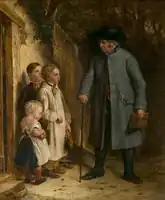 The Village Schoolmaster by Charles West Cope

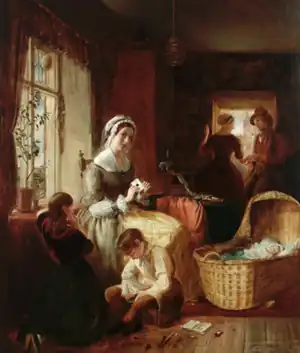

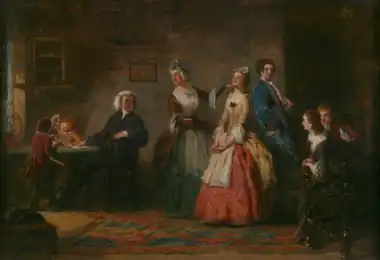
 The Tired Soldier Resting at a Roadside Well by Frederick Goodall
 The Departure of Charles II from Bentley in Staffordshire by Charles Landseer
 The Sanctuary by Edwin Landseer
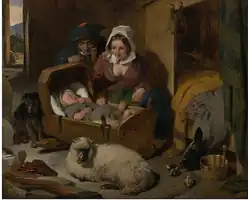 A Highland Shepherd's Home by Edwin Landseer

 Henry VI, Part Two, Act II, Scene 1 at St Albans by Edward Matthew Ward
 A Fishmonger's Shop by Jacques-Laurent Agasse
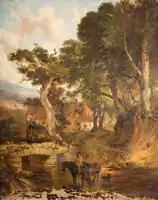 The Watering Place by Frederick Richard Lee

 The Death of Sir William Lambton at the Battle of Marston Moor by Richard Ansdell
 The Marriage of the Covenanter by Alexander Johnston
 Floretta by Robert Farrier
 The Magdalen by William Etty
 The Ravine Leading to Petra by David Roberts
 The Hawthorn Bush by Charles West Cope
 The Sisters by Charles Lock Eastlake
 Portrait of Queen Victoria by John Partridge
 Portrait of Prince Albert by John Partridge
 Portrait of Francis Baring by John Linnell
 Portrait of William Coningham by John Linnell
 Portrait of Robert Stopford by Frederick Richard Say
 Portrait of Edward Pyndar Lygon by William Salter
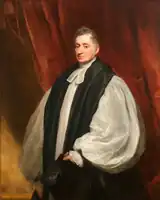 Portrait of the Bishop of Chichester by Thomas Phillips
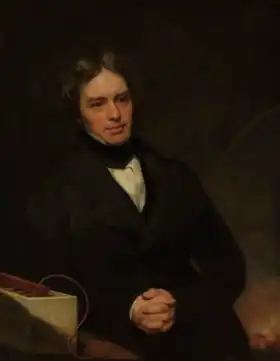
 Portrait of William Gordon by Henry William Pickersgill
See also
- Salon of 1842, held at the Louvre in Paris
References
- 1 2 Postle, Martin (2018). "1842: Snowstorm and Sanctuary". The Royal Academy of Arts Summer Exhibition: A Chronicle, 1769–2018. Paul Mellon Centre for Studies in British Art. Retrieved August 10, 2026.
- ↑ Hamilton p.437-40
- ↑ "War. The Exile and the Rock Limpet". Tate.
- ↑ "View of Sir David Wilkie's House in Vicarage Place, Kensington". National Galleries of Scotland. Retrieved August 10, 2026.
- ↑ Tromans p.338
Bibliography
- Hamilton, James. Turner - A Life. Sceptre, 1998.
- Tromans, Nicholas. David Wilkie: The People's Painter. Edinburgh University Press, 2007.