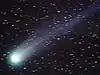
C/2019 U5 (PanSTARRS)
| Discovery[1][2] | |
|---|---|
| Discovered by | Pan-STARRS |
| Discovery site | Haleakalā Observatory |
| Discovery date | 22 October 2019 |
| Designations | |
| A/2019 U5[1] | |
| Orbital characteristics[3] | |
| Epoch | 27 September 2022 (JD 2459849.5) |
| Observation arc | 6.34 years |
| Earliest precovery date | 11 October 2019 |
| Number of observations | 5,421 |
| Perihelion | 3.624 AU |
| Eccentricity | 1.00143 |
| Orbital period | 5.9 million years (inbound)[4] |
| Inclination | 113.52° |
| 2.637° | |
| Argument of periapsis | 181.51° |
| Mean anomaly | –0.001° |
| Last perihelion | 29 March 2023 |
| TJupiter | –0.942 |
| Earth MOID | 2.626 AU |
| Jupiter MOID | 1.834 AU |
| Physical characteristics[5] | |
Mean radius | 30–47.5 km (18.6–29.5 mi)[6] |
| |
| Absolute magnitude (H) | 6.84±0.02 |
| Comet total magnitude (M1) | 8.5[3] |
| 10.3[7] (2023 apparition) | |
Comet C/2019 U5 (PanSTARRS), formerly known by its provisional designation A/2019 U5, is a distant non-periodic comet moving in a retrograde trajectory around the Sun. It is one of several comets discovered by the Pan-STARRS survey.
Observational history
When it was first discovered in October 2019,[1] it was presumed to be a hyperbolic asteroid.[6] Later observations from September 2020 revealed that weak cometary activity was detected and increasing as it went closer to the Sun.[2] Further observations of a persistent coma seen from Hawaii, Japan, and other European nations confirmed its nature as a comet.[2]
Physical characteristics
Optical photometry obtained from the Sanglokh Observatory (193) between May and September 2022 reveal an absolute magnitude of 6.84±0.02, with color indices suggesting a quasi-steady activity within its coma.[5] Morphological observations while it was 4.63–4.03 AU (693–603 million km) from the Sun also show no signs of jet-like or other structural features within the coma.[5] The comet's nucleus is estimated to be about 60–95 km (37–59 mi) in diameter.[6]
Orbit
Barycentric osculating parameters from HORIZONS show that C/2019 U5 is a dynamically new comet from the Oort cloud.[5] It reached perihelion on 29 March 2023 at a distance of 3.624 AU (542.1 million km) from the Sun.[4] The comet is expected to leave the Solar System on its outbound trajectory.[4]
References
- 1 2 3 R. Wainscoat; C. Crowder; T. Burdullis; et al. (1 November 2019). "A/2019 U5". Minor Planet Electronic Circulars. 2019-V10. ISSN 1523-6714.
- 1 2 3 M. Micheli; K. J. Meech; J. Kleyna; et al. (April 2021). D. W. Green (ed.). "Comet C/2019 U5 (PanSTARRS)". Central Bureau Electronic Telegrams. 4953: 1. Bibcode:2021CBET.4953....1M.
- 1 2 "C/2019 U5 (PanSTARRS) – JPL Small-Body Database Lookup". ssd.jpl.nasa.gov. Jet Propulsion Laboratory. Retrieved 21 July 2026.
- 1 2 3 Horizons output. "Barycentric Osculating Orbital Elements for Comet PanSTARRS (C/2019 U5)". Retrieved 21 July 2026. (Solution using the Solar System's barycenter (Sun+Jupiter). Select Ephemeris Type:Elements and Center:@0)
Inbound period (PR) = 2.15E+09 / 365.25 days = 5.9 million years - 1 2 3 4 G. I. Kokhirova; E. S. Bakanas; V. V. Emel'yanenko; F. D. Rakhmatullaeva; A. P. Kartashova (2026). "Photometric characteristics of comet C/2019 U5 during the pre-perihelion period and its dynamical features". Planetary and Space Science. 278–279 106302. Bibcode:2026P&SS..27806302K. doi:10.1016/j.pss.2026.106302.
- 1 2 3 T. Hromakina; I. Belskaya; Y. Krugly; et al. (2021). "Small Solar System objects on highly inclined orbits. Surface colours and lifetimes" (PDF). Astronomy & Astrophysics. 647: 71–85. arXiv:2101.04541. doi:10.1051/0004-6361/202039737.
- ↑ "Observation list for C/2019 U5". COBS – Comet OBServation database. Retrieved 21 July 2026.
External links
- C/2019 U5 at the JPL Small-Body Database
- C/2019 U5 at Seiichi Yoshida's website