74P/Smirnova–Chernykh
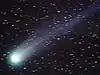
 Comet Smirnova–Chernykh near galaxy PGC 49413 on 25 January 2010 | |
| Discovery[1] | |
|---|---|
| Discovered by | Tamara M. Smirnova Nikolai S. Chernykh |
| Discovery site | Crimean Astrophysical Observatory |
| Discovery date | 4 March 1975 |
| Designations | |
| P/1967 EU, P/1975 E2 | |
| |
| Orbital characteristics[2][3] | |
| Epoch | 21 November 2025 (JD 2461000.5) |
| Observation arc | 58.95 years |
| Earliest precovery date | 9 March 1967 |
| Number of observations | 6,540 |
| Aphelion | 5.391 AU |
| Perihelion | 4.836 AU |
| Semi-major axis | 5.114 AU |
| Eccentricity | 0.05432 |
| Orbital period | 11.56 years |
| Inclination | 6.015° |
| 51.724° | |
| Argument of periapsis | 59.702° |
| Mean anomaly | 348.44° |
| Last perihelion | 2 March 2026[4] |
| Next perihelion | 14 June 2034[5] |
| TJupiter | 3.007 |
| Earth MOID | 2.567 AU |
| Jupiter MOID | 0.479 AU |
| Physical characteristics[2] | |
Mean radius | 2.23 km (1.39 mi)[6] |
| Comet total magnitude (M1) | 6.7 |
| Comet nuclear magnitude (M2) | 12.1 |
| Perihelion distance at different epochs[7] | |||||||
| Epoch | Perihelion (AU) | ||||||
|---|---|---|---|---|---|---|---|
| 1929 | 5.68 | ||||||
| 1967 | 3.55 | ||||||
| 2026 | 4.84 | ||||||
| 2034 | 3.84 | ||||||
74P/Smirnova–Chernykh is an Encke-type comet with a 5:7 orbital resonance with Jupiter.[8] It is also classified as a quasi-Hilda comet.[9] It was discovered in late March 1975 by Tamara Mikhaylovna Smirnova while examining exposures from the Crimean Astrophysical Observatory.[10] In the discovery images the comet had an apparent magnitude of ~15.[10] In the year of discovery, the comet came to perihelion on 6 August 1975.[10]
The comet had been photographed during 1967, but was identified as an asteroid and assigned the designation 1967 EU.[11][12]
The comet is estimated at 4.46 km (2.77 mi) in diameter.[6]
A close approach to Jupiter in 2021 lifted perihelion from 3.54 AU to 4.84 AU.
See also
References
- ↑ T. M. Smirnova; N. S. Chernykh (13 January 2004). "Comet Smirnova–Chernykh (1975e)". IAU Circular. 8267 (1). Bibcode:1975IAUC.2764....1S.
- 1 2 "74P/Smirnova–Chernykh – JPL Small-Body Database Lookup". ssd.jpl.nasa.gov. Jet Propulsion Laboratory. Retrieved 25 January 2010.
- ↑ "74P/Smirnova–Chernykh Orbit". Minor Planet Center. Retrieved 24 February 2019.
- ↑ "Horizons Batch for 74P/Smirnova-Chernykh (90000821) on 2026-Mar-02" (Perihelion occurs when rdot flips from negative to positive). JPL Horizons. Retrieved 29 September 2025. (JPL#K264/21, Soln.date: 2025-Oct-01)
- ↑ "Horizons Batch for 74P/Smirnova-Chernykh (90000821) on 2034-Jun-14" (Perihelion occurs when rdot flips from negative to positive). JPL Horizons. Archived from the original on 29 September 2025. Retrieved 29 September 2025. (JPL#K264/20, Soln.date: 2025-Sep-22)
- 1 2 P. L. Lamy; I. Toth; Y. R. Fernández; H. A. Weaver (2004). "The Sizes, Shapes, Albedos, and Colors of Cometary Nuclei" (PDF). Comets II. University of Arizona Press. pp. 223–264. Bibcode:2004come.book..223L. doi:10.2307/j.ctv1v7zdq5.22. ISBN 978-0-8165-2450-1. JSTOR j.ctv1v7zdq5.22.
- ↑ Kinoshita, Kazuo (13 November 2018). "74P/Smirnova-Chernykh past, present and future orbital elements". Comet Orbit. Retrieved 5 October 2025.
- ↑ G. Kastel (1975). "The new Comet 1975e Smirnova–Chernykh". Soviet Astronomy Letters (in Russian). 1: 155. Bibcode:1975SvAL....1..155K.
- ↑ I. Toth (2006). "The quasi-Hilda subgroup of ecliptic comets - an update" (PDF). Astronomy and Astrophysics. 448 (3): 1191–1196. Bibcode:2006A&A...448.1191T. doi:10.1051/0004-6361:20053492.
- 1 2 3 G. W. Kronk. "74P/Smirnova–Chernykh". Cometography. Retrieved 25 January 2010.
- ↑ S. Nakano (1984). Identifications of Minor Planets with Comets. pp. 453–454. Bibcode:1984impw.book.....N.
- ↑ Seiichi Yoshida (28 August 2005). "74P/Smirnova-Chernykh". Seiichi Yoshida's Comet Catalog. Retrieved 25 January 2010.
External links
- 74P/Smirnova–Chernykh at the JPL Small-Body Database
- 74P/Smirnova–Chernykh at Kazuo Kinoshita's website
- 74P/Smirnova–Chernykh at Seiichi Yoshida's website