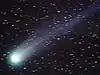
332P/Ikeya–Murakami
 332P/Ikeya–Murakami photographed by the Hubble Space Telescope in January 2016.[1] | |
| Discovery | |
|---|---|
| Discovered by | Kaoru Ikeya Shigeki Murakami |
| Discovery date | 3 November 2010 |
| Designations | |
| P/2010 V1, P/2015 Y2 | |
| Orbital characteristics | |
| Epoch | 2016 Jan. 13[2] |
| Observation arc | 124 days (fragment A)[3] |
| Perihelion | 1.573 AU (q) |
| Eccentricity | 0.4904 |
| Orbital period | 5.42 yr[2] (1980 days) |
| Inclination | 9.387° |
| Last perihelion | 18 August 2021 (A)[4] (unobserved) |
| Next perihelion | 19 January 2027? (A)[5] 6 June 2027?? (F)[6] |
| Earth MOID | 0.59 AU (A)[3] |
| Jupiter MOID | 0.46 AU (A)[3] 0.34 AU (F)[7] |
| Physical characteristics[8][9] | |
Mean radius | ≤ 2 km (original nucleus) ≤ 275 meters (A+C) ≤ 20 meters (F) |
| 0.04 (assumed) | |
| Comet total magnitude (M1) | 5.2 |
| Comet nuclear magnitude (M2) | 12.5 |
332P/Ikeya–Murakami (P/2010 V1) is a short-period comet with period of approximately 5.4 years[2] first identified independently by the two Japanese amateur astronomers Kaoru Ikeya and Shigeki Murakami on November 3, 2010.[10][11] As 332P/Ikeya–Murakami only approaches within 1.57 AU of the Sun, roughly Mars distance from the Sun, the fragmentation events may be a result of rapid rotation. The comet was last observed in October 2020 as during the 2021 perihelion passage the comet was only 7 degrees from the Sun. The comet will next come to perihelion in January 2027 when it will have a solar elongation of 100 degrees.
Observational history
Ikeya identified the comet using a 25-centimeter (10-inch) reflector at 39×, while Murakami used a 46 cm (18-inch) reflector at 78×.[10] Photographic confirmation of the comet was obtained by Ernesto Guido and Giovanni Sostero using a Global-Rent-a-Scope (GRAS) telescope in New Mexico. Both Ikeya and Murakami discovered the comet using manual observation through optical telescopes. Such visual discoveries have become rare in recent years.[10]
At the start of November 2010, a few weeks past perihelion passage, it was discovered the comet had undergone a major outburst between October 31 and November 3.[12] After the 2010 perihelion passage, the comet only had about an 80-day observation arc.[12]
The recovery of P/2010 V1 on December 31, 2015, at magnitude 20 was announced on January 2, 2016, and designated as P/2015 Y2.[2] A secondary fragment (B) was confirmed and announced on January 5, 2016.[13] The comet is now composed of component A and B with two different comas, envelopes and tails.[13] Around January 11, 2016, two fainter potential fragments, designated P/2010 V1-C and P/2010 V1-D have been located, both likely having been fragmented from P/2010 V1-B. As of January 29, fragments B and D had nearly entirely disintegrated, and fragment C had undergone an outburst, making it as bright as P/2010 V1-A.
Fragment–A has a 124-day observation arc,[3] and fragment–F has the poorest orbit determination as it has a short arc of only 11-days.[7] Most of the fragments are estimated to have an orbital period of about 1980 days. Fragment–F is estimated to have a longer orbital period of around 2050 days. After two orbits (11 years) of becoming divergent, fragment–F is estimated to come to perihelion 4 months and 18 days after fragment–A.
Fragments
| Comet fragment | semimajor axis (AU) | perihelion | eccentricity | inclination | M2 | ascending node | argument of peri | Discovery date |
|---|---|---|---|---|---|---|---|---|
| A | 3.08642 | 1.572883 | 0.49039 | 9.3869 | 19.3 | 3.7827 | 152.442 | 2016/01/02 |
| B | 3.0834 | 1.57287 | 0.48989 | 9.3824 | 20.8 | 3.796 | 152.378 | 2016/01/01 |
| C | 3.0894 | 1.57293 | 0.49086 | 9.3870 | 12.5 | 3.7810 | 152.430 | 2010/11/03 |
| D | 3.083 | 1.5714 | 0.4904 | 9.379 | 19.5 | 3.76 | 152.6 | 2016/02/01 |
| E | 3.09 | 1.573 | 0.491 | 9.39 | 22.5 | 3.8 | 152.5 | 2016/01/18 |
| F | 3.15 | 1.585 | 0.496 | 9.51 | 22.1 | 3.60 | 152.4 | 2016/02/05 |
| G | 3.06 | 1.551 | 0.494 | 9.27 | 20.6 | 3.6 | 154.5 | 2016/02/10 |
| H | 3.0860 | 1.57283 | 0.49033 | 9.3857 | 18.9 | 3.786 | 152.421 | 2016/02/05 |
| I | 3.083 | 1.5730 | 0.490 | 9.38 | 21.7 | 3.80 | 152.4 | 2016/02/05 |
See also
References
- ↑ "Cosmic Fragments". www.spacetelescope.org. Retrieved 20 September 2016.
- 1 2 3 4 "MPEC 2016-A10 : COMET P/2010 V1 = 2015 Y2 (Ikeya–Murakami)". IAU Minor Planet Center. 2016-01-02. Retrieved 2016-01-12. (PK15Y020)
- 1 2 3 4 "332P/Ikeya–Murakami-A – JPL Small-Body Database Lookup". ssd.jpl.nasa.gov. Jet Propulsion Laboratory. Retrieved 17 September 2021.
- ↑ "332P/Ikeya–Murakami Orbit". Minor Planet Center. Retrieved 10 April 2017.
- ↑ "Horizons Batch for 332P/Ikeya–Murakami-A (90001304) on 2027-Jan-19?" (Perihelion occurs when rdot flips from negative to positive). JPL Horizons. Retrieved 2021-09-17. (JPL#15 / Soln.date: 2021-Feb-24 / last obs: 2016-05-05)
- ↑ "Horizons Batch for 332P/Ikeya–Murakami-F (90001309) on 2027-Jun-06??" (Perihelion occurs when rdot flips from negative to positive). JPL Horizons. Retrieved 2025-10-13. (JPL#8 / Soln.date: 2018-Apr-05 / last obs: 2016-02-16)
- 1 2 "332P/Ikeya–Murakami-F – JPL Small-Body Database Lookup". ssd.jpl.nasa.gov. Jet Propulsion Laboratory. Retrieved 13 October 2025.
- ↑ D. C. Jewitt; M. Mutchler; H. Weaver; M. T. Hui; J. Agarwal; et al. (2016). "Fragmentation Kinematics in Comet 332P/Ikeya–Murakami". The Astrophysical Journal Letters. 829 (1): 8–14. arXiv:1609.04452. Bibcode:2016ApJ...829L...8J. doi:10.3847/2041-8205/829/1/L8.
- ↑ M. T. Hui; Q. Z. Ye; P. Wiegert (2017). "Constraints on Comet 332P/Ikeya-Murakami". The Astronomical Journal. 153 (1): 4–14. arXiv:1610.00877. Bibcode:2017AJ....153....4H. doi:10.3847/1538-3881/153/1/4.
- 1 2 3 Sinnott, Roger (2010-11-04). "New Binocular Comet in the Morning Sky". Sky & Telescope. Retrieved 2010-11-05.
{{cite web}}: CS1 maint: deprecated archival service (link) - ↑ "Ikeya–Murakami: The New Comet on the Cosmic Block". NASA. November 17, 2010. Retrieved 14 December 2010.
- 1 2 M. Ishiguro; D. C. Jewitt; H. Hanayama; F. Usui; T. Sekiguchi; et al. (2014). "Outbursting Comet P/2010 V1 (Ikeya–Murakami): A Miniature Comet Holmes". The Astrophysical Journal. 787 (1): 55. arXiv:1404.1630. Bibcode:2014ApJ...787...55I. doi:10.1088/0004-637X/787/1/55. ISSN 0004-637X. S2CID 50869105.
- 1 2 D. W. Green (5 January 2016). "Comet P/2015 Y2 (Ikeya–Murakami)". Central Bureau for Astronomical Telegrams.
External links
- P 2010 V1 IKEYA-MURAKAMI
- 332P/Ikeya-Murakami – Seiichi Yoshida @ aerith.net