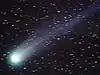
160P/LINEAR
 Comet 160P/LINEAR photographed by the Zwicky Transient Facility on 31 October 2019 | |
| Discovery[1][2] | |
|---|---|
| Discovered by | LINEAR |
| Discovery date | 15 July 2004 |
| Designations | |
| P/2004 NL21 | |
| Orbital characteristics[3][4] | |
| Epoch | 21 November 2025 (JD 2461000.5) |
| Observation arc | 24.13 years[a] |
| Earliest precovery date | 8 September 1996[5][6] |
| Number of observations | 991 |
| Aphelion | 5.765 AU |
| Perihelion | 1.796 AU |
| Semi-major axis | 3.781 AU |
| Eccentricity | 0.52491 |
| Orbital period | 7.35 years |
| Inclination | 15.589° |
| 333.32° | |
| Argument of periapsis | 12.793° |
| Mean anomaly | 292.65° |
| Last perihelion | 2 December 2019 |
| Next perihelion | 7 April 2027[7] |
| TJupiter | 2.775 |
| Earth MOID | 1.067 AU |
| Jupiter MOID | 0.081 AU |
| Physical characteristics[3] | |
Mean radius | 0.87 km (0.54 mi)[8] |
| Comet total magnitude (M1) | 6.7 |
| Comet nuclear magnitude (M2) | 16.0 |
160P/LINEAR is a Jupiter-family comet with a roughly 7.35-year orbit around the Sun. It is one of many comets discovered by the Lincoln Near-Earth Asteroid Research (LINEAR) survey.
Observational history
It was first detected as a faint 19th-magnitude asteroid-like object from LINEAR observations in 15 July 2004. Calculations of its orbit has informed the Minor Planet Center that the object, formerly labeled as 2004 NL21, is a possible new comet.[9][10] Robert H. McNaught confirmed its cometary nature after detecting some weak activity on 6 September 2004.[2]
The comet later received its official numerical designation (160P) after Maik Meyer confirmed its precovery photographic plates taken by the Near-Earth Asteroid Tracking (NEAT) survey in 1996.[5] It was subsequently re-observed in its next two apparitions in 2012 and 2019 respectively.
Physical characteristics
In 2006, observations from the Isaac Newton Telescope while it was approximately 4.0 AU (600 million km) away from the Sun revealed that its nucleus has an effective radius of roughly 0.87 ± 0.07 km (0.541 ± 0.043 mi).[8] However, the presence of a background galaxy at the time prevented direct measurements of the chemical composition of its surrounding coma.[8]
Orbit
 Diagram of the orbit of 160P/LINEAR by the Jet Propulsion Laboratory
Notes
- ↑ Observation arc from the Minor Planet Center database covering dates from 8 September 1996 until 25 October 2020.
References
- ↑ R. H. McNaught (18 September 2004). B. G. Marsden (ed.). "Comet P/2004 NL21 (LINEAR)" (TXT). Central Bureau for Astronomical Telegrams. 87: 1. Bibcode:2004CBET...87....1M.
- 1 2 R. H. McNaught (23 September 2004). D. W. Green (ed.). "Comet P/2004 NL21 (LINEAR)". IAU Circular. 8408 (1). Bibcode:2004IAUC.8408....1M.
- 1 2 "160P/LINEAR – JPL Small-Body Database Lookup". ssd.jpl.nasa.gov. Jet Propulsion Laboratory. Retrieved 22 August 2026.
- ↑ "160P/LINEAR Orbit". Minor Planet Center. Retrieved 18 June 2014.
- 1 2 M. Meyer (3 October 2004). D. W. Green (ed.). "Comet 160P/2004 NL21 (LINEAR)". IAU Circular. 8414 (3). Bibcode:2004IAUC.8414....3M.
- ↑ E. F. Helin; S. Pravdo; K. J. Lawrence; et al. (18 September 2004). B. G. Marsden (ed.). "Comet P/2004 NL21 (LINEAR)". Minor Planet Electronic Circulars. 2004-S18. Bibcode:2004MPEC....S...18H. ISSN 1523-6714.
- ↑ "Horizons Batch for 160P/LINEAR (90001101) on 2027-Apr-07" (Perihelion occurs when rdot flips from negative to positive). JPL Horizons. Retrieved 16 April 2026. (JPL#59 Soln.date: 2022-May-19)
- 1 2 3 C. S. Snodgrass; S. C. Lowry; A. Fitzsimmons (2007). "Optical observations of 23 distant Jupiter Family Comets, including 36P/Whipple at multiple phase angles" (PDF). Monthly Notices of the Royal Astronomical Society. 385 (2): 737–756. arXiv:0712.4204. Bibcode:2008MNRAS.385..737S. doi:10.1111/j.1365-2966.2008.12900.x. S2CID 55536237.
- ↑ "Daily Orbit Update (2004 July 28 UT)". Minor Planet Electronic Circulars. 2004-O40. 28 July 2004. Bibcode:2004MPEC....O...40.. ISSN 1523-6714.
- ↑ "Daily Orbit Update (2004 Sept 17 UT)". Minor Planet Electronic Circulars. 2004-S06. 17 September 2004. Bibcode:2004MPEC....S...06.. ISSN 1523-6714.
External links
- 160P/LINEAR at the JPL Small-Body Database
- 160P/LINEAR at Gideon van Buitenen's website
- 160P/LINEAR at Seiichi Yoshida's website