121P/Shoemaker–Holt
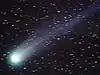
 Infrared image of Comet Shoemaker–Holt from the Spitzer Space Telescope on 1 August 2006 | |
| Discovery[1] | |
|---|---|
| Discovered by | Carolyn S. Shoemaker Eugene Merle Shoemaker Henry E. Holt |
| Discovery date | 9 March 1989 |
| Designations | |
| P/1989 E2, P/1995 Q3 | |
| |
| Orbital characteristics[3][4] | |
| Epoch | 21 November 2025 (JD 2461000.5) |
| Observation arc | 37.19 years |
| Earliest precovery date | 4 March 1989 |
| Number of observations | 798 |
| Aphelion | 5.448 AU |
| Perihelion | 3.733 AU |
| Semi-major axis | 4.591 AU |
| Eccentricity | 0.18669 |
| Orbital period | 9.835 years |
| Inclination | 20.162° |
| 94.104° | |
| Argument of periapsis | 12.047° |
| Mean anomaly | 87.563° |
| Last perihelion | 28 June 2023 |
| Next perihelion | 5 May 2033[5] |
| TJupiter | 2.858 |
| Earth MOID | 2.620 AU |
| Jupiter MOID | 0.131 AU |
| Physical characteristics[3] | |
Mean radius | 3.61 km (2.24 mi)[6] |
| ~10 hours[7] | |
| (V–R) = 0.53±0.03[8] | |
| Comet total magnitude (M1) | 6.7 |
| Comet nuclear magnitude (M2) | 12.6 |
121P/Shoemaker–Holt, also known as Shoemaker–Holt 2, is a Jupiter-family comet with an orbital period of about 10 years. The comet was discovered by Carolyn S. Shoemaker, Eugene M. Shoemaker, and Henry E. Holt on 9 March 1989. The comet then had an apparent magnitude of 13, was diffuse and had a tail about 2 arcminutes long.[1] It was recovered by James V. Scotti on 29 August 1995 in images obtained as part of the Spacewatch survey.[9]
The nucleus of the comet is estimated to have a radius of 3.87 km based on infrared imaging by the Spitzer Space Telescope, when the comet displayed dust emission.[8] Observations of the comet from the Isaac Newton Telescope indicate an effective radius of 3.61 kilometers. The rotational period was calculated to be 10 hours, but with high uncertainty.[7]
References
- 1 2 C. S. Shoemaker; E. M. Shoemaker; H. E. Holt (10 March 1989). D. W. Green (ed.). "Comet Shoemaker–Holt (1989j)". IAU Circular. 4755 (1).
- ↑ "Periodic Comet Names and Designations". Planetary Data System: Small Body Node. NASA. Retrieved 14 July 2026.
- 1 2 "121P/Shoemaker–Holt 2 – JPL Small-Body Database Lookup". ssd.jpl.nasa.gov. Jet Propulsion Laboratory. Retrieved 13 July 2026.
- ↑ "121P/Shoemaker–Holt Orbit". Minor Planet Center. Retrieved 16 April 2026.
- ↑ "Horizons Batch for 121P/Shoemaker-Holt 2 (90001019) on 2033-May-05" (Perihelion occurs when rdot flips from negative to positive). JPL Horizons. Retrieved 16 April 2026.
- ↑ M. M. Knight; R. Kokotanekova; N. H. Samarasinha (2024). "Physical and Surface Properties of Comet Nuclei from Remote Observations". In K. J. Meech (ed.). Comets III. University of Arizona Press. pp. 361–404. arXiv:2304.09309. JSTOR jj.21819446.18.
- 1 2 C. Snodgrass; S. C. Lowry; A. Fitzsimmons (2008). "Optical observations of 23 distant Jupiter Family Comets, including 36P/Whipple at multiple phase angles". Monthly Notices of the Royal Astronomical Society. 385 (2): 737–756. arXiv:0712.4204. Bibcode:2008MNRAS.385..737S. doi:10.1111/j.1365-2966.2008.12900.x.
- 1 2 Y. R. Fernández; M. S. P. Kelley; P. L. Lamy; I. Toth; O. Groussin; et al. (2013). "Thermal properties, sizes, and size distribution of Jupiter-family cometary nuclei". Icarus. 226 (1): 1138–1170. arXiv:1307.6191. Bibcode:2013Icar..226.1138F. doi:10.1016/j.icarus.2013.07.021.
- ↑ J. V. Scotti; D. W. Green; B. G. Marsden (1 September 1995). "Comet P/1995 Q3 (Shoemaker-Holt 2)". IAU Circular. 6219 (2). Bibcode:1995IAUC.6219....2S. ISSN 0081-0304.
External links
- 121P/Shoemaker–Holt at the JPL Small-Body Database
- 121P/Shoemaker–Holt at Gideon van Buitenen's website
- 121P/Shoemaker–Holt at Gary W. Kronk's Cometography
- 121P/Shoemaker–Holt at Shuichi Nakano's website
- 121P/Shoemaker–Holt at Seiichi Yoshida's website