118P/Shoemaker–Levy
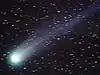
 Comet Shoemaker–Levy 4 photographed on 5 March 2010 | |
| Discovery[1] | |
|---|---|
| Discovered by | |
| Discovery date | 9 February 1991 |
| Designations | |
| P/1991 C2, P/1995 M1 | |
| Shoemaker–Levy 4 1990 XII, 1991f | |
| Orbital characteristics[2][3] | |
| Epoch | 21 November 2025 (JD 2461000.5) |
| Observation arc | 34.31 years |
| Number of observations | 4,088 |
| Aphelion | 4.869 AU |
| Perihelion | 1.829 AU |
| Semi-major axis | 3.349 AU |
| Eccentricity | 0.45380 |
| Orbital period | 6.129 years |
| Inclination | 10.093° |
| 142.05° | |
| Argument of periapsis | 314.97° |
| Mean anomaly | 175.62° |
| Last perihelion | 24 November 2022 |
| Next perihelion | 11 January 2029 |
| TJupiter | 2.957 |
| Earth MOID | 0.865 AU |
| Jupiter MOID | 0.614 AU |
| Physical characteristics[2] | |
Mean radius | 2.61 km (1.62 mi)[4] |
| Comet total magnitude (M1) | 12.4 |
| Comet nuclear magnitude (M2) | 14.8 |
118P/Shoemaker–Levy (also known as Shoemaker–Levy 4) is a Jupiter-family comet discovered by astronomers Carolyn and Eugene M. Shoemaker and David Levy.[1]
During the 2010 apparition the comet became as bright as apparent magnitude 11.5.[5]
On 3 December 2015, comet Shoemaker–Levy 4 passed 0.0442 AU (6.61 million km; 4.11 million mi) from asteroid 4 Vesta.[2]
This comet should not be confused with Comet Shoemaker–Levy 9 (D/1993 F2) which spectacularly crashed into Jupiter in 1994.
Physical characteristics
Hubble observations in 2004 estimated that the nucleus of Shoemaker–Levy 4 is estimated to be about 4.8 km (3.0 mi) in diameter.[6] Follow-up observations in 2011 revealed that it is slightly larger, at 5.22 km (3.24 mi) in diameter.[4]
References
- 1 2 C. S. Shoemaker; E. M. Shoemaker; D. H. Levy (11 February 1991). D. W. Green (ed.). "Comet Shoemaker–Levy (1991f)". IAU Circular. 5185 (1). Bibcode:1991IAUC.5185....1S.
- 1 2 3 "118P/Shoemaker–Levy 4 – JPL Small-Body Database Lookup". ssd.jpl.nasa.gov. Jet Propulsion Laboratory. Retrieved 3 March 2010.
- ↑ "118P/Shoemaker–Levy Orbit". Minor Planet Center. Retrieved 29 April 2023.
- 1 2 C. Snodgrass; A. Fitzsimmons; S. C. Lowry; P. Weissman (2011). "The size distribution of Jupiter Family comet nuclei" (PDF). Monthly Notices of the Royal Astronomical Society. 414 (1): 458–469. arXiv:1101.4228. Bibcode:2011MNRAS.414..458S. doi:10.1111/j.1365-2966.2011.18406.x.
- ↑ Seiichi Yoshida (17 January 2010). "Weekly Information about Bright Comets (2010 Jan. 16: North)". Seiichi Yoshida's Comet Catalog. Retrieved 4 March 2010.
- ↑ P. L. Lamy; I. Toth; Y. R. Fernández; H. A. Weaver (2004). "The Sizes, Shapes, Albedos, and Colors of Cometary Nuclei" (PDF). Comets II. University of Arizona Press. pp. 223–264. Bibcode:2004come.book..223L. doi:10.2307/j.ctv1v7zdq5.22. ISBN 978-0-8165-2450-1. JSTOR j.ctv1v7zdq5.22. Archived from the original (PDF) on 9 October 2022. Retrieved 30 March 2026.
External links
- 118P/Shoemaker–Levy at the JPL Small-Body Database
- 118P/Shoemaker–Levy on Gary W. Kronk's Cometography
- 118P/Shoemaker–Levy at Seiichi Yoshida's website
- 118P/Shoemaker–Levy at Kazuo Kinoshita's website