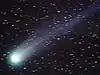
112P/Urata–Niijima
 Comet Urata–Niijima imaged from the Zwicky Transient Facility on 27 January 2020 | |
| Discovery[1] | |
|---|---|
| Discovered by | Takeshi Urata Tsuneo Niijima |
| Discovery site | Ojima, Japan |
| Discovery date | 30 October 1986 |
| Designations | |
| |
| |
| Orbital characteristics[3][4] | |
| Epoch | 9 June 2026 (JD 2461200.5) |
| Observation arc | 39.88 years[a] |
| Earliest precovery date | 4 October 1986 |
| Number of observations | 653 |
| Aphelion | 5.601 AU |
| Perihelion | 1.441 AU |
| Semi-major axis | 3.521 AU |
| Eccentricity | 0.59071 |
| Orbital period | 6.61 years |
| Inclination | 24.204° |
| 31.794° | |
| Argument of periapsis | 21.585° |
| Mean anomaly | 344.36° |
| Last perihelion | 7 February 2020 |
| Next perihelion | 21 September 2026[5] |
| TJupiter | 2.688 |
| Earth MOID | 0.481 AU |
| Jupiter MOID | 0.316 AU |
| Physical characteristics[6] | |
Mean radius | 0.90±0.05 km |
| 0.04 | |
| (V–R) = 0.53±0.04[7] | |
| Comet total magnitude (M1) | 13.4 |
| Comet nuclear magnitude (M2) | 17.9 |
Comet Urata–Niijima, also known as 112P/Urata–Niijima, is a Jupiter-family comet with a 6.6-year orbit around the Sun. It was the only comet discovered by Japanese astronomers Takeshi Urata and Tsuneo Niijima.
Observational history
1986 apparition
The comet was first spotted by Urata and Niijima as a fast-moving asteroid-like object called 1986 UD, on 30 October 1986.[1] At the time, it was a 16th-magnitude object within the constellation Aries.[b] Four days later, Tsutomu Seki would confirm the object's cometary nature after spotting a very faint, diffuse coma on 3 November 1986.[9] Further observations by Miklós Lovas and orbital calculations by Brian G. Marsden determined the periodic nature of Urata–Niijima on 17 November 1986.[10] Its brightness remained consistent at roughly 15–16 throughout the entire apparition.[11] The comet was last observed by Tom Gehrels on 27 March 1987.[8]
On August 1987, Shuichi Nakano would later link two asteroids, 1986 TD4 and 1986 WP5, as the same object as Comet Urata–Niijima.[8]
Subsequent apparitions
The comet was recovered by James V. Scotti at the Kitt Peak Observatory on 20 October 1993.[12] As with the previous apparition in 1986, the comet never went brighter than apparent magnitude 15, and it was an extremely faint 22nd-magnitude object when it was last seen in April 1994.[13] Philippe L. Lamy and Harold A. Weaver used the Hubble Space Telescope to recover the comet on its next apparition on 4 March 2000.[14]
At the perihelion passage in late September 2026 the solar elongation will be 83 degrees with a declination of +34. The comet should brighten to about magnitude 15.5 placing it near the limit of smart telescopes.
Physical characteristics
The nucleus of the comet has an effective radius of 0.90 ± 0.05 km (0.559 ± 0.031 mi), assuming a geometric albedo of 0.04.[6] During its 1983 apparition, emissions of CN, C3 and C2 were detected from Urata–Niijima's coma.[15]
Notes
References
- 1 2 T. Urata; T. Niijima (3 November 1986). B. G. Marsden (ed.). "1986 UD". IAU Circular. 4267 (2). Bibcode:1986IAUC.4267....2U.
- 1 2 "Comet Names and Designations". International Comet Quarterly. Retrieved 29 August 2026.
- ↑ "112P/Urata–Niijima – JPL Small-Body Database Lookup". ssd.jpl.nasa.gov. Jet Propulsion Laboratory. Retrieved 21 November 2023.
- ↑ "112P/Urata–Niijima Orbit". Minor Planet Center. Retrieved 17 June 2014.
- ↑ "Horizons Batch for 112P/Urata–Niijima (90000986) on 2026-Sep-21" (Perihelion occurs when rdot flips from negative to positive). JPL Horizons. Retrieved 6 July 2023. (JPL#35 Soln.date: 2021-Sep-20)
- 1 2 P. L. Lamy; I. Toth; H. A. Weaver; M. F. A'Hearn; L. Jorda (2009). "Properties of the nuclei and comae of 13 ecliptic comets from Hubble Space Telescope snapshot observations" (PDF). Astronomy & Astrophysics. 508 (2): 1045–1056. Bibcode:2009A&A...508.1045L. doi:10.1051/0004-6361/200811462. S2CID 125249770.
- ↑ M. M. Knight; R. Kokotanekova; N. H. Samarasinha (2024). "Physical and Surface Properties of Comet Nuclei from Remote Observations". In K. J. Meech (ed.). Comets III. University of Arizona Press. pp. 361–404. arXiv:2304.09309. JSTOR jj.21819446.18.
- 1 2 3 Kronk, Meyer & Seargent 2017, pp. 234–237.
- ↑ T. Seki; T. Urata; T. Niijima; K. Suzuki (5 November 1986). B. G. Marsden (ed.). "Comet Urata–Niijima (1986o)". IAU Circular. 4269 (1). Bibcode:1986IAUC.4269....1S.
- ↑ M. Lovas (17 November 1986). B. G. Marsden (ed.). "Periodic Comet Urata–Niijima (1986o)". IAU Circular. 4270 (1). Bibcode:1986IAUC.4270....1L.
- ↑ M. J. Hendrie (1987). "Comet Section: Urata–Niijima 1986o (1986 UD)". Journal of the British Astronomical Association. 97 (2): 67. Bibcode:1987JBAA...97...67H.
- ↑ J. V. Scotti (21 October 1993). D. W. Green (ed.). "Periodic Comet Urata–Niijima (1993q)". IAU Circular. 5882 (1).
- ↑ Kronk, Meyer & Seargent 2017, pp. 805–806.
- ↑ P. L. Lamy; I. Toth; H. A. Weaver; et al. (2000). "The nucleus of 13 short-period comets". Bulletin of the American Astronomical Society. 32: 1061. Bibcode:2000DPS....32.3604L.
- ↑ S. Wyckoff; S. Tegler (17 December 1986). D. W. Green (ed.). "Spectroscopic Observations of Comets". IAU Circular. 4284 (3). Bibcode:1986IAUC.4284....3W.
Bibliography
- Kronk, Gary W.; Meyer, Maik; Seargent, David A. J. (2017). Cometography: A Catalog of Comets. Vol. 6: 1983–1993. Cambridge University Press. ISBN 978-0-521-87216-4.
External links
- 112P/Urata–Niijima at the JPL Small-Body Database
- 112P/Urata–Niijima at Gary W. Kronk's Cometography
- 112P/Urata–Niijima at Kazuo Kinoshita's Comets
- 112P/Urata–Niijima at Seiichi Yoshida's website
- 112P/Urata–Niijima at Gideon van Buitenen's website