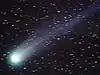
104P/Kowal
 Comet Kowal 2 photographed from the Zwicky Transient Facility on 12 February 2022 | |
| Discovery[1] | |
|---|---|
| Discovered by | Charles T. Kowal |
| Discovery date | 13 January 1979 |
| Designations | |
| P/1979 B1, P/1991 X1 | |
| |
| Orbital characteristics[2][3] | |
| Epoch | November 21, 2025 |
| Observation arc | 4,685 days (12.83 yr) |
| Earliest precovery date | 11 January 1973[4] |
| Number of observations | 2241 |
| Aphelion | 5.345 AU |
| Perihelion | 1.072 AU |
| Semi-major axis | 3.209 AU |
| Eccentricity | 0.6659 |
| Orbital period | 5.75 yr |
| Inclination | 5.70° |
| 207.2° | |
| Argument of periapsis | 227.3° |
| Mean anomaly | 241.5 |
| Last perihelion | 11 January 2022 |
| Next perihelion | 12 October 2027[5] |
| TJupiter | 2.789 |
| Earth MOID | 0.111 AU (16.6 million km) |
| Jupiter MOID | 0.288 AU (43.1 million km) |
| Physical characteristics[6] | |
| Dimensions | 2.0±1.0 km |
| Comet total magnitude (M1) | 10.5 |
104P/Kowal, also known as Kowal 2, is a periodic Jupiter-family comet discovered by Charles T. Kowal in 1979. The orbit was confirmed after new sightings in 1991 and 1998.[7]
By July 2027, the comet should be around apparent magnitude 14.[8] At the perihelion passage on 12 October 2027 the solar elongation will be 66 degrees at a magnitude of approximately 11,[8][7] The comet should be observable with small telescopes.
Observational history
In 2003, Gary Kronk and Brian Marsden noticed that an object observed by Leo Boethin in 1973 was actually 104P/Kowal. From Boethin's report, it was apparent that comet Kowal 2 had been in a short, major outburst to apparent magnitude 9.5 in 1973.[4]
During the 1997–98 apparition, the comet was brighter than expected, reaching an apparent magnitude of 13 in mid January.[9] The comet wasn't observed during the 2010 apparition.[7] During the 2022 apparition, it brightened to a magnitude of 9.2 according to Chris Wyatt.[10]
Orbit
| Date of closest approach |
Jupiter distance (AU) |
Sun distance (AU) |
Velocity wrt Jupiter (km/s) |
Velocity wrt Sun (km/s) |
Uncertainty region (3-sigma) |
Reference |
|---|---|---|---|---|---|---|
| 1924-May-04 ± 3 days | 0.005 AU (750 thousand km; 460 thousand mi) | 5.32 AU (796 million km; 495 million mi) | 19.6 | 21.9 | ± 800000 km | Horizons |
The comet was in an orbit with a perihelion distance of 1.50 AU and an orbital period of 6.38 years until an approach to Jupiter on 15 January 1996 reduced both to 1.40 AU and 6.18 years respectively.[9] A further encounter with Jupiter on 4 July 2007 at a distance of 0.300 AU reduced the perihelion distance to 1.18 AU and the orbital period to 5.90 years. One more close approach to Jupiter on 30 May 2019 reduced the perihelion distance to 1.07 AU and orbital period to 5.74 years.[2]
References
- ↑ C. T. Kowal (30 January 1979). B. G. Marsden (ed.). "Comet Kowal (1979a)". IAU Circular. 3321 (1). Bibcode:1979IAUC.3321....1K.
- 1 2 3 "104P/Kowal 2 – Small-Body Database Lookup". ssd.jpl.nasa.gov. Jet Propulsion Laboratory. Archived from the original on 29 April 2026. Retrieved 16 July 2023.
- ↑ "104P/Kowal Orbit". Minor Planet Center. Retrieved 7 April 2017.
- 1 2 L. Boethin; G. W. Kronk (11 December 2003). B. G. Marsden (ed.). "Comet 104P/Kowal". IAU Circular. 8255 (1). Bibcode:2003IAUC.8255....1B.
- ↑ "Horizons Batch for 104P/Kowal 2 (90000956) on 2027-Oct-12" (Perihelion occurs when rdot flips from negative to positive). JPL Horizons. Retrieved 6 July 2023. (JPL#K222/11 Soln.date: 2023-Apr-05)
- ↑ P. L. Lamy; I. Toth; Y. R. Fernández; H. A. Weaver (2004). "The Sizes, Shapes, Albedos, and Colors of Cometary Nuclei". Comet II (PDF). University of Arizona Press. p. 238.
- 1 2 3 Yoshida, Seiichi (24 January 2016). "104P/Kowal 2". Aerith Comet Catalog. Retrieved 29 March 2016.
- 1 2 G. van Buitenen. "104P/Kowal". astro.vanbuitenen.nl. Retrieved 26 April 2026.
- 1 2 Kronk, Gary. "104P/Kowal 2". cometography.com. Retrieved 16 July 2023.
- ↑ Yoshida, Seiichi. "Weekly Information about Bright Comets (2022 Mar. 12: North)". www.aerith.net. Retrieved 16 July 2023.
External links
- 104P/Kowal at the JPL Small-Body Database
- 104P/Kowal 2 at Seiichi Yoshida's website
- 104P/Kowal at Gideon van Buitenen's website