Portal:Astronomy

Introduction

Astronomy is a natural science that studies celestial objects and the phenomena that occur in the cosmos. It uses mathematics, physics, and chemistry to explain their origin and their overall evolution. Objects of interest include planets, moons, stars, nebulae, galaxies, meteoroids, asteroids, and comets. Relevant phenomena include supernova explosions, gamma ray bursts, quasars, blazars, pulsars, and cosmic microwave background radiation. More generally, astronomy studies everything that originates beyond Earth's atmosphere. Cosmology is the branch of astronomy that studies the universe as a whole.
Astronomy is one of the oldest natural sciences. The early civilizations in recorded history made methodical observations of the night sky. These include the Egyptians, Babylonians, Greeks, Indians, Chinese, Maya, and many ancient indigenous peoples of the Americas. In the past, astronomy included disciplines as diverse as astrometry, celestial navigation, observational astronomy, and the making of calendars.
Astronomy is one of the few sciences in which amateurs play an active role. This is especially true for the discovery and observation of transient events. Amateur astronomers have helped with many important discoveries, such as finding new comets. (Full article...)
General images -
 Babylonian tablet in the British Museum recording Halley's Comet in 164 BC (from History of astronomy)
 This image contains two side-by-side pictures of the night sky comparing the effects of light pollution on the visibility of celestial objects. (from Amateur astronomy)
 Comparison of CMB (Cosmic microwave background) results from satellites COBE, WMAP and Planck documenting a progress in 1989–2013 (from History of astronomy)
 A voting session is conducted in 2006 International Astronomical Union's general assembly for determining a new definition of a planet (from Astronomer)
 The inflationary theory as an augmentation to the Big Bang theory was first proposed by Alan Guth of MIT. Inflation solves the 'horizon problem' by making the early universe much more compact than was assumed in the standard model. Given such smaller size, causal contact (i.e., thermal communication) would have been possible among all regions of the early universe. The image was an adaptation from various generic charts depicting the growth of the size of the observable universe, for both the standard model and inflationary model respectively, of the Big Bang theory. (from Physical cosmology)
 History of the Universe – gravitational waves are hypothesized to arise from cosmic inflation, a rapidly accelerated expansion just after the Big Bang (from Physical cosmology)
 The main platform at La Silla hosts a huge range of telescopes with which astronomers can explore the Universe. (from Observational astronomy)
 An example of a gravitational lens found in the DESI Legacy Surveys data. There are four sets of lensed images in DESI-090.9854-35.9683, corresponding to four distinct background galaxies—from the outermost giant red arc to the innermost bright blue arc, arranged in four concentric circles. All of them are gravitationally warped—or lensed—by the orange galaxy at the very center. Dark matter is expected to produce gravitational lensing also. (from Physical cosmology)
 Sunset at the equinox from the prehistoric site of Pizzo Vento at Fondachelli Fantina, Sicily (from History of astronomy)
 Places like Paranal Observatory offer crystal clear skies for observing astronomical objects with or without instruments. (from Amateur astronomy)
 50 cm refracting telescope at Nice Observatory (from Observational astronomy)
 Ultra HD photography taken at La Silla Observatory (from Observational astronomy)
 Amateur astronomy groups are often involved in outreach to introduce astronomy to the general public (from Amateur astronomy)

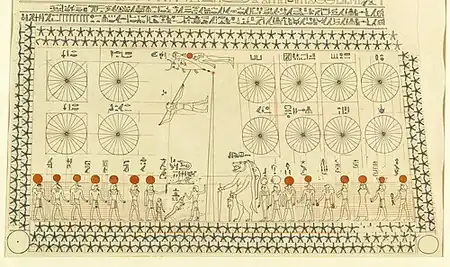 Segment of the astronomical ceiling of Senenmut's Tomb (circa 1479–1458 BC), depicting constellations, protective deities, and twenty-four segmented wheels for the hours of the day and the months of the year (from History of astronomy)
 ALMA is the world's most powerful telescope for studying the Universe at submillimeter and millimeter wavelengths. (from Observational astronomy)

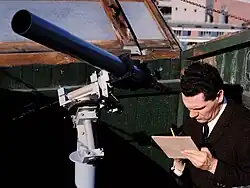 Amateur astronomer recording observations of the sun. (from Amateur astronomy)
 Artist conception of the Big Bang cosmological model, the most widely accepted out of all in physical cosmology (neither time nor size to scale) (from Physical cosmology)
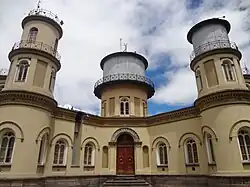 One of the Oldest Observatories in South America is the Quito Astronomical Observatory, founded in 1873 and located 12 minutes south of the Equator in Quito, Ecuador. The Quito Astronomical Observatory is the National Observatory of Ecuador and is located in the Historic Center of Quito and is managed by the National Polytechnic School. (from Observational astronomy)

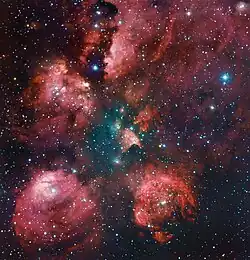 An image of the Cat's Paw Nebula created combining the work of professional and amateur astronomers. The image is the combination of the 2.2-metre MPG/ESO telescope of the La Silla Observatory in Chile and a 0.4-meter amateur telescope. (from Amateur astronomy)
 Overview of types of observational astronomy by observed wavelengths and their observability. (from Observational astronomy)
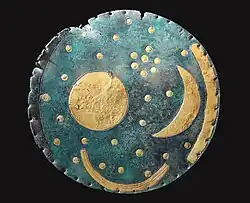 The Nebra sky disk, Germany, 1800–1600 BC (from History of astronomy)
 The Crab Nebula as seen in various wavelengths (from Observational astronomy)

 A map of the northern celestial hemisphere from Johann Bayer's 1661 edition of Uranometria, the first atlas to feature star charts covering the entire celestial sphere (from History of astronomy)
 Portrait of William Herschel, 1785 (from History of astronomy)
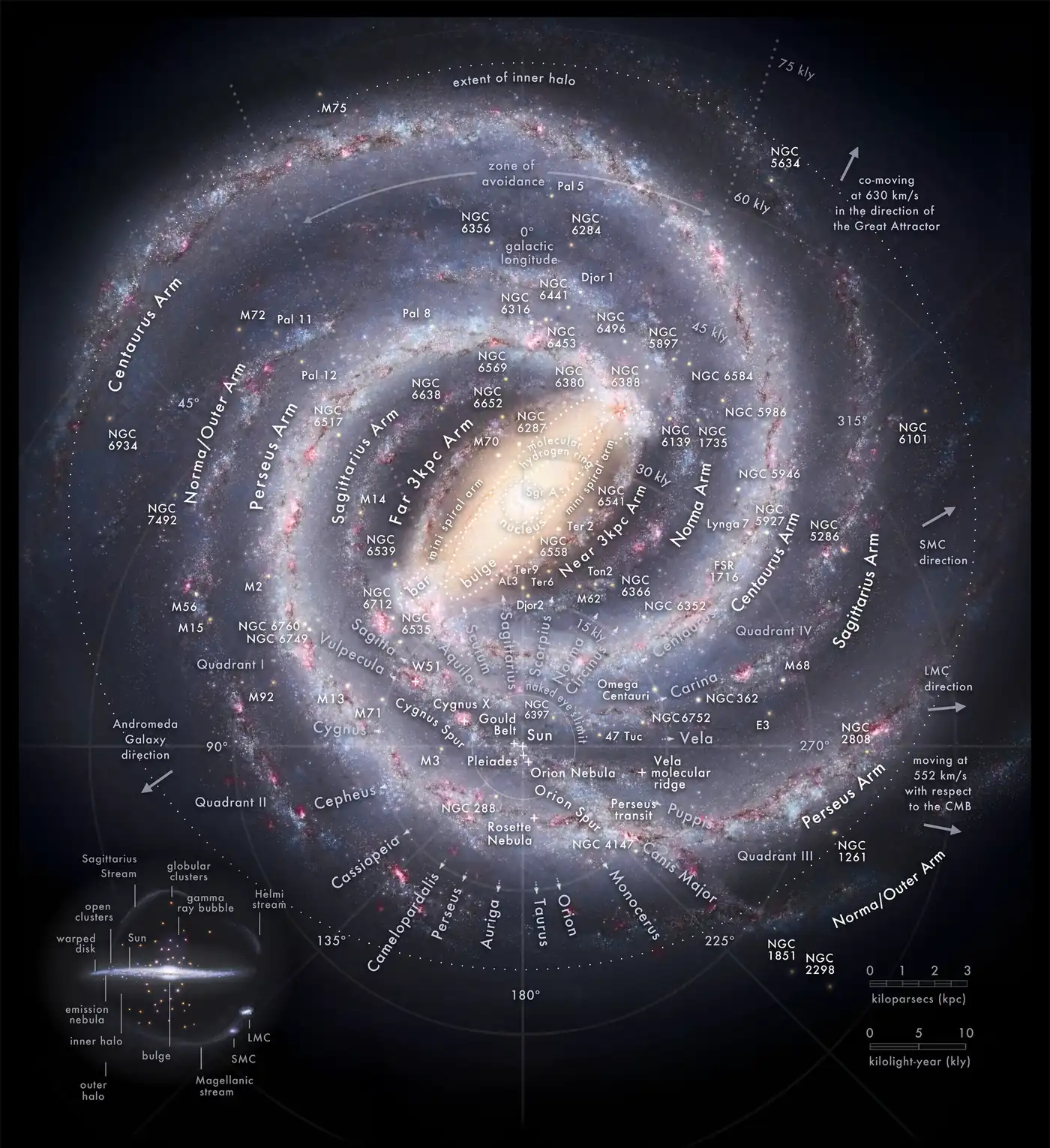 Map of the Milky Way Galaxy, with the constellations that cross the galactic plane in each direction and the known prominent components annotated including main arms, spurs, bar, nucleus/bulge, notable nebulae and globular clusters (from History of astronomy)


 An amateur astrophotography setup with an automated guide system connected to a laptop (from Observational astronomy)
 The Hubble Space Telescope (from History of astronomy)
 Megaliths from Nabta Playa, constructed by Neolithic populations, located in Aswan, Upper Egypt. Excavations of the megalith structures were completed in 2008. (from History of astronomy)
 9th-century diagram of the positions of the seven planets on 18 March 816, from the Leiden Aratea (from History of astronomy)
 A map of the southern celestial hemisphere, also by Bayer (from History of astronomy)
 Sir Patrick Moore was one of the world's leading popularisers of astronomy. (from Amateur astronomy)
 Featured article -

The atmosphere of Jupiter is the largest planetary atmosphere in the Solar System. It is mostly made of molecular hydrogen and helium in roughly solar proportions; other chemical compounds are present only in small amounts and include methane, ammonia, hydrogen sulfide, and water. Although water is thought to reside deep in the atmosphere, its directly-measured concentration is very low. The nitrogen, sulfur, and noble gas abundances in Jupiter's atmosphere exceed solar values by a factor of about three.
The atmosphere of Jupiter lacks a clear lower boundary, and gradually transitions into the liquid interior of the planet. From lowest to highest, the atmospheric layers are the troposphere, stratosphere, thermosphere and exosphere. Each layer has characteristic temperature gradients. The lowest layer, the troposphere, has a complicated system of clouds and hazes composed of layers of ammonia, ammonium hydrosulfide, and water. The upper ammonia clouds visible at Jupiter's surface are organized in a dozen zonal bands parallel to the equator and are bounded by powerful zonal atmospheric flows (winds) known as jets, exhibiting a phenomenon known as atmospheric super-rotation. The bands alternate in color: the dark bands are called belts, while light ones are called zones. Zones, which are colder than belts, correspond to upwellings, while belts mark descending gas. The zones' lighter color is believed to result from ammonia ice; what gives the belts their darker colors is uncertain. The origins of the banded structure and jets are not well understood, though a "shallow model" and a "deep model" exist. (Full article...)
Did you know -
- ... that the Lone Signal project sends messages by ordinary citizens to extraterrestrial civilizations using the Jamesburg Earth Station?
- ... that 6Q0B44E, a recently discovered satellite of Earth, is thought to be a large piece of space debris?
- ... that approximately one-third of nearby galaxies contain low-ionization nuclear emission-line regions?
- ... that lunar lava tubes could provide natural shelters for manned lunar habitats?
- ... that many geographic features on Campbell Island, New Zealand, were named for members of the French 1874 Transit of Venus astronomical expedition?
More Did you know (auto generated)

- ... that a group of K-pop fans performed a dance with the goal of convincing a company to commit to 100% renewable energy?
- ... that the majority of extrasolar planets in fiction are inhabited by native species?
- ... that the galaxy CDG-2 is over 99.9% dark matter, one of the highest proportions discovered?
- ... that Kim Ye-ji's performance in the 10 meter air pistol at the 2024 Summer Olympics led her to be dubbed the "coolest person on the planet"?
- ... that two competing hypotheses seek to explain the unusual orbit of the exoplanet Nu Octantis Ab?
- ... that in many works of fiction, the asteroid belt is the remnants of a destroyed planet?
WikiProjects
 |
 |
| WikiProject Astronomy | WikiProject Solar System |
|---|---|
 |
 |
| WikiProject Cosmology | WikiProject Spaceflight |
Selected image -

The five Moons of Pluto include Pluto's small satellite Hydra. Image is an artist's concept of the surface of Pluto, Hydra (center), Charon (right) and Nix (bright dot on left).
Astronomy News


- 12 August 2026 – MoM-BH*-1
- Astronomers studying a little red dot found by the James Webb Space Telescope announce in Nature the discovery of the first black hole star. The first object classed as such, [[MoM-BH;12 August 2026 – MoM-BH*-1
- -1]], in the constellation of Cetus, is the size of the Solar System and emits a light that outshines its host galaxy. (The Guardian) (PopSci)
- 16 July 2026 –
- Astronomers report the first observationally confirmed atmosphere around a rocky exoplanet within its star's habitable zone, after detecting helium escaping from the upper atmosphere of LHS 1140 b, a super-Earth approximately 49 light-years from Earth. (Space.com)
- 15 July 2026 – Discoveries of exoplanets
- Astronomers directly image the exoplanet Beta Pictoris d next to its star, located 63 light-years away, using NASA's James Webb Space Telescope and European Southern Observatory's Very Large Telescope. It is also reported to be fainter than its sibling Beta Pictoris b. The discovery is published in the The Astrophysical Journal. (ABC News) (Space.com)
- 13 July 2026 –
- Astronomers announce that an erythrulose molecule was detected inside a cloud of gas and dust near the center of the Milky Way. It is the first evidence of sugar in interstellar space. (Nature)
- 16 June 2026 – Discoveries of exoplanets
- The NASA's James Webb Space Telescope discovers that the Hot Jupiter exoplanet HD 80606 b is being roasted by its home star. The research findings were presented at the 248th American Astronomical Society in Pasedena, California, U.S. (Space.com)
- 3 March 2026 –
- Astronomers announce the discovery 1,900 light-years from Earth of TIC 120362137, the tightest known quadruple star system, using data from NASA's Transiting Exoplanet Survey Satellite. (Space.com)
August anniversaries
- 4 August 2007 – The Phoenix Mars Lander is launched from Cape Canaveral, carrying science instruments to analyze soil samples of the Martian northern polar region
- 6 August 2012 – The Mars rover Curiosity lands on the Red Planet as part of NASA's Mars Science Laboratory mission
- 7 August 1996 – Announcement of possible microfossils found in ALH84001 Martian Meteorite
- 20 August 1977 – Voyager 2 space probe is launched by NASA to study the outer planets and interstellar space beyond the Sun's heliosphere
- 21 August 2017 – NASA.gov conducts a broadcast of the total solar eclipse with more than 50 million views of the live broadcast, and almost 31 million unique views on Facebook before and after the eclipse
- 24 August 2006 – The International Astronomical Union votes to approve a new definition of "planet" that excludes Pluto
- 25 August 2003 – The Spitzer Space Telescope (SIRTF) is launched, dedicated to infrared astronomy
- 27 August 1962 – Mariner 2 launches on a journey to Venus, and is the first robotic space probe to conduct a successful planetary encounter
- 31 August 1913 – Bernard Lovell, a British physicist and radio astronomer is born
Space-related Portals
Astronomical events
All times UT unless otherwise specified. Portal:Astronomy/Events/August 2026

Topics
| Astronomy by |
| ||||||||||
|---|---|---|---|---|---|---|---|---|---|---|---|
| Optical telescopes | |||||||||||
| Related |
| ||||||||||
Subcategories
Things you can do
|
Here are some Open Tasks :
Astronomy featured article candidates:
Astronomy articles for which peer review has been requested:
|
Wikibooks

These books may be in various stages of development. See also the related Science and Mathematics bookshelves.
- Astronomy
- GAT: A Glossary of Astronomical Terms
- Introduction to Astrophysics
- General relativity
- Observing the Sky from 30°S
- Observing the Sky from 40°N
Wikijunior
Associated Wikimedia
The following Wikimedia Foundation sister projects provide more on this subject:
-
 Commons
Free media repository -
 Wikidata
Free knowledge base -
 Wikiquote
Collection of quotations -
 Wikisource
Free-content library -
 Wikiversity
Free learning tools -
 Wiktionary
Dictionary and thesaurus
-
 List of all portals
-

-

-

-

-

-

-

-

-

-
 Random portal
-
 WikiProject Portals
Shortcuts to this page: Astronomy portal • P:ASTRO