Portal:History

The History Portal

History is the systematic study of the past, focusing primarily on the human past. As an academic discipline, it analyses and interprets evidence to construct narratives about what happened and explain why it happened. Some theorists categorize history as a social science, while others see it as part of the humanities or consider it a hybrid discipline. Similar debates surround the purpose of history—for example, whether its main aim is theoretical, to uncover the truth, or practical, to learn lessons from the past. In a more general sense, the term history refers not to an academic field but to the past itself, times in the past, or to individual texts about the past.
Historical research relies on primary and secondary sources to reconstruct past events and validate interpretations. Source criticism is used to evaluate these sources, assessing their authenticity, content, and reliability. Historians strive to integrate the perspectives of several sources to develop a coherent narrative. Different schools of thought, such as positivism, the Annales school, Marxism, and postmodernism, have distinct methodological approaches.
History is a broad discipline encompassing many branches. Some focus on specific time periods, such as ancient history, while others concentrate on particular geographic regions, such as the history of Africa. Thematic categorizations include political history, military history, social history, and economic history. Branches associated with specific research methods and sources include quantitative history, comparative history, and oral history.
History emerged as a field of inquiry in antiquity to replace myth-infused narratives, with influential early traditions originating in Greece, China, and later in the Islamic world. Historical writing evolved throughout the ages and became increasingly professional, particularly during the 19th century, when a rigorous methodology and various academic institutions were established. History is related to many fields, including historiography, philosophy, education, politics, and archaeology. (Full article...)
 Featured articles –


Roman painting from the House of Giuseppe II, Pompeii, early 1st century AD, most likely depicting Cleopatra VII, wearing her royal diadem, consuming poison in an act of suicide, while her son Caesarion, also wearing a royal diadem, stands behind her
Cleopatra VII, the last ruler of the Ptolemaic Kingdom of Egypt, died on either 10 or 12 August, 30 BC, in Alexandria, when she was 39 years old. According to popular belief, Cleopatra killed herself by allowing an asp (Egyptian cobra) to bite her, but according to the Roman-era writers Strabo, Plutarch, and Cassius Dio, Cleopatra poisoned herself using either a toxic ointment or by introducing the poison with a sharp implement such as a hairpin. Modern scholars debate the validity of ancient reports involving snakebites as the cause of death and whether she was murdered. Some academics hypothesize that her Roman political rival Octavian (later Emperor Augustus) forced her to kill herself in a manner of her choosing. The location of Cleopatra's tomb is unknown. It was recorded that Octavian allowed for her and her husband, the Roman politician and general Mark Antony, who stabbed himself with a sword, to be buried together properly.
Cleopatra's death effectively ended the final war of the Roman Republic between the remaining triumvirs Octavian and Antony, in which Cleopatra aligned herself with Antony. Antony and Cleopatra fled to Egypt following their loss at the 31 BC Battle of Actium in Roman Greece, after which Octavian invaded Egypt and defeated their forces. Committing suicide allowed her to avoid the humiliation of being paraded as a prisoner in a Roman triumph celebrating the military victories of Octavian, who would become Rome's first emperor in 27 BC and be known as Augustus. Octavian, rival heir of Julius Caesar had Cleopatra's son Caesarion (also known as Ptolemy XV) killed in Egypt but spared her three children with Antony and brought them to Rome. Cleopatra's death marked the end of the Hellenistic period and Ptolemaic rule of Egypt, as well as the beginning of Roman Egypt, which became a province of the Roman Empire. (Full article...)
SMS Scharnhorst was an armored cruiser of the Imperial German Navy, built at the Blohm & Voss shipyard in Hamburg, Germany. She was the lead ship of her class, which included SMS Gneisenau. Scharnhorst and her sister were enlarged versions of the preceding Roon class; they were equipped with a greater number of main guns and were capable of a higher top speed. The ship was named after the Prussian military reformer General Gerhard von Scharnhorst and commissioned into service on 24 October 1907.
Scharnhorst served briefly with the High Seas Fleet in Germany in 1908, though most of this time was spent conducting sea trials. She was assigned to the East Asia Squadron based in Qingdao, China, in 1909. After arriving, she replaced the cruiser Fürst Bismarck as the squadron flagship, a position she would hold for the rest of her career. Over the next five years, she went on several tours of various Asian ports to show the flag for Germany. She frequently carried the squadron commanders to meet Asian heads of state and was present in Japan for the coronation of the Taishō Emperor in 1912. (Full article...)
The Battle of Goodenough Island (22–27 October 1942), also known as Operation Drake, was a battle of the Pacific campaign of World War II. The Allies landed on Goodenough Island, Papua, and clashed with a Japanese Kaigun Rikusentai (Special Naval Landing Force). The Japanese troops had been stranded on the island during the Battle of Milne Bay in late August 1942. "Drake Force", consisting of the Australian 2/12th Battalion and attachments, landed on the southern tip of Goodenough Island at Mud Bay and Taleba Bay on 22 October, tasked with denying the Japanese use of the island prior to the Buna campaign. Following a short but intense fight, the Japanese forces withdrew to Fergusson Island on 27 October. After the battle, Goodenough Island was developed into a major Allied base for operations later in the war. (Full article...)
Humphrey Stafford, 1st Duke of Buckingham, 6th Earl of Stafford, 7th Baron Stafford (15 August 1402 – 10 July 1460) of Stafford Castle in Staffordshire, was an English nobleman and a military commander in the Hundred Years' War and the Wars of the Roses. Through his mother he was of royal descent from King Edward III, his great-grandfather, while from his father, he inherited, at an early age, the earldom of Stafford. By his marriage to a daughter of Ralph, Earl of Westmorland, Humphrey was related to the powerful Neville family and to many of the leading aristocratic houses of the time. He joined the English campaign in France with King Henry V in 1420. Following Henry V's death two years later he became a councillor for the new king, the nine-month-old Henry VI. Stafford acted as a peacemaker during the factional politics of the 1430s, when Humphrey, Duke of Gloucester, vied with Cardinal Beaufort for political supremacy. Stafford also took part in the eventual arrest of Gloucester in 1447.
Stafford returned to the French campaign during the 1430s, and for his loyalty he was elevated from Earl of Stafford to Duke of Buckingham. Around the same time, his mother died. As much of his estate—as her dower—had previously been in her hands, Humphrey went from having a reduced income in his early years to being one of the wealthiest and most powerful landowners in England. His lands stretched across much of the country, ranging from East Anglia to the Welsh border. Being such an important figure in the localities was not without its dangers and for some time he feuded violently with Sir Thomas Malory in the Midlands. (Full article...)
The tree of life as depicted by Ernst Haeckel in The Evolution of Man (1879) illustrates the 19th-century view of evolution as a progressive process leading towards man.
Evolutionary thought, the recognition that species change over time and the perceived understanding of how such processes work, has roots in antiquity. With the beginnings of modern biological taxonomy in the late 17th century, two opposed ideas influenced Western biological thinking: essentialism, the belief that every species has essential characteristics that are unalterable, a concept which had developed from medieval Aristotelian metaphysics, and that fit well with natural theology; and the development of the new anti-Aristotelian approach to science. Naturalists began to focus on the variability of species; the emergence of palaeontology with the concept of extinction further undermined static views of nature. In the early 19th century prior to Darwinism, Jean-Baptiste Lamarck proposed his theory of the transmutation of species, the first fully formed theory of evolution.
In 1858 Charles Darwin and Alfred Russel Wallace published a new evolutionary theory, explained in detail in Darwin's On the Origin of Species (1859). Darwin's theory, originally called descent with modification, is known contemporarily as Darwinism or Darwinian theory. Unlike Lamarck, Darwin proposed common descent and a branching tree of life, meaning that two very different species could share a common ancestor. Darwin based his theory on the idea of natural selection: it synthesized a broad range of evidence from animal husbandry, biogeography, geology, morphology, and embryology. Debate over Darwin's work led to the rapid acceptance of the general concept of evolution, but the specific mechanism he proposed, natural selection, was not widely accepted until it was revived by developments in biology that occurred during the 1920s through the 1940s. Before that time most biologists regarded other factors as responsible for evolution. Alternatives to natural selection suggested during "the eclipse of Darwinism" (c. 1880 to 1920) included inheritance of acquired characteristics (neo-Lamarckism), an innate drive for change (orthogenesis), and sudden large mutations (saltationism). Mendelian genetics, a series of 19th-century experiments with pea plant variations rediscovered in 1900, was integrated with natural selection by Ronald Fisher, J. B. S. Haldane, and Sewall Wright during the 1910s to 1930s, and resulted in the founding of the new discipline of population genetics. During the 1930s and 1940s population genetics became integrated with other biological fields, resulting in a widely applicable theory of evolution that encompassed much of biology—the modern synthesis. (Full article...)
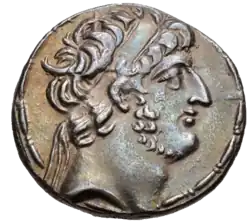
Demetrius III Theos Philopator Soter Philometor Euergetes Callinicus (Ancient Greek: Δημήτριος θεός Φιλοπάτωρ σωτήρ Φιλομήτωρ Εὐεργέτης Καλλίνικος, surnamed Eucaerus; between 124 and 109 BC – after 87 BC) was a Seleucid monarch who reigned as the King of Syria between 96 and 87 BC. The son of Antiochus VIII, he took control of Damascus after his father's murder while his brother Seleucus VI prepared for war against their father's half-brother and rival, Antiochus IX, who occupied the Syrian capital Antioch.
The civil war dragged on; Seleucus VI eliminated his uncle, whose heir Antiochus X counterattacked and drove Seleucus VI to his death. Then the twins Antiochus XI and Philip I, brothers of Demetrius III, attempted to avenge Seleucus VI; it ended with the death of Antiochus XI and the interference of Demetrius III on the side of Philip I in a war against Antiochus X that probably lasted until 88 BC. In 89 BC, Demetrius III invaded Judaea and crushed the forces of its king, Alexander Jannaeus; his near victory was cut short by the death of Antiochus X. Demetrius III rushed to Antioch before Philip I could take advantage of the power vacuum and strengthen his position relative to Demetrius III. (Full article...)
The 4th Army was a Royal Yugoslav Army formation mobilised prior to the German-led Axis invasion of the Kingdom of Yugoslavia during World War II. It was drawn from the peacetime 4th Army District. When mobilised, it consisted of three divisions, a brigade-strength detachment, one horse cavalry regiment and one independent infantry regiment. It formed part of the 1st Army Group, and was responsible for defending a large section of the Yugoslav–Hungarian border, being deployed behind the Drava river between Varaždin and Slatina. Like all Yugoslav formations at the time, the 4th Army had serious deficiencies in both mobility and firepower.
Despite concerns over a possible Axis invasion, orders for the general mobilisation of the Royal Yugoslav Army were not issued by the government until 3 April 1941, in order to not provoke Germany any further following the military coup d'état and precipitate war. When the invasion commenced on 6 April, the 4th Army was only partially mobilised, and this weakness was exacerbated by fifth-column activities within its major units and higher headquarters. Revolts of Croat soldiers broke out in all three divisions in the first few days, causing significant disruption to their mobilisation and deployment. The town of Bjelovar was taken over by rebel troops. Widespread desertions of Croat troops, many of whom turned on their Serb comrades, made control even more difficult. German activity in the 4th Army sector in the first four days included limited objective attacks to seize crossings over the Mura and Drava rivers, along with air attacks by the Luftwaffe. (Full article...)
A clay tessera bearing a possible depiction of Odaenathus wearing a diadem
Odaenathus, the king of Palmyra from 260 to 267 CE, has been identified by modern scholars as the subject of sculptures, seal impressions, and mosaic pieces. His city was part of the Roman Empire, and he came to dominate the Roman East when in 260 he defeated Shapur I, the Sasanian emperor of Persia, who had invaded the Roman Empire. Odaenathus besieged the Sasanian capital Ctesiphon in 263, and although the city did not fall, the campaign led to a full restoration of Roman provinces taken by Shapur I. In the aftermath of his Persian war, Odaenathus assumed the title King of Kings, which was a challenge to the Persian monarch's claims of authority in the region. Odaenathus ruled the Roman East unopposed with imperial consent. In 267, he was assassinated alongside his eldest son Herodianus while conducting a campaign against Germanic raiders in Bithynia; he was succeeded by his son Vaballathus under the regency of the widow queen Zenobia.
Palmyrene portraits were usually abstract, depicting little individuality. Most reported portraits of Odaenathus are undated and have no inscriptions, making identification speculative. Generally, the criteria for determining whether a piece represents the king are its material (imported marble, in contrast to local limestone) and iconography, such as the presence of royal attributes (crowns or diadems). Several limestone head portraits from Palmyra were identified by several twentieth-century scholars as depicting Odaenathus, based on criteria such as the size of the portrait and the presence of a wreath; the latter element was not special in Palmyrene portraits, as priests were also depicted with wreaths. More recent research on the limestone portraits indicates that these pieces were probably funerary objects depicting private citizens. (Full article...)- Air Marshal Selwyn David Evans, AC, DSO, AFC (3 June 1925 – 2 September 2020) was a senior commander of the Royal Australian Air Force (RAAF), and a writer and consultant on defence matters. He served as Chief of the Air Staff from 1982 to 1985. After leaving the RAAF, he published two military treatises, A Fatal Rivalry: Australia's Defence at Risk and War: A Matter of Principles, as well as an autobiography.
Enlisting in the Air Force in 1943, Evans graduated from flying school as a sergeant pilot, and was converting to Beaufort bombers when World War II ended. He gained his commission as a pilot officer in 1947. From 1948 to 1949, he was a member of the Australian contingent operating C-47 Dakota transports in the Berlin Airlift. He was a flying instructor in the early 1950s, before becoming a VIP captain with the Governor-General's Flight in 1954. His service in the flight earned him the Air Force Cross in 1957. In the 1960s Evans was twice posted to No. 2 Squadron, flying Canberra jet bombers, first as a flight commander when the unit was based in Malaysia from 1960 to 1962, then as its commanding officer during the Vietnam War from 1967 to 1968. The Canberras achieved a high degree of accuracy on their bombing missions under his leadership, and he was awarded the Distinguished Service Order after completing his tour in Vietnam. (Full article...) - Castell Coch (Welsh for 'red castle'; Welsh pronunciation: [ˈkas.tɛɬ koːχ]) is a 19th-century Gothic Revival castle built above the village of Tongwynlais in Wales. The first castle on the site was built by the Normans after 1081 to protect the newly conquered town of Cardiff and control the route along the River Taff. Abandoned shortly afterwards, the castle's earth motte was reused by Gilbert de Clare as the basis for a new stone fortification, which he built between 1267 and 1277 to control his freshly annexed Welsh lands. This castle may have been destroyed in the native Welsh rebellion of 1314. In 1760, the castle ruins were acquired by John Stuart, 3rd Earl of Bute, as part of a marriage settlement that brought the family vast estates in South Wales.
John Crichton-Stuart, 3rd Marquess of Bute, inherited the castle in 1848. One of Britain's wealthiest men, with interests in architecture and antiquarian studies, he employed the architect William Burges to rebuild the castle, "as a country residence for occasional occupation in the summer", using the medieval remains as a basis for the design. Burges rebuilt the outside of the castle between 1875 and 1879, before turning to the interior; he died in 1881 and the work was finished by Burges's remaining team in 1891. Bute reintroduced commercial viticulture into Britain, planting a vineyard just below the castle, and wine production continued until the First World War. He made little use of his new retreat, and in 1950 his grandson, the 5th Marquess of Bute, placed it into the care of the state. It is now controlled by the Welsh heritage agency Cadw. (Full article...)
James VI and I (James Charles Stuart; 19 June 1566 – 27 March 1625) was King of Scotland as James VI from 24 July 1567, and King of England and Ireland as James I from the union of the Scottish and English crowns on 24 March 1603, until his death in 1625. Though he long attempted to get both countries to adopt a closer political union, the kingdoms of Scotland and England remained sovereign states ruled by James in personal union, with their own parliaments, judiciaries and laws.
James was the son of Mary, Queen of Scots, and a great-great-grandson of Henry VII, King of England and Lord of Ireland, and thus a potential successor to all three thrones. He acceded to the Scottish throne at the age of thirteen months, after his mother was forced to abdicate. Although his mother was a Catholic, James was raised as a Protestant. Four regents governed during his minority, which ended officially in 1578, though he did not gain full control of his government until 1583. In 1589, he married Anne of Denmark. Three of their children survived to adulthood: Henry Frederick, Elizabeth, and Charles. In 1603, James succeeded his cousin Elizabeth I, the last Tudor monarch of England and Ireland, who had died childless. He reigned in all three kingdoms for 22 years, a period known as the Jacobean era, until he died in 1625. After the Union of the Crowns in 1603, he based himself in England, returning to Scotland only once in 1617, and styled himself King of Great Britain and Ireland. He advocated for a single parliament for England and Scotland. During his reign, the Plantation of Ulster and the English colonisation of the Americas began. (Full article...)
USS New Jersey (BB-62) is an Iowa-class battleship and the second ship of the United States Navy to be named after the U.S. state of New Jersey. She was often referred to fondly as "Big J". New Jersey earned more battle stars for combat actions than the other three completed Iowa-class battleships, and was the only US battleship used to provide gunfire support during the Vietnam War.
During World War II, New Jersey shelled targets on Guam and Okinawa, and screened aircraft carriers conducting raids in the Marshall Islands. During the Korean War, she was involved in raids along the North Korean coast, after which she was decommissioned into the United States Navy reserve fleets, better known as the "mothball fleet". She was briefly reactivated in 1968 and sent to Vietnam to support US troops before returning to the mothball fleet in 1969. Reactivated once more in the 1980s as part of the 600-ship Navy program, New Jersey was modernized to carry missiles and recommissioned for service. In 1983, she participated in US operations during the Lebanese Civil War. (Full article...)- Samuel Jackson Randall (October 10, 1828 – April 13, 1890) was an American politician from Pennsylvania who represented the Queen Village, Society Hill, and Northern Liberties neighborhoods of Philadelphia from 1863 to 1890 and served as the 29th speaker of the United States House of Representatives from 1876 to 1881. He was a contender for the Democratic Party nomination for President of the United States in 1880 and 1884.
Born in Philadelphia to a family active in Whig politics, Randall shifted to the Democratic Party after the Whigs' demise. His rise in politics began in the 1850s with election to the Philadelphia Common Council and then to the Pennsylvania State Senate for the 1st district. Randall served in a Union cavalry unit in the American Civil War before winning a seat in the federal House of Representatives in 1862. He was re-elected every two years thereafter until his death. The representative of an industrial region, Randall became known as a staunch defender of protective tariffs designed to assist domestic producers of manufactured goods. While often siding with Republicans on tariff issues, he differed with them in his resistance to Reconstruction and the growth of federal power. (Full article...)
The Royal Australian Air Force (RAAF) has operated forty-eight Lockheed C-130 Hercules transport aircraft. The type entered Australian service in December 1958, when No. 36 Squadron accepted the first of twelve C-130As, replacing its venerable Douglas C-47 Dakotas. The acquisition made Australia the first operator of the Hercules after the United States. In 1966 the C-130As were joined by twelve C-130Es, which equipped No. 37 Squadron. The C-130As were replaced by twelve C-130Hs in 1978, and the C-130Es by twelve C-130J Super Hercules in 1999. No. 37 Squadron became the RAAF's sole Hercules operator in 2006, when No. 36 Squadron transferred its C-130Hs before converting to Boeing C-17 Globemaster III heavy transports. The C-130Hs were retired in November 2012, leaving the C-130J as the only model in Australian service. A further twenty C-130Js will be ordered to replace the current fleet.
The RAAF's first strategic airlifter, the Hercules has frequently been used to deliver disaster relief in Australia and the Pacific region, as well as to support military deployments overseas. The aircraft saw extensive service during the Vietnam War, transporting troops and cargo to Southeast Asia and undertaking aeromedical evacuation. Nineteen of the RAAF's fleet of twenty-four C-130s took part in relief efforts in 1974–75 after Cyclone Tracy struck Darwin. Since then, the Hercules have been involved in humanitarian missions to New Guinea, Ethiopia, Rwanda, Cambodia, Bali, Sumatra, and New Zealand. They have also seen service during the Iranian Revolution in 1979, the Fijian coups in 1987, operations in Somalia in 1993, INTERFET operations in East Timor in 1999–2000, and the wars in Afghanistan and Iraq from 2001 to 2021. In over fifty years of Australian service, the Hercules have accumulated more than 800,000 flying hours. (Full article...)
Helicopter 66 was a United States Navy Sikorsky Sea King helicopter used during the late 1960s for the water recovery of astronauts during five missions of the Apollo program. It has been called "one of the most famous, or at least most iconic, helicopters in history", was the subject of a 1969 song by Manuela, and was made into a die-cast model by Dinky Toys. In addition to its work in support of NASA, Helicopter 66 also transported the Shah of Iran during his 1973 visit to the aircraft carrier USS Kitty Hawk.
Helicopter 66 was delivered to the U.S. Navy in 1967 and formed part of the inventory of U.S. Navy Helicopter Anti-Submarine Squadron Four for the duration of its active life. Among its pilots during this period was Donald S. Jones, who would go on to command the United States Third Fleet. Later re-numbered Helicopter 740, the aircraft crashed in the Pacific Ocean in 1975 during a training exercise. At the time of its crash, it had logged more than 3,200 hours of service. (Full article...)




Featured picture
 Photo credit: Gustaf NordenskiöldAn 1891 photograph of Cliff Palace, the largest cliff dwelling—a structure built within caves and under outcroppings in cliffs—in North America, located in what is now Mesa Verde National Park, Colorado, USA. There are about 150 rooms in the 288 ft (88 m) long structure, although only 25 to 30 of those were used as living space by Ancient Pueblo peoples. it is estimated that the population of Cliff Palace was roughly 100–150 people.
 Mosaic: UnknownAlexander the Great (356–323 BC), the King of Macedonia, as depicted in a detail from the Alexander Mosaic. Originally from the House of the Faun in Pompeii and dated to c. 100 BC, the mosaic depicts a battle between the armies of Alexander the Great and Darius III of Persia. It is believed to be a copy of an early 3rd century BC Hellenistic painting, probably by Philoxenos of Eretria. The whole mosaic measures 2.72 × 5.13 m (8 ft 11 in × 16 ft 9 in).
 Photograph: Andrew ShivaAn aerial view of Masada, an ancient fortification in the Southern District of Israel. Found atop an isolated rock plateau, it overlooks the Dead Sea. The first fortifications on the mountain were built by Alexander Jannaeus, and significantly strengthened by the Roman client king Herod between 37 and 31 BCE. During the First Jewish–Roman War of 66–73 CE, the fortress was besieged, falling only after the 960 Sicarii defending it committed mass suicide.
Masada is among the more popular tourist attractions in Israel, and in 2001 it was made a UNESCO World Heritage Site. Painting by Benjamin HaydonBenjamin Haydon's painting of Thomas Clarkson addressing the 1840 Anti-Slavery Convention, held by the Anti-Slavery Society at Exeter Hall in London. The organisation was the second to bear that name and was dedicated to the abolishment of slavery worldwide. It continues to function today as Anti-Slavery International.
 Photo: Philip PikartThe Nefertiti Bust is a 3300-year-old painted limestone bust of Nefertiti, the Great Royal Wife of the Pharaoh Akhenaten and one of the most copied works of Ancient Egypt. It is believed to have been crafted in 1345 BC by the sculptor Thutmose, in whose workshop it was discovered in 1912 by a German archaeological team led by Ludwig Borchardt. It is part of the Egyptian Museum of Berlin collection, currently on display in the Neues Museum and has been the subject of an intense argument between Egypt and Germany over the Egyptian demands for its repatriation.
 Photo credit: Frank HurleyA group of Australian infantry wearing Small Box Respirators (SBRs) at the Third Battle of Ypres in September 1917. After the introduction of poison gas in World War I, countermeasures were developed. SBRs represented the pinnacle of gas mask development during the war, a mouthpiece connected via a hose to a box filter (hanging around the wearer's neck in this picture), which in turn contained granules of chemicals that neutralised the gas. The SBR was the prized possession of the ordinary infantryman; when the British were forced to retreat during the German Spring Offensive of 1918, it was found that while some troops had discarded their rifles, hardly any had left behind their respirators.
 Photo: William Henry Jackson; Restoration: Lise BroerA man climbs a statue of a Buddhist idol at Borobudur, a 9th-century Mahayana Buddhist monument near Magelang, Central Java, Indonesia, in this 1895 hand-tinted lantern slide. The monument comprises six square platforms topped by three circular platforms, and is decorated with 2,672 relief panels and 504 Buddha statues. The monument is both a shrine to the Lord Buddha and a place for Buddhist pilgrimage. Evidence suggests Borobudur was abandoned following the 14th-century decline of Buddhist and Hindu kingdoms in Java, and the Javanese conversion to Islam. The monument is a UNESCO World Heritage Site and is the most popular tourist attraction in the country.
 Chromolithograph: Romanet & cie.A 19th-century set of ten cards depicting events in the history of ballooning and parachuting. These cards depict, from left to right:
Top row:- Joseph Louis Gay-Lussac and Jean-Baptiste Biot reaching an altitude of 4,000 metres (13,000 ft) (1804)
- André-Jacques Garnerin making a parachute descent in his gondola (1797)
- Louis-Sébastien Lenormand making the first witnessed parachute descent (1783)
- A series of fantastic flying machines dreamed up during the 18th century
- Use of balloons for reconnaissance during the Battle of Mainz (1795)
Bottom row:- The coronation balloon of Napoleon I (1804)
- The death of Sophie Blanchard (1819)
- Francesco Zambeccari and two companions adrift in the Adriatic Sea (1804)
- The death of Thomas Harris (1824)
- Francesco Arban is rescued by Italian fishermen (1846)
 Photo credit: Anthony FialaA panorama from the Ziegler Polar Expedition of 1903–05, an unsuccessful attempt to reach the North Pole. The party remained stranded north of the Arctic Circle for two years before being rescued, yet all but one of its members survived.
 A Chola dynasty sculpture depicting Shiva. In Hinduism, Shiva is the deity of destruction and one of the most important gods; in this sculpture he is dancing as Nataraja, the divine dancer who unravels the world in preparation for it being remade by Brahma.
 Photo: Martin St-AmantMachu Picchu, with the peak Huayna Picchu behind it. Perhaps the most famous Inca site, Machu Picchu is situated on a mountain ridge above the Urubamba Valley in Peru. It was probably built as an estate for the Inca emperor Pachacuti in the 15th century, but abandoned soon after during the Spanish conquest of the Inca Empire. Although known locally, it was unknown to the outside world before being brought to international attention in 1911 by the American historian Hiram Bingham, and it is now an important tourist attraction.
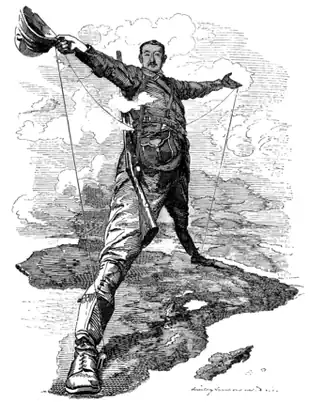 Illustration: Edward Linley SambourneThe Rhodes Colossus is an iconic editorial cartoon of the Scramble for Africa period, depicting British colonialist Cecil John Rhodes as a giant standing over the continent, after his announcement of plans to extend an electrical telegraph line from Cape Town to Cairo. Rhodes is shown in a visual pun as the ancient Greek statue the Colossus of Rhodes, with his right foot in Cape Town and his left in Cairo, illustrating his broader "Cape to Cairo" concept for British domination of Africa.
 The "Theatre" at PetraPhoto: Douglas PerkinsPetra is an archaeological site in Jordan, lying in a basin among the mountains which form the eastern flank of Wadi Araba, the great valley running from the Dead Sea to the Gulf of Aqaba. It is famous for having many stone structures carved into the rock.
 Graphic: Arne NordmannA color visual interpretation of the digital signal in the Arecibo message, sent in 1974 from the Arecibo Observatory. Broadcast into space via frequency modulated radio waves at a ceremony to mark the remodeling of the Arecibo radio telescope in Puerto Rico, the message consisted of 1,679 binary digits, approximately 210 bytes, transmitted at a frequency of 2,380 MHz. It was aimed at the Great Globular Cluster in Hercules, some 25,000 light-years away, and contains information related to mathematics, chemistry, and astronomy.
 Photo credit: USHMMJews captured by SS and SD troops during the suppression of the Warsaw Ghetto Uprising are forced to leave their shelter and march to the Umschlagplatz for deportation. The SD trooper pictured second from the right, is Josef Blösche, who was identified by Polish authorities using this photograph. Blösche was tried for war crimes in Erfurt, East Germany in 1969, sentenced to death and executed in July of that year.
 Artist: UnknownA 1786 depiction of the first hot air balloon to carry humans, built by the Montgolfier brothers of Annonay, France. The flight occurred on 21 November 1783 from the grounds of the Château de la Muette in the western outskirts of Paris. Jean-François Pilâtre de Rozier, a physician, and François Laurent d'Arlandes, an army officer, flew aloft about 3,000 feet (1,000 m) above the city for a distance of 9 kilometres (6 mi), with a total flying time of 25 minutes.
 Map credit: Konstantinos PlakidasA map of Constantinople, the capital of the Byzantine Empire. Throughout the Middle Ages, Constantinople, strategically located between the Golden Horn and the Sea of Marmara at the point where Europe meets Asia, was Europe's largest and wealthiest city. It was officially renamed to its modern name Istanbul (Turkish: İstanbul) in 1930.
 Photograph credit: Neil ArmstrongApollo 11 was the fifth crewed mission of NASA's Apollo program. After launching from the Kennedy Space Center in Florida on July 16, 1969, commander Neil Armstrong and Apollo Lunar Module pilot Buzz Aldrin landed Eagle in Mare Tranquillitatis on July 20, at 20:17:40 UTC, while command module pilot Michael Collins remained on Columbia in lunar orbit. Armstrong was the first to exit the spacecraft, stepping onto the surface 6 hours and 39 minutes later, on July 21, at 02:56:15 UTC; nineteen minutes later, Aldrin joined him on extravehicular activity, which lasted 2 hours, 31 minutes and 40 seconds. Armstrong and Aldrin lifted off from Tranquility Base after almost 22 hours on the lunar surface and rejoined Collins in the command module, before splashing down in the Pacific Ocean on July 24.
The mission was planned to the minute, with the majority of the photographic tasks performed by Armstrong with a single Hasselblad camera. Most of the photographs taken on the Moon that include an astronaut are of Aldrin; there are only five images of Armstrong partly shown or reflected, as in this photograph, with Armstrong and the lunar module reflected in Aldrin's helmet visor. "As the sequence of lunar operations evolved," Aldrin explained, "Neil had the camera most of the time [...] It wasn't until we were back on Earth and in the Lunar Receiving Laboratory looking over the pictures that we realized there were few pictures of Neil."
Did you know (auto generated)

- ... that according to the official history of the Song dynasty, Zhao Kuangyin's soldiers stormed his bedroom and proclaimed him emperor, to his surprise?
- ... that The Use and Abuse of History: Or How the Past Is Taught explores how school textbooks across the world distort history to serve political interests?
- ... that the Cova de les Dones contains prehistoric art and ancient Roman inscriptions?
- ... that Call of Duty: Black Ops 6's four-year development cycle was the longest in Call of Duty's history?
- ... that Iceland had the world's first openly gay head of government in 2009?
- ... that Cory Booker delivered the longest recorded individual speech in United States Senate history while protesting the second presidency of Donald Trump?
Featured biography –

Óengus son of Fergus (Pictish: *Onuist map Vurguist; Old Irish: Óengus mac Fergusso, lit. 'Angus son of Fergus'; died 761) was king of the Picts from 732 until his death in 761. His reign can be reconstructed in some detail from a variety of sources. The unprecedented territorial gains he made from coast to coast, and the legacy he left, mean Óengus can be considered the first king of what would become Scotland.
Wresting power from his rivals, Óengus became the chief king in Pictland following a period of civil war in the late 720s. (Full article...)
On this day

- 1640 – Bishops' Wars: Scottish Covenanter forces led by Alexander Leslie defeated the English army near Newburn, England.
- 1789 – With the first use of his 1.2-metre (3.9 ft) telescope, then the largest in the world, William Herschel discovered a new moon of Saturn, later named Enceladus (pictured).
- 1909 – The 1909 Monterrey hurricane dissipated; one of the deadliest Atlantic tropical cyclones on record, it killed an estimated 4,000 people throughout Mexico.
- 1963 – American civil-rights leader Martin Luther King Jr. delivered the speech "I Have a Dream" during the March on Washington, calling for civil and economic rights and an end to racism in the United States.
- 1993 – The NASA spacecraft Galileo flew by the asteroid 243 Ida and took photographs that later revealed the first known asteroid moon.
- He Gui (d. 919)
- Johannes Banfi Hunyades (d. 1646)
- Katharine Abraham (b. 1954)
- Alex Polizzi (b. 1971)
Selected quote
Who controls the past controls the future: who controls the present controls the past.
— George Orwell, author, in Nineteen-Eighty Four
Related portals
More Did you know...

- ... that in 1898, the United States government annexed the Kingdom of Hawaii despite protestation from Queen Liliuokalani (pictured)?
- ... that Jean Thurel was a soldier in the French Régiment de Touraine for more than 75 years?
- ... that the severed head of Julia Martha Thomas — murdered, boiled and dismembered by her maid in 1879 — was found next door to Sir David Attenborough's house in 2010?
- ... that the 18th-century Indian automaton Tipu's Tiger shows a near life-size European being mauled by a tiger, and emits wails and grunts as well as containing a pipe organ?
- ... that Svið, a traditional Icelandic dish, consists of a sheep's head that has been cut in half, singed, and boiled with the brain removed?
- ... that, despite overseeing the construction of the crematoria and gas chambers at Auschwitz, what specifically shocked SS-Obersturmführer Robert Mulka at the camp was his colleagues' dress sense?
- ... that Tsar Alexander II of Russia had a special crystal bottle of Roederer champagne made for the Three Emperors Dinner in 1867 so that he could admire the bubbles?
- ... that the Gudea cylinders are the longest literary composition ever found in the Sumerian language?
Topics
| Primary | |
|---|---|
| Interdisciplinary |
|
| List | |
| Other categorizations | |

| Key concepts | |||||||||
|---|---|---|---|---|---|---|---|---|---|
| Measurement and standards |
| ||||||||
| Philosophy of time | |||||||||
| |||||||||
| Human experience and use of time | |||||||||
| Time in science |
| ||||||||
| Related | |||||||||
Categories

History • By period • By region • By topic • By ethnic group • Historiography • Archaeology • Books • Maps • Images • Magazines • Organizations • Fictional • Museums • Pseudohistory • Stubs • Timelines • Chronology • People • Wikipedia historians
WikiProjects
 WikiProject History •
Ancient Near East • Australian History • Classical Greece and Rome • Dacia • Former countries • History of Canada • Chinese history • European history • Heraldry and vexillology • Indian history • Jewish history • Medieval Scotland • Mesoamerica • Military history • Middle Ages • History of Science
WikiProject Time • Days of the Year • Years
WikiProject Biography • Composers • Political figures • Saints • United States Presidents
Things you can do
 |
Here are some tasks awaiting attention:
|
Associated Wikimedia
The following Wikimedia Foundation sister projects provide more on this subject:
-
 Commons
Free media repository -
 Wikidata
Free knowledge base -
 Wikiquote
Collection of quotations -
 Wikisource
Free-content library -
 Wikiversity
Free learning tools -
 Wiktionary
Dictionary and thesaurus
-
 List of all portals
-

-

-

-

-

-

-

-

-

-
 Random portal
-
 WikiProject Portals