Road signs in Sri Lanka

Road signs in Sri Lanka are legally prescribed in the Motor Traffic Act (Chapter 203).[1] They are also laid out in a supplementary guide, the Manual on Traffic Control Devices, published by the Ministry of Transport and Highways and the Road Development Authority.[2]
Sri Lankan road signs display text in Sinhala, Tamil and English.
Warning signs
 Curve to the left
 Curve to the right
 Double curve, first to the left
 Double curve, first to the right
 Hairpin curve to the left
 Hairpin curve to the right
 Dual Carriageway ends
 Dual Carriageway starts
 Road narrows
 Road narrows on the left
 Road narrows on the right
 Crossroads
 Staggered junctions
 Staggered junctions
 T-junction
 Y-junction
 Merging traffic from the left
 Joining a side road at right angles to the left
 Merging traffic from the right
 Joining a side road at right angles to the right
 Narrow bridge
 Two-way traffic ahead
 Stop sign ahead
 Give way sign ahead
 Roundabout ahead
 Traffic lights ahead
 Steep descent
 Steep ascent
 Slippery road
 Loose gravel
 Falling rocks
 Pedestrian crossing ahead
 Children
 Blind pedestrians crossing
 Roadworks
 Level crossing with barriers ahead
 Level crossing without barriers ahead
 Bus lane ahead
 Cycle lane ahead
 Cyclists
 Domestic animals
 Quayside or riverbank
 Dangerous cliff
 Uneven road
 Bump ahead
 Dip
 Hump bridge
 Tunnel
 Low-flying aircraft
Regulatory signs
Prohibitory signs
 No entry
 No left turn
 No right turn
 No U-turn
 No overtaking
 End of overtaking prohibition
 No overtaking by trucks
 End of overtaking prohibition by trucks
 No horns
 All vehicles prohibited
 No motor vehicles
 No buses
 No trucks
 No trailers
 No tractors
 No hand tractors
 No three-wheeled vehicles
 No motorcycles
 No bicycles
 No animal-drawn vehicles
 No handcarts
 No pedestrians
 No parking
 No parking and standing
 No parking on odd-numbered days
 No parking on even-numbered days
Restrictive signs
 Width limit
 Height Limit
 Weight Limit
 Weight Limit on One Axle
 Maximum speed limit (for vehicles within built-up areas except for 3 wheelers and land vehicles)
 Maximum speed limit (light vehicles outside built-up areas)
 Maximum speed limit (heavy vehicles in non built-up areas)
 Maximum speed limit (3 wheelers and land vehicles in built-up and non built-up areas)
 Maximum speed limit (all vehicles within school areas and hospitals)
 Maximum speed limit ends
Mandatory signs
 Proceed straight
 Turn left ahead
 Turn right ahead
 Turn left
 Turn right
 Pass onto left
 Pass onto right
 Roundabout
Priority signs

 Give way (without inscription)
 Give way (with inscription)
 Priority road
 End of priority road
 Priority to oncoming traffic
 Priority over oncoming traffic
Additional panels
Additional panels to be used with regulatory signs
 School (supplementing a regulatory sign)
 5.00 am - 9.00 pm (supplementing a regulatory sign)
 To be affixed to signs PHS-1, PHS-2 or PHS-3 at the entry to an expressway
Directional informative signs
National highways
 Beginning of an administrative area
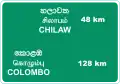 Confirming distances
Provincial roads
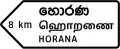 Direction sign
Expressways
 Exit ramp
Other signs useful for drivers
 Pedestrian crossing
 One-way street
 Hospital
 Parking
 Parking for disabled persons
 Bus stop
 Bus lane
 End of bus lane
 Expressway
 End of expressway
 Telephone
 Information
 Industral zone
 Restaurant
 Light refreshment
 Hotel or motel
 Petrol station
 Breakdown service
Road markings
 Overtaking line
 Warning line
 Pedestrian crossing
 Cycle crossing
Traffic light signals
 Red traffic light
 Red & yellow traffic light
 Green traffic light
 Yellow traffic light
Light signals for pedestrians
 Light signals for pedestrians
See also
References
- ↑ "The Motor Traffic Act (Chapter 203)" (PDF). documents.gov.lk. The Gazette of the Democratic Socialist Republic of Sri Lanka. 12 November 2015. Archived from the original (PDF) on 13 July 2025. Retrieved 31 October 2025.
- ↑ Ministry of Highways and Development; Road Development Authority (August 2007). Manual on Traffic Control Devices Part I. Retrieved 31 October 2025 – via Scribd.

Road signs in Asia | |
|---|---|
| Sovereign states |
|
| States with limited recognition | |
| Dependencies and other territories | |
