Road signs in Japan


Road signs in Japan are standardized by the "Order on Road Sign, Road Line, and Road Surface Marking (道路標識、区画線及び道路標示に関する命令)" established in 1968 with origins from the Tokyo Metropolitan Police Department's "Order on Standardization of Road Sign" of 1934 and the Home Ministry of Japan's "Order on Road Signs" of 1942.[1] The previous designs have been used since 1986 after several amendments of order.[2]
They are divided into "Principal Sign" (本標識, hon-hyōshiki) and "Supplemental Sign" (補助標識, hojo-hyōshiki).
History

The first standardised road signage schemes appeared in 1922. At first, two types of signs were established: "road warning signs" equivalent to warning signs and "road guide signs" as information signs.[3] Warning signs at that time closely resembled the British design as used in Hong Kong, the only difference was the white-on-black lettering.
Japanese road signs in the early 1940s closely followed European road signage practices at that time based on the 1931 Geneva Convention, except that most road signages contained text. A variation of the early 1940s Japanese road signage system is still in use today in Taiwan.[3][4]
In 1950, a complete revision of the "Road Signs Ordinance" was promulgated and enforced as an Ordinance of the Prime Minister's Office and the Ministry of Construction. Unlike the 1922 and the 1940s devised road signs, it included both bilingual Japanese and English text and symbols. Warning signs were changed from a European red-bordered triangular design to an American MUTCD yellow diamond design.[3] It also introduces the yellow American stop sign that only lasted for 10 years. This road signage system was used until 1963, when it was replaced with a new road signage system that is based on the Vienna Convention on Road Signs and Signals. The present-day Japanese road signage system also replaced the stop sign's shape with an inverted equilateral triangle like the old stop sign used in China.[3]

In 2016, it was announced that the Japanese National Police Agency was considering changing the design of the "Stop" sign used on Japanese roads since 1963 from the inverted red triangle sign to an octagonal design more closely conforming to the recommendations of the 1968 Vienna Convention on Road Signs and Signals.[5] The inverted red triangle sign was introduced in 1963 ahead of the 1964 Summer Olympic Games in Tokyo, and replaced the earlier red octagonal sign used from 1960, which in turn had replaced the yellow octagonal sign used from 1950.[5] It was later decided to make the stop sign bilingual in both Japanese and English, but to maintain the inverted triangular shape.[6]
Principal signs
Principal signs (本標識, hon-hyōshiki) are categorized into 4 types; guide, warning, regulatory and instruction signs.
Guide signs
Guide signs (案内標識, an'nai-hyōshiki) indicates directions or distances of the road. Guide signs have dark green backgrounds and white text for expressways. In urban areas and on national highways, direction signs have dark blue backgrounds. The signs are normally written in Japanese and English. Since 2014, Vialog is used as the typeface for English words and Place name Transcriptions.[7]
 Expressway ramp ahead
 Expressway exit ahead
 Exits and distance (expressway)
 Junction (expressway)
 Expressway number (E1; Tomei)
 Expressway shield (E4; Tōhoku)

 Intersection
 Intersection
 Distance of cities and areas
 National highway shield (Route 20)
 National highway shield
 National highway shield
 Prefectural highway shield (Fukuoka Route 758)
 Prefectural highway shield
 Prefectural highway shield (inter-city route)
 Prefectural highway shield
 Prefectural highway shield (inter-city route)
 Street name
 Detour
 Detour
 Mitigated limitation of height (expressway)
 Mitigated limitation of weight
Warning signs
Warning signs (警戒標識, keikai-hyōshiki) warn drivers of dangers or situations that they must pay attention to. Their design, black pattern and border on yellow diamond (usually with 45 cm per a side), is based on the U.S. MUTCD.[8]
 Crossroads
 T-intersection with road on the right
 T-junction
 T-intersection with road on the left
 Y-junction
 Traffic circle / Roundabout
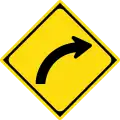 Curve to the right
 Curve to the left
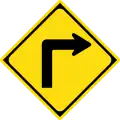 Sharp curve to the right
 Sharp curve to the left
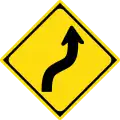 Double curve, first to the right
 Double curve, first to the left
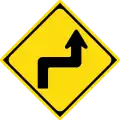 Double sharp, first to the right
 Double sharp, first to the left
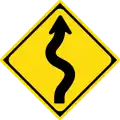 Winding road first curve to the right
 Winding road first curve to the left
 Railroad crossing ahead
Steam locomotive Railroad crossing ahead
Electric train School ahead
 Traffic light ahead
 Slippery road
 Fallen rocks
 Bumpy road
 Traffic merges from the left
 Left lane ends
 Road narrows on both sides
 Two-way traffic ahead
 Steep descent (10%, 1:10)
 Steep ascent (10%, 1:10)
 Men at work
 Crosswind
 Watch for large animals (deer)
 Watch for large animals (rabbit)
 Watch for large animals (monkey)
 Watch for large animals (raccoon dogs)
 Other danger
The nature of the danger is written on the supplementary sign
Regulatory signs
Regulatory signs (規制標識, kisei-hyōshiki) show the regulations of each roads in order to keep road condition and prevent dangers of traffic.
The stop sign is a red, downward-pointing triangle, with the text 止まれ (tomare) & "stop" (in English, for the pre-1963 and current designs only) in white. Prohibition signs are round with white backgrounds, red borders, and blue pictograms. Mandatory instruction signs are round with blue backgrounds and white pictograms.
- Stop and slow down
 Slow down (In Japanese and English, current design from 2017)
 Stop (In Japanese and English, current design from 2017)
 Stop (In English Only, used in United States Armed Forces Bases in Japan.)
- Exclusions
 Road closed to all
 Road closed to vehicles
 No entry
 No motor vehicles except motorcycles and mopeds
 No trucks
 No buses
 No motorbikes or general mopeds
 No non-motorized vehicles except bicycles
 No bicycles or specified small motorized bicycles
 No motor vehicles
 No two-person motorbikes
 No vehicles carrying dangerous goods
 Weight limit
 Height limit
 Width limit
 Motor vehicles only (except mopeds)
 Bicycles and specified small motorized bicycles only
 Bicycles and pedestrians only[9]
 Pedestrians only
 Road closed to pedestrians
- Turns
 Only straight ahead or left turn permitted
 Only straight ahead or right turn permitted
 Turn left
 Turn right
 No turns
 Turn left or right
 Directions permitted
 Roundabout
 Keep left
 Keep right
 No crossing center line to enter e.g. a car park
 No U-turn
 Two-stage right turn for general mopeds required.
 Two-stage right turn for general mopeds not required.
- Restrictions
 No crossing center line to overtake. 追越し禁止 sign below = no passing at all
 Speed limit
 End of special speed limit
The statutory speed limit applies End of speed restriction limit[10]
 Minimum speed limit
 One-way street to the left
 One way street to the right
 One-way street ahead
 One way (bicycles and specified small motorized bicycles)
 Trucks use left lane[11]
 Buses-only lane
 Bike lane
 Buses-priority lane
 Lane usage
 Lane usage
 Lane usage
 Lane usage
 Use car horns
 No jaywalking
- Parking and stopping
 No stopping
 No parking
 Restricted parking
 Parallel parking
 Perpendicular parking
 Angle parking
Instruction signs
Instruction signs (指示標識, shiji-hyōshiki) show points and devices on the road that drivers should pay attention.
 Cyclists are permitted to ride side-by-side.
 Driving on tram line permitted (Except two-wheelers)
 Priority road
 Center line
 Stop line
 Parking zone
 Stopping permitted
 Crosswalk
Alt. A Crosswalk
Alt. B: school zone Bike crossing
 Bike and crosswalk

 Controls ahead
Supplemental signs
Supplemental signs (補助標識, hojo-hyōshiki) are usually put just below the principal signs, and shows their valid range like time, day and category of vehicle.[12] They are equivalent to the "plaque" of the American MUTCD. The width of the plates is usually 60 cm, and the sentences should be less than 7 characters per a line or 3 lines.[13] When the sentences can not be shortened less than the limitation, they should apply changeable signs.[13]
 100 meters ahead
 Next 50 meters
 Except Sundays and Holidays
 8 a.m. to 8 p.m.
 Except general mopeds
 Large trucks
 Bicycles (symbol)
 Cars (symbol)
 Cars (side view)
 Trucks (symbol)
 Buses (symbol)
 Trucks carrying over 3 tonnes (symbol)
 Only for permitted vehicles
 Leave at least 6 meters road width clear when you park
 Permitted until the time the parking meter shows
 Restriction begins (symbol)
 Restriction begins
 Restriction begins
 Restricted zone (symbol)
 Restricted zone
 End of restriction (symbol)
 End of restriction
 End of restriction
 End of restriction
 School zone
 No passing or overtaking
 Yield
 Train crossing caution
 Caution crosswind
 Caution wild animals
 Caution
 Safety speed: 30 km/h
 Caution soft shoulder
 Be quiet
 Direction
 Control zone: Honmachi, Komoro
 Starts
 Ends
Other signs
 Expressway name (Tomei)
 Asian Highway route shield (AH1)
 Ferry (pictogram established in Japanese Industrial Standards)
Retired signs
 Slow down (In Japanese Only, phased out in 2017)
 Yield (In Japanese Only, phased out in 2017)
 Stop (In Japanese Only, used from 1963 to 2017)
1922 road signs
- Crossroads
 Steep ascent
 Gentle curve to the left
 Gentle curve to the right
 School
 Level crossing
 Steep descent
1942 road signs
 Weight limit
 Speed limit
 No turns
 No U-turns
 No motor vehicles
 No parking
 No trucks
 No entry
 Straight ahead or right turn permitted
 Turn right
 Road closed to vehicles
 No bicycles
 No non-motorized vehicles except bicycles
 No motorcycles
 Winding road
 Danger
 School
 Slow down
 Level crossing
 Crossroads
 Gentle curve to the left
 Gentle curve to the right
1950 road signs
 Crossroads
 T-intersection
 T-junction
 Y-junction
 Curve
 Sharp curve
 Double curve
 Double sharp curve
 Winding road
 Railroad crossing ahead
 School
 Danger
 Caution
 Road closed
 Closed to all vehicles
 Closed to cars
 Closed to carts
 Closed to bicycles
 Closed to pedestrians
 No U-turn
 No left turn
 No right turn
 Right turn only
 Left turn only
 No turns
 No entry
 No passing
 No stopping
 No parking
 Speed limit
 Speed limit ends
 Weight limit
 Height limit
 Quiet
 Horn
 One way
 Stop
 Pedestrian crossing
 Parking area
 Stop line
 Safety zone
 Construction zone
 Detour
1960 road signs
 Road closed
 Closed to all vehicles
 Closed to all motor vehicles
 Closed to large-sized motor vehicles
 Closed to all motor vehicles and bicycles with motor
 Closed to carts
 Closed to bicycles
 Closed to pedestrians
 No left turn
 No right turn
 Right turn only
 Left turn only
 No turns
 No crossing for pedestrians on left
 No crossing for pedestrians on right
 No crossing for vehicles
 No U-turn
 No backing
 No passing
 No parking
 No parking or stopping
 Dangerous goods prohibited
 Maximum width
 Load limit
 Clearance
 Maximum speed limit
 Minimum speed limit
 Motor vehicles only
 One way (left)
 One way (right)
 Drive to the right side
 May drive on tramway
 Right turn toward immediate outside
 Slow down
 May stopping
 May parking
 May parking or stopping
 Parking line
 Right-angle parking
 Angle parking
 Sound horn
 Section for sound of horn
 Stop
Photographs
 Street name and highway shields (Chiba Prefecture)
 Expressway exit sign
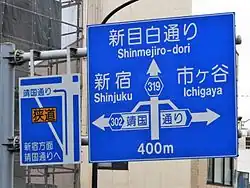 Intersection guide sign
 Height and weight restrictions apply (to streets pointed to by arrows)
 Lane usage signs
 Changeable lane usage signs
 Directions permitted
 Tram stop
 Right turn prohibition (7-9 a.m.) ends
 Taxis without any passengers can not enter from 9 p.m. until 2 a.m.
 Restrictions 200 m ahead
 Asian highway sign and symbol of Nihonbashi (Shuto Expressway)
References

- ↑ 時崎賢二 1990, p. 22.
- ↑ dark-RX 2008, p. 105.
- 1 2 3 4 "道路標識の歴史(変遷) | KICTEC". KICTEC | 交通インフラから公共空間まで多彩な快適環境保全創りに挑みます (in Japanese). 2012-06-18. Retrieved 2023-01-24.
- ↑ "旧型道路標識一覧(禁止・指導・規制・警戒標識)". trafficsignal.jp (in Japanese). Retrieved 2022-09-09.
- 1 2 "Design of Japanese stop signs might change ahead of Olympic tourism surge". The Japan Times. Japan: The Japan Times Ltd. 21 January 2016. Retrieved 23 January 2016.
- ↑ "英語併記の新標識お目見え 一時停止に「STOP」". 日本経済新聞 電子版 (in Japanese). Retrieved 2018-01-24.
- ↑ "Fuenfwerken-Schrift in Japan | Fuenfwerken". www.fuenfwerken.com (in German). Retrieved 2018-03-23.
- ↑ 時崎賢二 1979, p. 24.
- ↑ On sidewalks, exceptional specified small motorized bicycles are permitted (at a maximum speed of 6 km/h); in other cases, specified small motorized bicycles are allowed (at a maximum speed of 20 km/h).
- ↑ A left arrow or ここまで in the supplemental sign (plaque) means "END". A right arrow or ここから in the plaque means "BEGIN".
- ↑ The symbol can be changed to other vehicles.
- ↑ 全標協 2013, p. 3(設置)
- 1 2 警察庁 2017, p. 32.
Bibliography
- 時崎賢二 (1979). "道路標識等の基礎知識". 月刊交通. 10 (5). 東京法令出版: 18–29.
- 時崎賢二 (1990). "道路標識の国際化". 月刊交通. 21 (4). 東京法令出版: 19–39.
- dark-RX (2008-03-20). "見つけよう! 旧標識". 酷道をゆく. イカロス出版: 104–107. ISBN 978-4-86320-025-8.
{{cite journal}}: CS1 maint: periodical has ISBN (link) - 全国道路標識標示業協会(編) (2013). 道路標識ハンドブック (2012年度版 ed.). 全国道路標識・標示業協会.
- 警察庁交通局 (2017-04-24). "交通規制基準" (PDF). 警察庁. Retrieved 2017-11-08.
- "道路標識、区画線及び道路標示に関する命令 別表第2". www.mlit.go.jp. Archived from the original on 2017-10-14. Retrieved 2018-01-24.
- "17062814_ichiran(止まれ、徐行正式版追加)" (PDF). www.mlit.go.jp (PDF). 2017-06-28. Retrieved 2018-01-25.

Road signs in Asia | |
|---|---|
| Sovereign states |
|
| States with limited recognition | |
| Dependencies and other territories | |
