Road signs in Mauritius

Road signs in Mauritius are standardised traffic signs used in Mauritius according to the Traffic Signs Regulations 1990 (French: Règlement sur la Signalisation Routière 1990). They are heavily modelled on road signs in the United Kingdom, since Mauritius is a former British colony, making Mauritius one of the few Southern African Development Community member states who have not adopted its system of road signing.
Signing system
The traffic signs are divided into three classes: circles give orders, triangles warn of possible dangers and rectangles give information. Different colours are used within these shapes; blue circles are mandatory signs, which give positive instructions, while red circles are prohibitory signs, which give negative instructions. Blue rectangles give general information while green rectangles are used for direction signs on main roads. However, there are three exceptions for these shapes and colour rules; these are the octagonal stop sign, the diamond priority road sign and the inverted red triangle give way sign.[1]
Warning signs
Warning signs indicate a hazard ahead on the road that may not be readily apparent to a driver.
 Curve to the right
 Double curve to the right
 Chevrons

 Side road (right)
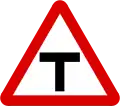 T-Junction
 Staggered junction
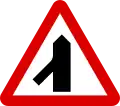 Traffic merging from the left
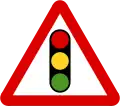 Traffic signals ahead
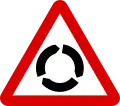 Roundabout ahead
 Pedestrian crossing ahead
 Pedestrians in the road ahead
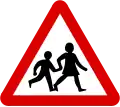 Children
 Roadworks ahead
 Cyclists
 Domestic animals (cattle)
 Wild animals (deer)
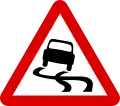 Slippery road
 Loose gravel
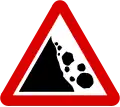 Falling rocks
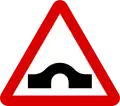 Hump bridge
 Hump
 Uneven surface
 Quayside
 Steep ascent
 Steep descent
 Low-flying aircraft
 Crosswinds
 Ungated level crossing
 Gated level crossing
 Two-way traffic across one-way road
 Two-way traffic ahead
 Road narrows on right side
 Road narrows on both sides
 Right lane ends
 Other dangers nearby
Priority signs
Priority signs are intended to instruct road users on what they must or should do (or not do) under a given set of circumstances.
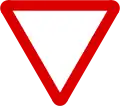

 Priority road
 Priority road ends
 Give way to oncoming vehicles
 Priority over oncoming vehicles
 Temporary closure of road - Go
 Temporary closure of road - Stop
Prohibitiory signs
Prohibitory signs are used to prohibit certain types of manoeuvres or some types of traffic. The No symbol surrounding a pictogram is used to indicate something that is not permitted.
 No vehicles - Vehicular traffic prohibited in both directions except for cyclists being pushed by pedestrians
 No entry
 No motor vehicles
 No entry for motorcycles
 No trucks

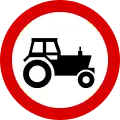 No agricultural vehicles (Tractors)
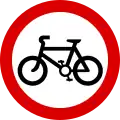 No cyclists
 No entry for handcarts
 No entry for pedestrians
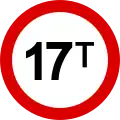 Weight Limit
 Axle weight limit
 Height limit
 Width limit
 Length limit
 No left turn
 No right turn
 No U-turns
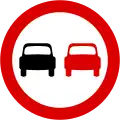 No overtaking
 No overtaking for lorries
 No motor noise
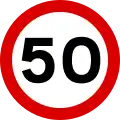 Maximum speed limit (50 km/h)
 End of all prohibitions
 Maximum speed limit zone

 No stopping (Clearway)
 Prohibition of passing without stopping
 Prohibition of passing without stopping - Police
 Prohibition of passing without stopping - Customs
 Prohibition of passing without stopping - Children
Mandatory signs
Mandatory signs are used to set the obligations of all traffic which use a specific area of road. Unlike prohibitory or restrictive signs, mandatory signs tell traffic what it must do, rather than must not do.
 Left turn only
 Right turn only
 Vehicular traffic must turn to the left ahead
 Vehicular traffic must turn to the right ahead
 Ahead only (turning left and right is prohibited)
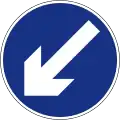 Pass on the left
 Pass on the right
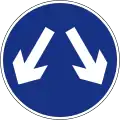 Pass either side
 Roundabout - Vehicles entering the junction must give way to traffic to vehicles coming from the right
 Pedestrians only
 Cyclists only
 Buses only
 Minimum speed limit (30 Km/h)
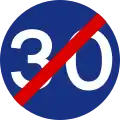 End of minimum speed limit (30 Km/h)
Information signs
Information signs informs people.
 Hump


 No through road to the right
 No through road to the left
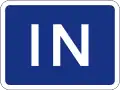 In
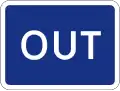 Out
 No entry to a designated area
 No exit to a designated area
 Parking
 Hospital
 Sign notifying an entry to a motorway
 Sign notifying an exit from a motorway


References
- ↑ Road Safety Unit. "Understanding our traffic sign" (PDF). Government of Mauritius. Archived from the original (PDF) on 1 August 2014. Retrieved 28 February 2013.
External links

