Road signs in Albania

Albania is a signatory to the Vienna Convention on Road Signs and Signals. Therefore, road signs do not differ much from the rest of Europe, such as Italy, San Marino, Montenegro and Kosovo. The Ministry of Infrastructure and Energy regulates them. Albania drives on the right as with the rest of Europe, except for Cyprus, Ireland, Malta and the United Kingdom. Although Albania is not a member of the European Union, the road signs largely follow the general European conventions concerning the use of shape and colour to indicate their function.[1][2]
Warning signs
Warning signs (Albanian: sinjale paralajmëruese) are used to warn road users of the danger that threatens them in a certain place, or part of the road, and to inform them about the nature of that danger. Warning signs are predominantly red and white in color. They include: [3]
 Deer on road ahead
 Unprotected quayside or riverbank
 Uneven road or series of bumps ahead
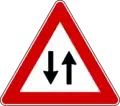 Two-way traffic ahead
 Tram crossing
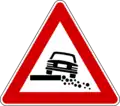 Soft verges
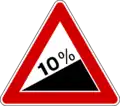 Steep ascent
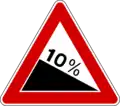 Steep descent
 Traffic signals ahead
 Traffic signals ahead (horizontal)
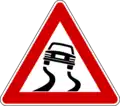 Slippery road surface
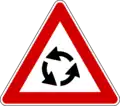 Roundabout ahead
 Road narrows on both sides
 Road hump ahead
 Pedestrian crossing ahead
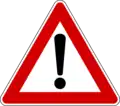 Other dangers
 Opening or swing bridge
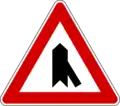 Merging traffic
 Low-flying aircraft
 Junction with a minor road
 Level crossing
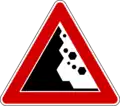 Falling rocks or debris
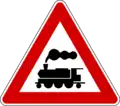 Level crossing without barriers ahead
 Level crossing with barriers ahead
 Dangerous crosswinds
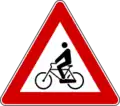 Cyclists ahead
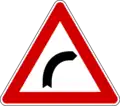 Curve ahead
 Crossroads with a minor road
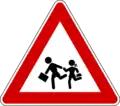 Children
 Crossroads with priority to the right
 Cows on road ahead
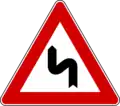 Double curve ahead
Temporary signs
Temporary signs (Albanian: sinjale të përkohëshme) are used to notify road users of a problem they will face while driving in certain place during a limited period of time, such as during construction activities on the road or damaged parts of it. Warning signs are predominantly red and yellow in color. They include:[3]

 Road narrows
 Road narrows on left
 Road narrows on right

 Other dangers
 Uneven road
 Loose chippings

Regulatory signs
Priority signs
Priority signs (Albanian: sinjale të prioritetit) are used to indicate the order in which vehicles shall pass intersection points. They include:[3]


 Give priority to vehicles from opposite direction

 End of priority road

 Junction with a minor side-road from right
 Junction with a minor side-road from left
 Merging traffic from right
 Merging traffic from left
 Traffic has priority over oncoming vehicles
Prohibition signs
Prohibition signs (Albanian: sinjale të ndalimit) are used to warn of prohibitions imposed on those who want to use the road. They include:[3]
 No entry for vehicular traffic
 Restricted vehicular access
 No overtaking
 Minimum distance
 Maximum speed 50km/h
 No use of horns


 No pedestrians
 No bicycles
 No motorcycles
 No handcarts

 No buses

 No large goods vehicles over weight shown
 No vehicles with trailer
 No tractors
 No vehicles carrying dangerous goods

 No vehicles carrying goods which could pollute water
 No vehicles over width shown
 No vehicles over height shown
 No vehicles over length shown
 Maximum weight in tonnes

 Derestriction
 End of maximum speed
 End of no overtaking
 End of no overtaking by heavy goods vehicles
 No parking on side where sign is placed.
 No stopping on the side where sign is placed
 Parking space reserved for vehicles used by people with disabilities
 Parking place
 Parking ahead in the direction of the arrow
Mandatory signs
Mandatory signs (Albanian: sinjale të detyrueshme) are used to warn of conditions imposed on those who want to use the road. They predominantly use blue and white. They include:[3]
 Drive straight
 Turn left
 Turn right
 Right turn only ahead
 Left turn only ahead
 Right or left turn only ahead
 Drive straight or turn right
 Drive straight or turn left
 Keep left
 Keep right
 Pass either side


 End of minimum speed
 Snow chains compulsory


 End of cycle lane

 End of shared path


 End of bridleway
 Stop, pay toll
 Stop, police check
Indication signs
Indication signs (Albanian: sinjale shpjeguese) are used to provide additional information to the road's users. They include:[3]


 Pedestrian ramp

 No through road (side road)
 Advisory speed limit
 End of advisory speed limit
 Fast-traffic highway, only motor vehicles allowed
 End of road reserved for motor vehicles
 Tunnel (roads other than motorways)
 Tunnel (motorways)
 Bridge (roads other than motorways)
 Bridge (motorways)

 Breakdown bay. The background is green on motorway
 Use of lanes on extra-urban roads
 Bus lane on urban road
 Bus lane on urban road
 Use of lanes on motorways
 End of lane. The background is green on motorway
 Increase in the number of lanes. The background is green on motorway

 Motorway starts
 Motorway ends
 Advised direction for trucks ahead
 Advised direction for trucks

 Repairs
 Telephone (formerly used
 )

 Petrol station with LPG

 Tram stop
 Information centre

 Picnic site


 Refreshments

 Taxi stop
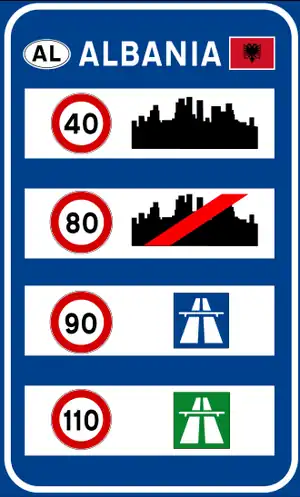 General speed limit (installed at national borders)
 Primary or secondary road direction
 Intermediate highway location marker with hectometre shown in roman numerals (in the example the sign is placed at the kilometre 24.8 of the road)
 Directions on a motorway
 Exit directions on a motorway
 European road number sign
 Motorway location marker and distance from the exit shown (horizontal version)
 Motorway ahead with a summary of transit restrictions
 Town sign: start of urban area
See also
References
- ↑ Programi i përgatitjes teorike për Lejet e Drejtimit të kategorive A1, A2, A, B1, B dhe BE (PDF). DPSHTRR. p. 7-31.
- ↑ Përmbledhëse legjislacioni për qarkullimin rrugor. Qendra e Botimeve Zyrtare. 2021. pp. 6–17. ISBN 978-9928-01-136-7.
- 1 2 3 4 5 6 Palnikaj, Mark (2012). Sinjalet rrugore. Grand Prind. p. 4-18.
