Road signs in Singapore

Road signs in Singapore closely follow those laid down in the United Kingdom's traffic sign regulations, although a number of changes over the years have introduced some slight deviations that suit local road conditions (such as fonts). Road signs in Singapore conform to the local Highway Code under the authority of Singapore Traffic Police.
The typeface used, which is regulated by the Land Transport Authority, has no official name.[1] It is also used on road signs in Brunei.
Since the mid-1990s, signs have been placed on a backing board, making them square or rectangular and standardised to a width of 600 mm on most roads and 900 mm on expressways. Prior to the 1990s and after 1964, signs were cut out to their shape (for example, round signs were cut to be circular) as in most countries around the world. Prior to 1964, signs were in the pre-Worboys style with a couple of differences.
Singapore traffic signs display text in English, one of the four official languages and the main language in the country. The three others – Malay, Chinese, and Tamil – as well as Japanese are also used for important public places such as tourist attractions, airports and immigration checkpoints.
Warning signs
Warning signs indicate possible dangers or unusual conditions ahead and alert motorists, so they may anticipate the appropriate actions to take. They are usually shaped as triangles with a red border, and mounted on a borderless white backing board.
 Danger
 Advance warning of a height restriction ahead
 Accident blackspot
 Restricted Zone ahead
 Electronic Road Pricing (road toll) gantry ahead
 Road Hump
 Uneven road
 Road narrows on right
 Road narrows on both sides ahead
 Two-way traffic crosses a one-way road
 Two-way traffic ahead
 Lanes merge ahead
 Double curve first to left (or to the right if the symbol is reversed)
 Dual carriageway ends
 Crossroads
 Side road on left
 Side road on right
 T-junction
 Traffic merging from left
 Staggered junction
 Roundabout ahead
 Traffic lights ahead
 Traffic queues expected ahead
 Slippery road
 Steep ascent
 Steep descent
 Quayside or river bank ahead
 Tunnel ahead
 Low flying aircraft
 Pedestrian crossing
 Curve to the right ahead (Left if symbol is reversed)
 School zone
 Beware of Animals
 Pedestrians on road ahead
 Elderly or blind people ahead
 Slow down
 Maintain a slow speed to anticipate hazards ahead
 Bridge with low headroom ahead
 Chevron
Regulatory signs
Regulatory signs either mandatory, which give positive instructions, or prohibitory, which indicate a prohibition. Many regulatory signs are accompanied by supplementary plates that provide interdependent exceptions to the rule, or indicates additional instruction or information to facilitate understanding of the rule implemented.
Mandatory signs
Mandatory signs are generally circular with a white border and symbol on a blue background. They usually indicate something all drivers must do (e.g. keep left) or a facility available to certain classes of traffic (e.g. pedal cycles only).
 Ahead only (Turning left and right is prohibited)
 Turn left ahead (right if symbol is reversed)
 Turn left (right if symbol is reversed)
 Keep left (Right if symbol is reversed)
 Split-way, i.e. motorists can pass to either side, but either side might not reach the same destination
 Route to be used by pedal bicycles only
 Route to be used by motorcycles only
Priority signs
The exceptions are the octagonal red STOP sign, the temporary STOP and GO signs and the triangular GIVE WAY sign.

 Stop, children crossing

 Temporary stop signs
 Temporary go signs
Prohibitory signs
Prohibitory signs, which generally tell drivers what they must not do, are mostly circular and have a red border. The red ring indicates the prohibition; diagonal bars are used only on signs which prohibit a specific manoeuvre, i.e. banned left or right turns and U-turns, or a certain class of vehicle, i.e. lorries
 No entry
 No left turn
 No right turn
 No trucks
 No vehicles with 3 axles or more
 No vehicles carrying dangerous goods into tunnels
 No pedal bicycles
 No Waiting
 No stopping
 No overtaking
 No horning, unless to prevent an accident
 No jaywalking
 No jaywalking in the bus park
Diagonal bars are excluded when restrictions are quantitative in nature, i.e. limits in speed, weight, axle, height, and width.
 No vehicles over height shown. Vehicles taller than 4.5m requires a police escort.
 No vehicles over width shown
 No vehicles over weight shown
 Maximum speed limit in kilometres per hour (km/h)
Information signs
Information signs are signs that may be mounted to indicate a certain condition or nature of the road ahead that motorists need to take note. They are independent of existing mandatory and prohibitive signs. Such signs are usually white or blue and rectangular in shape.
 U-turn allowed DIRECTLY AFTER the sign. Do not U-turn when there is no sign.
 One-way traffic
 Pedestrian crossing

 Parking zone for cars - Coupon Payment (in Transport typeface)
 Parking zone for Motor- Coupon Payment (in Transport typeface)
 Dead end
 Dead end on the left ahead
 Dead end on the right ahead
 End of restricted zone
 Keep a safe distance from vehicle in front
 Speed regulating strips ahead
 Right turn lanes ahead
 Watch out for traffic from side road
 Reminder to look out & give way to pedestrians crossing when making a right turn
 When "B" lights up in green, public buses from left lane proceed before green light for all other vehicles
 When "B" lights up in green, public buses proceed after exiting bus bay before green light for all other vehicles
 Advisory Give-way-to-buses-exiting-bus-bay rule ahead
 Mandatory Give-way-to-buses-exiting-bus-bay rule ahead
 Speed camera ahead
 Red light camera
 Expressway
 End of expressway
 Concealed exit ahead. Watch out for traffic coming from a concealed side road.
 U-Turning vehicles keep right
 Do not drive on the road shoulder
 Dual carriageway ahead
 Layout of traffic lanes ahead (for lane formation)
 Expressway name and distance marker
Temporary work-zone signs
Temporary work-zone signs (designated in amber orange signages) are mounted to ensure road users are notified in advance despite being affected by road works in the vicinity. It closely follows the American MUTCD traffic sign (e.g. reddish orange diamond, reddish orange rectangular or amber rectangular-shaped signs).
 Advance sign of road works ahead
 Indication of road stretch affected by road works
 Entry to works area
 Heavy vehicles turning ahead
 Heavy vehicles turning ahead
 Layout of lanes ahead
 Road narrows on right ahead
 Slow
 Slow down
 Temporary roundabout
 Temporary mandatory speed limit (40 km/h)
 Temporary traffic lights ahead
 Curve to right (Left if symbol is reversed)
 Supplementary plate to specify direction indicated for temporary road rule
 Beware Of Turning Vehicles
 Chevron
 Temporary Height limit
 Detour for pedestrians in direction indicated (Right)
 Other dangers nearby
Directional signs
- Signs indicating destinations reached via expressways has white lettering on a blue background.
- Signs indicating destinations reached via other roads have white lettering on a green background.
- Signs indicating local destinations have black lettering on a white background.
- Signs indicating recreational facilities and landmarks have white lettering on a brown background.
 On approach to a junction (single direction)
 At the junction
 On approach to a roundabout
 Get in lane with respect to the destinations stated above each downward-pointing lane arrow
 Direction to a place of interest
Road markings
Along the side of the road
 No parking between 7 am to 7 pm (Daily with the exception of Sundays and Public Holidays)
 Option 1 (Advisory) No waiting at any time, unless there are signs that specifically indicate seasonal restrictions.
 Option 2 (Mandatory) No waiting at any time, unless there are signs that specifically indicate seasonal restrictions.
 Clearway (No stopping) on that side of the road at any time
 Indication of a zebra crossing ahead.
 Edge line (used along roads, not in built-up areas, or divide the road shoulder of an expressway from the inside lane)
Road dividers
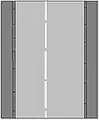 Keep left of the divider
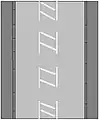 Keep left of the diagonally hatched divider
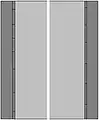 Keep left of the divider; no waiting on either side of the road at any time
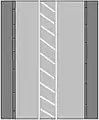 Keep left of the unbroken diagonally hatched divider; No crossing of the divider
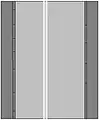 Keep left of the divider; no crossing of the divider in either direction at any time.
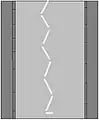 Zebra crossing ahead; keep left of the divider.
Historic signs
The following signs are historical, and are now obsolete.
Post-Worboys
 National Speed Limit Applies (1964–1990s)
 No U-turn (1964–1990s)
 Indication of a U-turn lane, on the lane closest to the road divider or carriageway (1964–1990s)
 Level crossing with gates (prior to June 2011)
 Level crossing with no gates (prior to June 2011)
 Level crossing (prior to June 2011)
 Left turn on red permitted (prior to 2024)
Pre-Worboys
 No Through Road For Motor Vehicles
 No Entry
 No Right Turn
 Cross Roads
 Turn Left
 Keep Left
 Road Works Ahead
 Ford
 No Waiting
 No Entry
 No Cycling
 Speed Limit
 National Speed Limit Applies
 Parking
 Cross Roads
 Speed Limit except Built-up Areas
 Turn Right
 Roundabout
 No Left Turn
 Signals Ahead
 Two Way Traffic
 Level Crossing with No Gates
 Halt at major road ahead
 Slow, major road ahead
 Motor vehicles prohibited
See also
References
- Singapore Official Highway Code (Basic Theory of Driving) Seventh Edition. ISBN 978-981-04-0567-0 . Published 2008 by Pacific Communications Pte Ltd under the authority of the Traffic Police.
- ↑ "Standard Details of Road Elements - Chapter 7: Directional Signs" (PDF). lta.gov.sg. Land Transport Authority. Retrieved 23 March 2025.
External links
- LTA Feedback Portal
- Provides information about LTA, major projects and other services
- DA Roadsigns, a replica of the Singaporean road sign typeface

Road signs in Asia | |
|---|---|
| Sovereign states |
|
| States with limited recognition | |
| Dependencies and other territories | |
