This portal's subpages should be checked. Subpages that are no longer needed should be reported here.
Please take care when editing, especially if using automated editing software.Learn how to update the maintenance information here.
The São Tomé and Príncipe Portal
São Tomé and Príncipe, officially the Democratic Republic of Sao Tome and Principe, is an island country in the Gulf of Guinea, off the western equatorial coast of Central Africa. It consists of two archipelagos around the two main islands of São Tomé and Príncipe, about 81 nautical miles (150km; 93mi) apart and about 135 and 121 nautical miles (250 and 224km; 155 and 139mi) off the northwestern coast of Gabon. With a population of 201,800 (2018 official estimate), São Tomé and Príncipe is the second-smallest and second-least populous African sovereign state after Seychelles.
The islands were uninhabited until Portuguese explorersJoão de Santarém and Pedro Escobar discovered them on 21 December 1470. Gradually colonized and settled throughout the 16th century, they collectively served as a vital commercial and trade centre for the Atlantic slave trade. The rich volcanic soil and proximity to the equator made São Tomé and Príncipe ideal for sugar cultivation, followed later by other cash crops such as coffee and cocoa. The lucrative plantation economy was heavily dependent upon enslaved Africans. Cycles of social unrest and economic instability throughout the 19th and 20th centuries culminated in peaceful independence in 1975 as a one-party communist state, which would remain in place until 1990. São Tomé and Príncipe has since remained one of Africa's most stable and democratic countries. São Tomé and Príncipe is a developing economy with a medium Human Development Index.
Construction of the first church of Our Lady of Grace was started at the end of the fifteenth century under Captain Álvaro de Caminha. This church was situated near the present cathedral. It became the seat of a diocese in 1534. The building was reconstructed between 1576 and 1578, during the reign of King Sebastian of Portugal. In 1784, it was in poor condition with the frontispiece broken. In 1814 it was rebuilt at the initiative of the local population. The last modification was made in 1956, when the church was remodeled in an eclectic revival style, with a neo-romanesque main façade. (Full article...)
Image 2Map of the Gulf of Guinea, showing São Tomé, Príncipe, and Annobón. These islands, together with the island of Bioko and Mount Cameroon on the African mainland, are part of the Cameroon line of volcanoes.
Image 3Hiking in the equatorial forest on the island of São Tomé
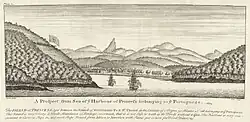
Image 5Island of Príncipe (Sao Tome and Principe), 1727. The inscription says: "The ISLAND of PRINCESS lies between the Islands of FERNANDO PO & St. THOMÉ in the Latitude of 1 Degree 30 Minutes N. all belonging to the Portuguese. This Island is very Woody and breeds abundance of Monkeys, insomuch that it is not safe to walk in the Woods without a gun. The harbour is very convenient to Careen Ships in, and most Ships Bound from Africa to America with Slaves put in here for Food, Water etc."
Image 6The island of São Tomé off the west coast of Africa








 Commons
 Wikidata
 Wikiquote
 Wikisource
 Wikiversity
 Wikivoyage
 Wiktionary
 List of all portals





 Random portal
 WikiProject Portals