Spanning the Eastern and Western hemispheres, at the centre of the water hemisphere, Oceania is estimated to have a land area of about 9,000,000 square kilometres (3,500,000sqmi) and a population of around 46.3 million as of 2024, when including Australia but excluding the Malay Archipelago. When compared against other continental land areas, Oceania is the smallest and the second-least populated after Antarctica. It is home to Earth’s third-largest remaining area of tropical rainforest, which covers much of the island of New Guinea.
The first settlers of Australia, New Guinea, and the large islands just to the east arrived more than 60,000 years ago. Oceania was first explored by Europeans from the 16th century onward. Portuguese explorers, between 1512 and 1526, reached the Tanimbar Islands, some of the Caroline Islands, and west New Guinea. Spanish and Dutch explorers followed, then British and French. On his first voyage in the 18th century, James Cook, who later arrived at the highly developed Hawaiian Islands, went to Tahiti and followed the east coast of Australia for the first time. The arrival of European settlers in subsequent centuries resulted in a significant alteration in the social and political landscape of Oceania. The Pacific theatre saw major action during the First and Second World Wars. (Full article...)
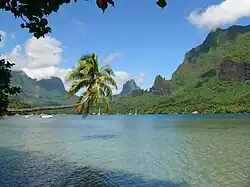
French Polynesia is divided into five island groups: the Austral Islands; the Gambier Islands; the Marquesas Islands; the Society Islands (comprising the Leeward and Windward Islands); and the Tuamotus. Among its 121 islands and atolls, 75 were inhabited at the 2017 census. Tahiti, which is in the Society Islands group, is the most populous island, home to nearly 69% of the population of French Polynesia as of 2017. Papeete, located on Tahiti, is the capital of French Polynesia. Although not an integral part of its territory, Clipperton Island was administered from French Polynesia until 2007. (Full article...)
Moai facing inland at Ahu Tongariki, restored by Chilean archaeologist Claudio Cristino in the 1990s
Moai or moꞌai (/ˈmoʊ.aɪ/ⓘMOH-eye; Rapa Nui: moꞌai, lit.'statue', pronounced[ˈmoʔai]; Spanish: moái) are monolithic human figures carved from stone by the Rapa Nui people, on Rapa Nui (Easter Island) in eastern Polynesia between the years 1250 and 1500. Nearly half are still at Rano Raraku, the main moai quarry, but hundreds were transported from there and set on stone platforms called ahu around the island's perimeter. Almost all moai have overly large heads, which account for three-eighths of the size of the whole statue. They also have no legs. The moai are chiefly the living faces (aringa ora) of deified ancestors (aringa ora ata tepuna).
Although the stone moai are the most famous, the Rapa Nui also carved small wooden moai: moꞌai kavakava (male), moꞌai paepae/papa (female), and moꞌai taŋata (male).
The statues still gazed inland across their clan lands when Europeans first visited the island in 1722, but all of them had fallen by the latter part of the 19th century. The moai were toppled in the late 18th and early 19th centuries, possibly as a result of European contact or internecine tribal wars. (Full article...)
Image 33The Polynesian spread of colonization in the Pacific (from Polynesia)
Image 34Map showing the migration and expansion of the Austronesians which began at about 3000 BC from Taiwan. The Polynesian branch is shown in green. (from Polynesia)
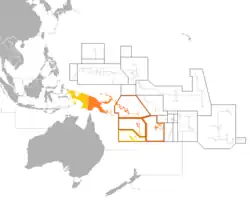
Image 42Outline of sovereign (orange) and dependent islands (yellow) (from Melanesia)
Image 43A common fishing canoe va'a with outrigger in Savaiʻi island, Samoa, 2009 (from Polynesia)
Image 44An illustration of the Cross Spikes Club of the US Navy on Bikini Atoll, one of several Marshall Islands used for atomic bomb tests. (from Micronesia)