Portal:Europe


| Main | Geography | Projects |
|
|

Europe is a continent located entirely in the Northern Hemisphere and mostly in the Eastern Hemisphere. It comprises the westernmost peninsulas of the continental landmass of Eurasia, and is bordered by the Arctic Ocean to the north, the Atlantic Ocean to the west, the Mediterranean Sea to the south, and Asia to the east. Europe is commonly considered to be separated from Asia by the watershed of the Ural Mountains, the Ural River, the Caspian Sea, the Greater Caucasus, the Black Sea, and the waterways of the Turkish Straits. Although much of this border is over land, Europe is generally accorded the status of a full continent because of its great physical size and the weight of history and tradition.
Europe covers about 10,180,000 km2 (3,930,000 sq mi), or 2% of the Earth's surface (6.8% of land area), making it the second smallest continent (using the seven-continent model). Politically, Europe is divided into about fifty sovereign states, of which Russia is the largest and most populous, spanning 39% of the continent and comprising 15% of its population. Europe had a total population of about 741 million (about 11% of the world population), as of 2018. The European climate is largely affected by warm Atlantic currents that temper winters and summers on much of the continent, even at latitudes along which the climate in Asia and North America is severe. Further from the sea, seasonal differences are more noticeable than close to the coast.
The history of Europe concerns itself with the discovery and collection, the study, organization and presentation and the interpretation of past events and affairs of the people of Europe since the beginning of written records. During the Neolithic era and the time of the Indo-European migrations, Europe saw human inflows from east and southeast and subsequent important cultural and material exchange. The period known as classical antiquity began with the emergence of the city-states of ancient Greece. Later, the Roman Empire came to dominate the entire Mediterranean basin. The fall of the Roman Empire in AD 476 traditionally marks the start of the Middle Ages. Beginning in the 14th century a Renaissance of knowledge challenged traditional doctrines in science and theology. Simultaneously, the Protestant Reformation set up Protestant churches primarily in Germany, Scandinavia and England. After 1800, the Industrial Revolution brought prosperity to Britain and Western Europe. The main European powers set up colonies in most of the Americas and Africa, and parts of Asia. In the 20th century, World War I and World War II resulted in massive numbers of deaths. The Cold War dominated European geo-politics from 1947 to 1989. After the fall of the Iron Curtain, the European countries grew together.
The culture of Europe is rooted in the art, architecture, film, different types of music, economic, literature, and philosophy that originated from the continent of Europe. European culture is largely rooted in what is often referred to as its "common cultural heritage".
The economy of Europe comprises more than 744 million people in 50 countries. The formation of the European Union (EU) and in 1999, the introduction of a unified currency, the euro, brings participating European countries closer through the convenience of a shared currency and has led to a stronger European cash flow. The difference in wealth across Europe can be seen roughly in former Cold War divide, with some countries breaching the divide (Greece, Estonia, Portugal, Slovenia and the Czech Republic). Whilst most European states have a GDP per capita higher than the world's average and are very highly developed (Liechtenstein, Luxembourg, Monaco, Andorra, Norway, Sweden, Denmark, Netherlands, Switzerland, United Kingdom, Ireland, Germany), some European economies, despite their position over the world's average in the Human Development Index, are poorer.
Featured article -

The Bal des Ardents (Ball of the Burning Men), or the Bal des Sauvages (Ball of the Wild Men), was a masquerade ball held on 28 January 1393 in Paris, France, at which King Charles VI had a dance performance with five members of the French nobility. Four of the dancers were killed in a fire caused by a torch brought in by Louis I, Duke of Orléans, the king's brother.
The ball, held at the royal palace of Saint-Pol, was one of a series of events organised to entertain Charles, who had suffered an attack of insanity in the previous summer of that year during an expedition at Le Mans. The circumstances of the fire undermined confidence in the king's capacity to rule; Parisians considered it proof of courtly decadence and threatened to rebel against the more powerful members of the nobility. The public's outrage forced King Charles VI and his brother the Duke of Orléans, whom a contemporary chronicler accused of attempted regicide and sorcery, to offer penance for the event. (Full article...)
Featured location -

Belgrade (/bɛlˈɡreɪd/ bel-GRAYD or /ˈbɛlɡreɪd/ BEL-grayd; Serbian: Београд / Beograd, lit. 'White City', pronounced [beǒɡrad] ⓘ) is the capital and historic largest city of Serbia. It is located at the confluence of the Sava and Danube rivers and at the crossroads of the Pannonian Plain and the Balkan Peninsula. According to the 2022 census, the population of Belgrade city proper stands at 1,197,114, its contiguous urban area has 1,298,661 inhabitants, while the population of the city's administrative area (which roughly corresponds to its metro area) totals 1,682,720 people. It is one of the major cities of Southeast Europe and the third-most populous city on the river Danube.
Belgrade is one of the oldest continuously inhabited cities in Europe. One of the most important prehistoric cultures of Europe, the Vinča culture, evolved within the Belgrade area in the 6th millennium BC. In antiquity, Thraco-Dacians inhabited the region and, after 279 BC, Celts settled the city, naming it Singidūn. It was conquered by the Romans under the reign of Augustus and awarded Roman city rights in the mid-2nd century. It was settled by the Slavs in the 520s, and changed hands several times between the Byzantine Empire, the Frankish Empire, the Bulgarian Empire, and the Kingdom of Hungary before it became the seat of the Serbian king Stefan Dragutin in 1284. Belgrade served as capital of the Serbian Despotate during the reign of Stefan Lazarević, and then his successor Đurađ Branković returned it to the Hungarian king in 1427. Noon bells in support of the Hungarian army against the Ottoman Empire during the siege in 1456 have remained a widespread church tradition to this day. In 1521, Belgrade was conquered by the Ottomans and became the seat of the Sanjak of Smederevo. It frequently passed from Ottoman to Habsburg rule, which saw the destruction of most of the city during the Ottoman–Habsburg wars. (Full article...)
Featured portrait
 |
In the News
- 28 August 2026 –
- Two men steal a 200-carat platinum-and-diamond necklace from the Museum of Applied Arts in Vienna, Austria, after smashing a display case with a hammer and fleeing, according to Austrian police. (AFP via CBS News)
- 28 August 2026 – Death and state funeral of Harald V
- King Harald V of Norway dies at the age of 89 after a 35-year reign and is succeeded by his son Haakon VIII. (AP) (BBC News) (CNN)
- 28 August 2026 – Forced contraception of women in Greenland
- Greenland establishes a truth and reconciliation commission after experts conclude that a decades-long Danish contraceptive program violated Inuit women's rights but disagree on whether it constituted genocide. (Al Jazeera)
- 27 August 2026 – Middle Eastern crisis
- The United Kingdom Maritime Trade Operations reports that a tanker in the Strait of Hormuz was hit by an "unknown projectile", causing a fire that was later extinguished. (Marine Insight)
- 27 August 2026 – 2026 European heatwaves
- Germany's Robert Koch Institute estimates 15,800 heat-related deaths during summer 2026, the highest total in a decade of monitoring, as repeated heat waves push temperatures above 40 °C (104 °F). (Kurdistan 24)
- 27 August 2026 – 2026 Gosen-Neu Zittau school stabbing
- Two people are killed in a stabbing at a private school in Gosen-Neu Zittau, Brandenburg, Germany. A suspect is arrested. (Xinhua)
Updated: 4:05, 29 August 2026
Categories

Featured biography -

Sergo Konstantinovich Ordzhonikidze (born Grigol Konstantines dze Orjonikidze; 24 October [O.S. 12 October] 1886 – 18 February 1937) was an Old Bolshevik and a Soviet statesman.
Born and raised in Georgia, in the Russian Empire, Ordzhonikidze joined the Bolsheviks at an early age and quickly rose within the ranks to become an important figure within the group. Arrested and imprisoned several times by the Russian police, he was in Siberian exile when the February Revolution began in 1917. Returning from exile, Ordzhonikidze took part in the October Revolution that brought the Bolsheviks to power. During the subsequent Civil War he played an active role as the leading Bolshevik in the Caucasus, overseeing the invasions of Azerbaijan, Armenia, and Georgia. He backed their union into the Transcaucasian Socialist Federative Soviet Republic (TSFSR), which helped form the Soviet Union, in 1922 and served as the First Secretary of the TSFSR until 1926. (Full article...)
Featured picture
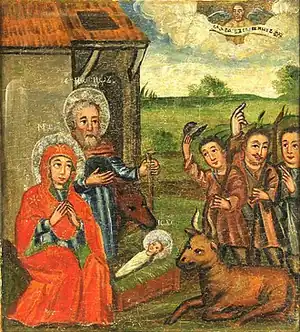 |
Related portals
Major Religions in Europe
Northern Europe
Western Europe
Central Europe
Eastern Europe, Balkans and Caucasus
Southern Europe
Featured panorama
 |
Topics
Associated Wikimedia
The following Wikimedia Foundation sister projects provide more on this subject:
-
 Commons
Free media repository -
 Wikidata
Free knowledge base -
 Wikiquote
Collection of quotations -
 Wikisource
Free-content library -
 Wikispecies
Directory of species -
 Wikiversity
Free learning tools -
 Wikivoyage
Free travel guide -
 Wiktionary
Dictionary and thesaurus
More portals
-
 List of all portals
-

-

-

-

-

-

-

-

-

-
 Random portal
-
 WikiProject Portals