Portal:Latin America


Intro

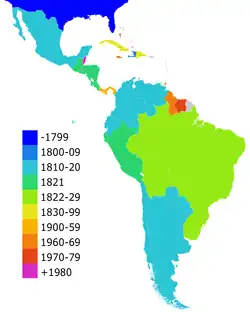
Latin America (Spanish: América Latina or Latinoamérica; Portuguese: América Latina) is the cultural region of the Americas where Romance languages are predominantly spoken, primarily Spanish and Portuguese.

Since it is defined according to its cultural identity instead of its geography, Latin America includes countries from both North and South America. For instance, countries from North America like Mexico, Honduras, Guatemala, etc. tend to be included. In fact, most of the countries in Central America, South America and the Caribbean are considered Latin American countries. English or Dutch-speaking countries in South America or the Caribbean like Belize, Guyana, Jamaica, Trinidad and Tobago, Suriname, etc. are not considered "Latin American" because they speak Germanic languages. As such, Latin America comprises Hispanic America along with Brazil. Related terms include the narrower Hispanic America, which exclusively refers to Spanish-speaking nations; and the broader Ibero-America, which includes all Iberian countries in the Americas.

The term Latin America was first introduced in 1856 at a conference named Initiative of the Americas: Idea for a Federal Congress of the Republics (Iniciativa de la América. Idea de un Congreso Federal de las Repúblicas), at Paris. Chilean politician Francisco Bilbao coined the term to refer to countries sharing cultural and linguistic heritage. It gained further prominence during the 1860s under the rule of Napoleon III, whose government sought to justify France's intervention in the Second Mexican Empire. (Full article...)

Recognized content -

Entries here consist of Good and Featured articles, which meet a core set of high editorial standards.

Nahua man from the Florentine Codex. The speech scrolls indicate speech or song.

Nahuatl (English: /ˈnɑːwɑːtəl/ NAH-wah-təl; hispanicized from Nawatl pronounced [ˈnaːwat͡ɬ] ⓘ), Aztec, or Mexicano is a language or, by some definitions, a group of languages of the Uto-Aztecan language family. Varieties of Nahuatl are spoken by about 1.7 million Nahuas, most of whom live mainly in Central Mexico and have smaller populations in the United States. Nahuatl has been spoken in central Mexico since at least the seventh century AD. It was the language of the Mexica, who dominated what is now central Mexico during the Late Postclassic period of Mesoamerican history. During the centuries preceding the Spanish conquest of the Aztec Empire, the Aztecs had expanded to incorporate a large part of central Mexico. Their influence caused the variety of Nahuatl spoken by the residents of Tenochtitlan to become a prestige language in Mesoamerica.

Following the Spanish conquest, Spanish colonists and missionaries introduced the Latin script, and Nahuatl became a literary language. Many chronicles, grammars, works of poetry, administrative documents and codices were written in Nahuatl during the 16th and 17th centuries. This early literary language based on the Tenochtitlan variety has been labeled Classical Nahuatl. It is among the most studied and best-documented Indigenous languages of the Americas. In 1570, King Philip II of Spain decreed that Nahuatl should become the official language of the colonies of New Spain to facilitate communication between the Spanish and natives of the colonies. (Full article...)

Topics

More did you know -

WikiProjects

  • WikiProject South America
  • WikiProject Latin America (semi-active)

Selected article -

Panama, officially the Republic of Panama, is a country located at the southern end of Central America in North America, bordering South America. It is bordered by Costa Rica to the west, Colombia to the southeast, the Caribbean Sea to the north, and the Pacific Ocean to the south. Its capital and largest city is Panama City, whose metropolitan area is home to nearly half of the country's over 4 million inhabitants.0

Before the arrival of Spanish colonists in the 16th century, Panama was inhabited by a number of different Indigenous peoples. It broke away from Spain in 1821 and joined the Republic of Gran Colombia, a union of Nueva Granada, Ecuador, and Venezuela. After Gran Colombia dissolved in 1831, Panama and Nueva Granada eventually became the Republic of Colombia. With the backing of the United States, Panama seceded from Colombia in 1903, allowing the construction of the Panama Canal to be completed by the United States Army Corps of Engineers between 1904 and 1914. The 1977 Torrijos–Carter Treaties agreed to transfer the canal from the United States to Panama on December 31, 1999. The surrounding territory was returned first, in 1979. (Full article...)

Did you know (auto-generated)

General images

The following are images from various Latin America-related articles on Wikipedia.

Selected panorama

Chichén Itzá
Chichén Itzá

Panorama of Chichen Itza, a large pre-Columbian archaeological site built by the Maya civilization located in the northern center of the Yucatán Peninsula, Yucatán state, present-day Mexico; and an UNESCO World Heritage Site. The Kukulkán Pyramid can be seen in the right.

Selected picture

Moai at Rano Raraku, Easter Island
Credit: Aurbina
Moai are monolithic human figures carved by the Rapa Nui people on Easter Island in eastern Polynesia between the years 1250 and 1500 CE.Nearly half are still at Rano Raraku, the main moai quarry, but hundreds were transported from there and set on stone platforms called ahu around the island's perimeter. Almost all moai have overly large heads three-eighths the size of the whole statue. The moai are chiefly the living faces (aringa ora) of deified ancestors (aringa ora ata tepuna).The statues still gazed inland across their clan lands when Europeans first visited the island, but most were cast down during later conflicts between clans.

Categories

Category puzzle
Category puzzle
Select [►] to view subcategories

Countries


North and Central America

Caribbean

South America

Associated Wikimedia

More portals

Discover Wikipedia using portals