Portal:Crustaceans

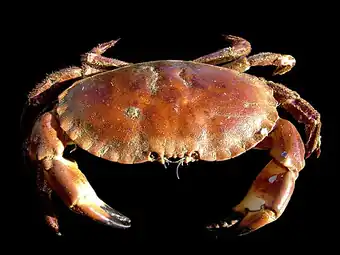
The Crustaceans Portal Crustaceans (from Latin word "crustacea" meaning: "those with shells" or "crusted ones") are mandibulate arthropods that are traditionally a part of the paraphyletic subphylum Crustacea (/krəˈsteɪʃə/). Crustaceans are mainly aquatic, including decapods (shrimps, prawns, crabs, lobsters, and crayfish), seed shrimps, branchiopods, fish lice, krill, remipedes, isopods, barnacles, copepods, opossum shrimps, amphipods and mantis shrimp. It is now well accepted that hexapods (insects and entognathans) are cladistically crustaceans, with the two groups now combined in the monophyletic clade Pancrustacea. The three classes Cephalocarida, Branchiopoda, and Remipedia are more closely related to the hexapods than they are to any other crustaceans (oligostracans and multicrustaceans). The 67,000 described species range in size from Stygotantulus stocki at 0.1 mm (0.004 in), to the Japanese spider crab with a leg span of up to 3.8 m (12.5 ft) and a mass of 20 kg (44 lb). Like other arthropods, crustaceans have an exoskeleton, which they moult to grow. They are distinguished from other groups of arthropods, such as insects, myriapods and chelicerates, by the possession of biramous (two-parted) limbs, and by their larval forms, such as the nauplius stage of branchiopods and copepods. Most crustaceans are free-living aquatic animals, but some are terrestrial (e.g. woodlice, sandhoppers), some are parasitic (e.g. Rhizocephala, fish lice, tongue worms) and some are sessile (e.g. barnacles). The group has an extensive fossil record, reaching back to the Cambrian. More than 7.9 million tons of crustaceans per year are harvested by fishery or farming for human consumption, consisting mostly of shrimp and prawns. Krill and copepods are not as widely fished, but may be the animals with the greatest biomass on the planet, and form a vital part of the food chain. The scientific study of crustaceans is known as carcinology (alternatively, malacostracology, crustaceology or crustalogy), and a scientist who works in carcinology is a carcinologist. (Full article...) Selected article
Did you know?
Selected biography
Selected image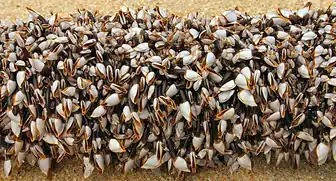 Goose barnacles (order Pedunculata), such as these Lepas anatifera, are filter-feeding crustaceans that live attached to hard surfaces of rocks and flotsam in the intertidal zone. General imagesThe following are images from various crustacean-related articles on Wikipedia.
Crustacean lists
Subcategories Select [►] to view subcategories
Crustacean redirects Related portals
WikiProjects
Associated WikimediaThe following Wikimedia Foundation sister projects provide more on this subject:
Discover Wikipedia using portals
|