Killer whales (orcas) are highly visible marine apex predators that hunt many large species. However, most marine activity takes place among microscopic organisms that cannot be seen individually with the naked eye, such as marine bacteria and phytoplankton.
The Echiura, or spoon worms, are a small group of marineanimals. Once treated as a separate phylum, they are now considered to belong to Annelida. Annelids typically have their bodies divided into segments, but echiurans have secondarily lost their segmentation. The majority of echiurans live in burrows in soft sediment in shallow water, but some live in rock crevices or under boulders, and there are also deep sea forms. More than 230 species have been described. Spoon worms are cylindrical, soft-bodied animals usually possessing a non-retractable proboscis which can be rolled into a scoop-shape to feed. In some species the proboscis is ribbon-like, longer than the trunk and may have a forked tip. Spoon worms vary in size from less than a centimetre in length to more than a metre.
Most are deposit feeders, collecting detritus from the sea floor. Fossils of these worms are seldom found and the earliest known fossil specimen is from the Middle Ordovician. (Full article...)
The emperor penguin (Aptenodytes forsteri) is the tallest and heaviest of all living penguin species and lives exclusively in Antarctica. The male and female are similar in plumage and size, reaching 100cm (39in) in length and weighing from 22 to 45kg (49 to 99lb). Feathers of the head and back are black and sharply delineated from the white belly, pale-yellow breast and bright-yellow ear patches.
Like all species of penguin, the emperor is flightless, with a streamlined body, and wings stiffened and flattened into flippers for a marine habitat. Its diet consists primarily of fish, but also includes crustaceans, such as krill, and cephalopods, such as squid. While hunting, the species can remain submerged around 20 minutes, diving to a depth of 535m (1,755ft). It has several adaptations to facilitate this, including an unusually structured haemoglobin to allow it to function at low oxygen levels, solid bones that reduce barotrauma, and the ability to reduce its metabolism and shut down non-essential organ functions. (Full article...)
Nemertea is a phylum of animals also known as ribbon worms or proboscis worms, consisting of about 1300 known species. Most ribbon worms are very slim, usually only a few millimeters wide, although a few have relatively short but wide bodies. Many have patterns of yellow, orange, red and green coloration.
The foregut, stomach and intestine run a little below the midline of the body, the anus is at the tip of the tail, and the mouth is under the front. A little above the gut is the rhynchocoel, a cavity which mostly runs above the midline and ends a little short of the rear of the body. All species have a proboscis which lies in the rhynchocoel when inactive but everts to emerge just above the mouth to capture the animal's prey with venom. A highly extensible muscle in the back of the rhynchocoel pulls the proboscis in when an attack ends. A few species with stubby bodies filter feed and have suckers at the front and back ends, with which they attach to a host. (Full article...)
Image 5
Southern right whale breaching
Right whales are three species of large baleen whales of the genusEubalaena: the North Atlantic right whale (E. glacialis), the North Pacific right whale (E. japonica) and the southern right whale (E. australis). They are classified in the family Balaenidae with the bowhead whale. Right whales have rotund bodies with arching rostrums, V-shaped blowholes and dark gray or black skin. The most distinguishing feature of a right whale is the rough patches of skin on its head, which appear white due to parasitism by whale lice. Right whales are typically 13–17m (43–56ft) long and weigh up to 100 short tons (91t; 89 long tons) or more.
All three species are migratory, moving seasonally to feed or give birth. The warm equatorial waters form a barrier that isolates the northern and southern species from one another although the southern species, at least, has been known to cross the equator. In the Northern Hemisphere, right whales tend to avoid open waters and stay close to peninsulas and bays and on continental shelves, as these areas offer greater shelter and an abundance of their preferred foods. In the Southern Hemisphere, right whales feed far offshore in summer, but a large portion of the population occur in near-shore waters in winter. Right whales feed mainly on copepods but also consume krill and pteropods. They may forage the surface, underwater or even the ocean bottom. During courtship, males gather into large groups to compete for a single female, suggesting that sperm competition is an important factor in mating behavior. Gestation tends to last a year, and calves are weaned at eight months old. (Full article...)
The sea otter (Enhydra lutris) is a marine mammal native to the coasts of the northern and eastern North Pacific Ocean. Adult sea otters typically weigh between 14 and 45kg (30–100lb), making them the heaviest members of the weasel family, but among the smallest marine mammals. Unlike most marine mammals, the sea otter's primary form of insulation is an exceptionally thick coat of fur, the densest in the animal kingdom. Although it can walk on land, the sea otter is capable of living exclusively in the ocean.
The sea otter inhabits nearshore environments, where it dives to the sea floor to forage. It preys mostly on marine invertebrates such as sea urchins, various mollusks and crustaceans, and some species of fish. Its foraging and eating habits are noteworthy in several respects. Its use of rocks to dislodge prey and to open shells makes it one of the few mammal species to use tools. In most of its range, it is a keystone species, controlling sea urchin populations which would otherwise inflict extensive damage to kelp forestecosystems. Its diet includes prey species that are also valued by humans as food, leading to conflicts between sea otters and fisheries. (Full article...)
Image 7
Ctenophora (/təˈnɒfərə/; fromAncient Greekκτείς (kteis)'comb'andφέρω (pherō)'to carry') or ctenophores (/ˈtɛnəfɔːr,ˈtiːnə-/), commonly known as comb jellies, is a basal phylum of marine invertebrateanimals notable for their unique aquatic locomotion using groups of cilia (commonly referred to as "combs"). They inhabit marine habitats worldwide, with 186 recognised living species.
Ctenophores are the largest animals to swim with cilia, with adult ctenophores range from a few millimeters to 1.5m (5ft) in size depending on the species. Their bodies consist of a mass of jelly (mesoglea) with a two-cell-thick layer on the outside, and another lining the internal cavity. The phylum has a wide range of body forms, including the egg-shaped cydippids with a pair of retractable tentacles that capture prey; the flat, generally combless platyctenids; and the large-mouthed beroids, which prey on other ctenophores. (Full article...)
Albatrosses, of the biological familyDiomedeidae, are large seabirds related to the procellariids, storm petrels, and diving petrels in the order Procellariiformes (the tubenoses). They range widely in the Southern Ocean and the North Pacific. They are absent from the North Atlantic, although fossil remains of short-tailed albatross show they lived there up to the Pleistocene, and occasional vagrants are found. Generally, the group depends on cold water currents for their foraging and nesting grounds. The geographically outlying genus Phoebastria which includes 3 North Pacific species and an equatorial (Galapagos) species exploits the California, Alaska, Oyashio and Humboldt currents, nesting on major oceanic islands near those currents.
Great albatrosses are among the largest of flying birds, with wingspans reaching up to 2.5–3.5 metres (8.2–11.5ft) and bodies over 1 metre (3.3ft) in length. The albatrosses are usually regarded as falling into four genera, but disagreement exists over the number of species. (Full article...)
A coral "group" is a colony of very many genetically identical polyps. Each polyp is a sac-like animal typically only a few millimeters in diameter and a few centimeters in height. A set of tentacles surround a central mouth opening. Each polyp excretes an exoskeleton near the base. Over many generations, the colony thus creates a skeleton characteristic of the species which can measure up to several meters in size. Individual colonies grow by asexual reproduction of polyps. Corals also breed sexually (two parts completing a whole) by spawning: polyps of the same species and release gametes simultaneously overnight, often around a full moon. Fertilized eggs form planulae, a mobile early form of the coral polyp which, when mature, settles to form a new colony. (Full article...)
Image 10
The false killer whale (Pseudorca crassidens) is a species of oceanic dolphin that is the only extant representative of the genus Pseudorca. It is found in oceans worldwide but mainly in tropical regions. It was first described in 1846 as a species of porpoise based on a skull, which was revised when the first carcasses were observed in 1861. The name "false killer whale" comes from having a skull similar to the orca or killer whale (Orcinus orca).
The false killer whale reaches a maximum length of 6m (20ft), though size can vary around the world. It is highly sociable, known to form pods of up to 50 members, and can also form pods with other dolphin species, such as the common bottlenose dolphin (Tursiops truncatus). It can form close bonds with other species, as well as have sexual interactions with them. But the false killer whale has also been known to eat other dolphins, though it typically eats squid and fish. It is a deep-diver; maximum known depth is 927.5m (3,043ft); maximum speed is around 30km/h (19mph). (Full article...)
Selected article -
Biological oceanography is the study of how organisms affect and are affected by the physics, chemistry, and geology of the oceanographic system. Biological oceanography may also be referred to as ocean ecology, in which the root word of ecology is Oikos (oικoσ), meaning ‘house’ or ‘habitat’ in Greek. The main focus of biological oceanography is on the microorganisms within the ocean; looking at how they are affected by their environment and how that affects larger marine creatures and their ecosystem. Biological oceanography is similar to marine biology, but is different because of the perspective used to study the ocean. Biological oceanography takes a bottom-up approach (in terms of the food web), while marine biology studies the ocean from a top-down perspective. Biological oceanography mainly focuses on the ecosystem of the ocean with an emphasis on plankton: their diversity (morphology, nutritional sources, motility, and metabolism); their productivity and how that plays a role in the global carbon cycle; and their distribution (predation and life cycle). (Full article...)
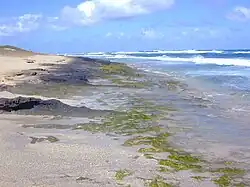
Image 6Waves and currents shape the intertidal shoreline, eroding the softer rocks and transporting and grading loose particles into shingles, sand or mud (from Marine habitat)
Image 7The Ocean Cleanup is one of many organizations working toward marine conservation such at this interceptor vessel that prevents plastic from entering the ocean. (from Marine conservation)
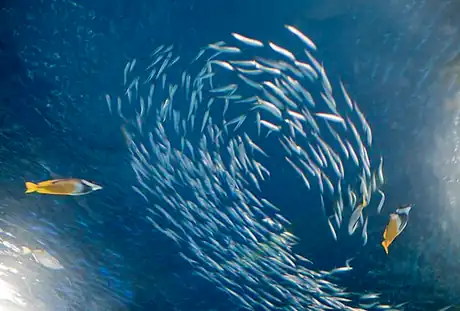
Image 8On average there are more than one million microbial cells in every drop of seawater, and their collective metabolisms not only recycle nutrients that can then be used by larger organisms but also catalyze key chemical transformations that maintain Earth's habitability. (from Marine food web)
Image 9Dickinsonia is one of the earliest widely accepted and undisputed animal fossils. They appear in the fossil record 571 million to 539 million years ago. (from Marine invertebrates)
Image 13Cnidarians are the simplest animals with cells organised into tissues. Yet the starlet sea anemone contains the same genes as those that form the vertebrate head. (from Marine invertebrates)
Different bacteria shapes (cocci, rods and spirochetes) and their sizes compared with the width of a human hair. A few bacteria are comma-shaped (vibrio). Archaea have similar shapes, though the archaeon Haloquadratum is flat and square.
The unit μm is a measurement of length, the micrometer, equal to 1/1,000 of a millimeter
Image 23Areas around the world that focus on protecting biodiversity and population recovery. (from Marine conservation)
Image 24The distribution of anthropogenic stressors faced by marine species threatened with extinction in various marine regions of the world. Numbers in the pie charts indicate the percentage contribution of an anthropogenic stressors' impact in a specific marine region. (from Marine food web)
Image 25Cycling of marine phytoplankton. Phytoplankton live in the photic zone of the ocean, where photosynthesis is possible. During photosynthesis, they assimilate carbon dioxide and release oxygen. If solar radiation is too high, phytoplankton may fall victim to photodegradation. For growth, phytoplankton cells depend on nutrients, which enter the ocean by rivers, continental weathering, and glacial ice meltwater on the poles. Phytoplankton release dissolved organic carbon (DOC) into the ocean. Since phytoplankton are the basis of marine food webs, they serve as prey for zooplankton, fish larvae and other heterotrophic organisms. They can also be degraded by bacteria or by viral lysis. Although some phytoplankton cells, such as dinoflagellates, are able to migrate vertically, they are still incapable of actively moving against currents, so they slowly sink and ultimately fertilize the seafloor with dead cells and detritus. (from Marine food web)
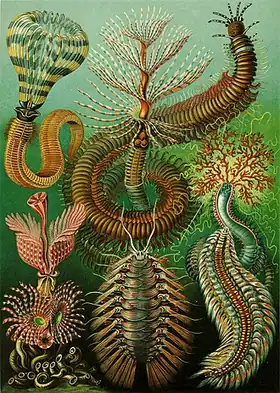
Image 30Ernst Haeckel's 96th plate, showing some marine invertebrates. Marine invertebrates have a large variety of body plans, which are currently categorised into over 30 phyla. (from Marine invertebrates)
This representation includes the traditionally neglected pelagic fungi, both parasitic and saprotrophic, highlighting the central role played by them, parasitic fungi in the mycoloop, and saprotrophic fungi as active contributors to the microbial loop. As depicted by this diagram, the activity of heterotrophic microbes, including pelagic fungi, has far-reaching global implications for fisheries (i.e., the amount of carbon that will ultimately flow to higher trophic levels) and climate change (i.e., the amount of carbon that will be sequestered in the ocean or respired back to CO2 and the release of other greenhouse gases; e.g., N2O). (from Marine fungi)
Image 41Estuaries occur when rivers flow into a coastal bay or inlet. They are nutrient rich and have a transition zone which moves from freshwater to saltwater. (from Marine habitat)
Image 42Marine Species Changes in Latitude and Depth in three different ocean regions(1973–2019) (from Marine food web)
Image 44Anthropogenic stressors to marine species threatened with extinction (from Marine food web)
Image 45Conceptual diagram of faunal community structure and food-web patterns along fluid-flux gradients within Guaymas seep and vent ecosystems. (from Marine food web)
Image 46
Model of the energy generating mechanism in marine bacteria
(1) When sunlight strikes a rhodopsin molecule (2) it changes its configuration so a proton is expelled from the cell (3) the chemical potential causes the proton to flow back to the cell (4) thus generating energy (5) in the form of adenosine triphosphate. (from Marine prokaryotes)
Image 50Archaea were initially viewed as extremophiles living in harsh environments, such as the yellow archaea pictured here in a hot spring, but they have since been found in a much broader range of habitats. (from Marine prokaryotes)
General images -
The following are images from various marine life-related articles on Wikipedia.
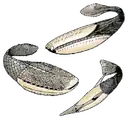
Image 8Lampreys are often parasitic and have a toothed, funnel-like sucking mouth (from Marine vertebrate)
Image 9Ecosystem services delivered by epibenthicbivalve reefs. Reefs provide coastal protection through erosion control and shoreline stabilization, and modify the physical landscape by ecosystem engineering, thereby providing habitat for species by facilitative interactions with other habitats such as tidal flat benthic communities, seagrasses and marshes. (from Marine ecosystem)
... that a person required intensive care after being splashed with salt water by a beluga whale?
More Did you know -
... Some cichlid fish, crocodiles and frogs keep their eggs or young in their mouths or stomachs.
... there are probably types of cetaceans that are as yet unknown. For example, the Longman's beaked whale is only known from skulls washed ashore in Somalia and Australia. It has never been seen alive!
... cetaceans with pointed beaks have good binocular vision, but others, such as the Sperm Whale cannot see directly in front or behind.
... the Sperm Whale, at 18 metres long, is the largest toothed animal to have ever lived.
... Epaulette sharks are often found in rock pools. They can move from one pool to another across dry land, by dragging themselves with their strong pectoral fins.
... the ‘strapped toothed’ whale is so called because in mature males there are only two teeth in the bottom jaw and these completely ‘strap’ the upper jaw, preventing it from opening more than a few centimetres. How these animals eat is unknown, but it may be that they stun their prey with high intensity sound.
The Green Sea Turtle (Chelonia mydas) is a large sea turtle, the only member of the genus Chelonia (Brongniart, 1800). This turtle grows to 1-1.5 m in length, and can weigh 200 kg, making it the largest of the hard-shelled turtles. Its distribution extends throughout tropical, subtropical and some warmer temperate waters. Females lay their eggs on traditional nesting beaches, and the turtles often bask in the sand to warm their ectothermic bodies, but otherwise this species is entirely marine.














 See also

 Commons
 Wikidata
 Wikiquote
 Wikisource
 Wikiversity
 Wiktionary
 The Wikiproject associated with this portal is the Marine Life WikiProject

 List of all portals






 Random portal
 WikiProject Portals