Entries here consist of Good and Featured articles, which meet a core set of high editorial standards.
Tricolour Beagle
The Beagle is a British breed of scent hound, similar in appearance to the much larger foxhound. It was bred primarily for hunting rabbit or hare, known as beagling. Its sense of smell and tracking instincts make it suitable for use as a detection dog for prohibited agricultural imports and foodstuffs in quarantine. It is commonly kept as a companion dog.
Brittle stars, serpent stars, or ophiuroids (fromLatin ophiurus'brittle star'; fromAncient Greekὄφις (óphis)'serpent'andοὐρά (ourá)'tail'; referring to the serpent-like arms of the brittle star) are echinoderms in the class Ophiuroidea. They crawl across the sea floor using their flexible arms for locomotion. The ophiuroids generally have five long, slender, whip-like arms which may reach up to 60cm (24in) in length on the largest specimens. (Full article...)
Sexual dimorphism is the condition where the two sexes of the same species exhibit different characteristics. Differences may include secondary sex characteristics, size, weight, color, or markings, as well as behavioral and cognitive differences. In the butterfly species Colias dimera (also known as the Dimera sulphur), seen here mating in Venezuela, the male on the right is a brighter shade of yellow than the female.
The golden toad (Bufo periglenes) is an extinct species of true toad that was once abundant in a small region of high-altitude cloud-covered tropical forests, about 30km2 (12sqmi) in area, above the city of Monteverde, Costa Rica. The last reported sighting of a golden toad was on 15 May 1989. Its sudden extinction may have been caused by chytrid fungus and extensive habitat loss.
Cymbiola nobilis is a species of sea snail in the familyVolutidae. Found in the Pacific Ocean, from Taiwan to Singapore, it averages 6 centimetres (2.4in) in length; females are larger than males. Because the shell is commonly collected, there has been an overharvesting of the snail, and it is now considered vulnerable.
Bolinus cornutus is a predatory species of sea snail, a marine gastropodmollusk in the familyMuricidae. This species is common along the west coast of Africa, where it prefers moderately shallow waters. The shell of the snail is distinctively large, spiny, and club-shaped, usually pale brown or tan in colour, with an elongated and straight siphonal canal.
The eastern grey kangaroo (Macropus giganteus) is a marsupial found in the eastern third of Australia, with a population of several million. The eastern grey kangaroo is the second largest living marsupial and native land mammal in Australia, with adult males weighing around 50 to 66kg (110 to 146lb) and females weighing around 17 to 40kg (37 to 88lb). Like all kangaroos, it is mainly nocturnal and crepuscular, and is mostly seen early in the morning, or as the light starts to fade in the evening. In the middle of the day, kangaroos rest in the cover of the woodlands and graze there. Kangaroos are the only large mammals to hop on two legs as their primary means of locomotion. This multiple exposure photograph shows an eastern grey kangaroo hopping in Mount Annan, New South Wales.
Liguus virgineus, also known as the candy cane snail, is a species of snail in the family Orthalicidae. It is native to the Caribbean island of Hispaniola, in the nations of Haiti and the Dominican Republic. There have also been at least three reports of living specimens being found in the Florida Keys of the United States. The snail lives on trees and feeds on moss, fungi and microscopic algae covering the bark.
Platyhelminthes (fromAncient Greekπλατύ (platy)'flat'andἕλμινς (helmins)'parasitic worm') is a phylum of relatively simple bilaterian, unsegmented, soft-bodied invertebrates commonly called flatworms or flat worms. Being acoelomates (having no body cavity), and having no specialised circulatory and respiratoryorgans, they are restricted to having flattened shapes that allow oxygen and nutrients to pass through their bodies by diffusion. The digestive cavity has only one opening for both ingestion (intake of nutrients) and egestion (removal of undigested wastes); as a result, the food can not be processed continuously. (Full article...)
A soybean cyst nematode (Heterodera glycines), together with an egg, as viewed through a low-temperature scanning electron microscope at 1000x magnification. This nematode infects the roots of soybeans, and the female nematode eventually becomes a cyst. Infection causes various symptoms that may include chlorosis of the leaves and stems, root necrosis, loss in seed yield and suppression of root and shoot growth.
Anatomical diagram of an adult female chambered nautilus, the best known species of nautilus, a "living fossil" related to the octopuses. The animal has a primitive brain that forms a ring around its oesophagus, has four gills (all other cephalopods have only two), and can only move shell-first (seemingly "backwards") by pumping water out through its funnel. The shell and tentacles are shown here as shadows.
Velodona togata is the only species in the octopus genus Velodona; the genus and species names come from the large membranes that connect its arms. It was first described by Carl Chun in his book Die Cephalopoden (from which this illustration is taken) in 1915. A second subspecies was described by Guy Coburn Robson in 1924.
The Common Brushtail Possum (Trichosurus vulpecula) is the largest possum species and is perhaps the most widespread mammal in Australia. It grows to about 32–58cm (13–23in) in length, with an additional 24–40cm (9–16in) for its prehensile tail (seen here hanging below the branch). It is mainly a folivore, but has been known to eat small mammals such as rats. It is common in cities, having adapted well to human habitation.
A macro view of a Gonia capitatafly feeding on honey, showing its proboscis and pedipalps (the two appendages protruding from the proboscis), two types of insect mouthparts. The proboscis actually comprises the labium, a quadrupedal structure, and a sponge-like labellum at the end. Flies eat solid food by secreting saliva and dabbing it over the food item. As the saliva dissolves the food, the solution is then drawn up into the mouth as a liquid. The labellum's surface is covered by minute food channels which form a tube leading to the esophagus, and food is drawn up the channels by capillary action.
The Bryozoa (also known as the Polyzoa, Ectoprocta or commonly as moss animals) are a phylum of simple, aquaticinvertebrate animals, nearly all living in sedentary colonies. Typically about 0.5 millimetres (1⁄64in) long, they have a special feeding structure called a lophophore, a "crown" of tentacles used for filter feeding. The bryozoa are classified as the marine bryozoa (Stenolaemata), freshwater bryozoa (Phylactolaemata), and mostly-marine bryozoa (Gymnolaemata), a few members of which prefer brackish water. Most marine bryozoans live in tropical waters, but a few are found in oceanic trenches and polar waters. 5,869living species of bryozoa are known. Originally all of the crown group Bryozoa were colonial, but as an adaptation to a mesopsammal (interstitial spaces in marine sand) life or to deep-sea habitats, secondarily solitary forms have since evolved. Five genera are solitary: Aethozooides, Aethozoon, Franzenella, Solella, which together make up the family Aethozoidae, and Monobryozoon, which has a statocyst-like organ with a supposed excretory function. (Full article...)
Entries here consist of Good and Featured articles, which meet a core set of high editorial standards.
Ants (family Formicidae in the orderHymenoptera) are the most species-rich of all social insects, with more than 12,000 described species and many others awaiting description. Formicidae is divided into 21 subfamilies, of which 17 contain extanttaxa, while four are exclusively fossil. Ants have come to occupy virtually all major terrestrial habitats, with the exception of tundra and cold ever-wet forests. They display a wide range of social behaviors, foraging habits and associations with other organisms, which has generated scientific and public interest. (Full article...)
...that six new species of marine slugs in the genus Phyllodesmium(Sp. kabiranum pictured) have been described in the last two years?
...that Maui's dolphin is the most endangered species of dolphin in the world, with only about 110 left?
...that the land snail Euglandina rosea is a significant threat to Hawaiian freshwater snail known as Newcomb's snail (Erinna newcombi), because the predatory Euglandina is able to hunt Erinna under water?
...that the body of the "X-ray fish" (Pristella maxillaris ) is so transparent that it is possible to see its backbone?
Image 8A brilliantly-coloured oriental sweetlips fish (Plectorhinchus vittatus) waits while two boldly-patterned cleaner wrasse (Labroides dimidiatus) pick parasites from its skin. The spotted tail and fin pattern of the sweetlips signals sexual maturity; the behaviour and pattern of the cleaner fish signal their availability for cleaning service, rather than as prey. (from Animal coloration)
Image 24The microscopic cave snail Zospeumtholussum, found at depths of 743 to 1,392m (2,438 to 4,567ft) in the Lukina Jama–Trojama cave system of Croatia, is completely blind with a translucent shell (from Fauna)
Image 25Kelp gull chicks peck at red spot on mother's beak to stimulate the regurgitating reflex. (from Zoology)
Image 38Idealised nephrozoan body plan. With an elongated body and a direction of movement the animal has head and tail ends. Sense organs and mouth form the basis of the head. Opposed circular and longitudinal muscles enable peristaltic motion. (from Animal)
Image 40A clade representation of seven dog breeds in relation to wolves. (from Zoology)
Image 41The hawk-cuckoo resembles a predatory shikra, giving the cuckoo time to lay eggs in a songbird's nest unnoticed (from Animal coloration)
Image 42Fish and frog melanophores are cells that can change colour by dispersing or aggregating pigment-containing bodies. (from Animal coloration)
Image 43A praying mantis in deimatic or threat pose displays conspicuous patches of colour to startle potential predators. This is not warning coloration as the insect is palatable. (from Animal coloration)
Image 44The blue whale is the largest animal that has ever lived; it can be up to 33.6 metres (110ft) long. (from Animal)
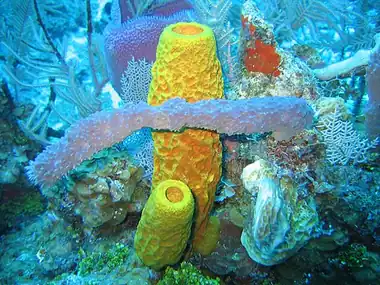
Image 45Bright coloration of orange elephant ear sponge, Agelas clathrodes signals its bitter taste to predators (from Animal coloration)
The following table lists estimated numbers of described extant species for the animal groups with the largest numbers of species,[1] along with their principal habitats (terrestrial, fresh water,[2] and marine),[3] and free-living or parasitic ways of life.[4] Species estimates shown here are based on numbers described scientifically; much larger estimates have been calculated based on various means of prediction, and these can vary wildly. For instance, around 25,000–27,000 species of nematodes have been described, while published estimates of the total number of nematode species include 10,000–20,000; 500,000; 10 million; and 100 million.[5] Using patterns within the taxonomic hierarchy, the total number of animal species—including those not yet described—was calculated to be about 7.77 million in 2011.[6][7][a]
↑The application of DNA barcoding to taxonomy further complicates this; a 2016 barcoding analysis estimated a total count of nearly 100,000 insect species for Canada alone, and extrapolated that the global insect fauna must be in excess of 10 million species, of which nearly 2 million are in a single fly family known as gall midges (Cecidomyiidae).[8]
↑Stork, Nigel E. (January 2018). "How Many Species of Insects and Other Terrestrial Arthropods Are There on Earth?". Annual Review of Entomology. 63 (1): 31–45. doi:10.1146/annurev-ento-020117-043348. PMID28938083. S2CID23755007. Stork notes that 1m insects have been named, making much larger predicted estimates.
↑Poore, Hugh F. (2002). "Introduction". Crustacea: Malacostraca. Zoological catalogue of Australia. Vol.19.2A. CSIRO Publishing. pp.1–7. ISBN978-0-643-06901-5.
1234Nicol, David (June 1969). "The Number of Living Species of Molluscs". Systematic Zoology. 18 (2): 251–254. doi:10.2307/2412618. JSTOR2412618.
↑Sluys, R. (1999). "Global diversity of land planarians (Platyhelminthes, Tricladida, Terricola): a new indicator-taxon in biodiversity and conservation studies". Biodiversity and Conservation. 8 (12): 1663–1681. doi:10.1023/A:1008994925673. S2CID38784755.
↑Morand, Serge; Krasnov, Boris R.; Littlewood, D. Timothy J. (2015). Parasite Diversity and Diversification. Cambridge University Press. p.44. ISBN978-1-107-03765-6. Archived from the original on 12 December 2018. Retrieved 2 March 2018.





















 Commons
 Wikidata
 Wikiquote
 Wikisource
 Wikispecies
 Wikiversity
 Wiktionary
 List of all portals






 Random portal
 WikiProject Portals