Portal:Biology


Introduction


Biology is the scientific study of life and living organisms. It is a broad natural science that encompasses a wide range of fields and unifying principles that explain the structure, function, growth, origin, evolution, and distribution of life. Central to biology are five fundamental themes: the cell as the basic unit of life, genes and heredity as the basis of inheritance, evolution as the driver of biological diversity, energy transformation for sustaining life processes, and homeostasis, the maintenance of internal stability.
Biology examines life across multiple levels of organization, from molecules and cells to organisms, population, and ecosystems. Subdisciplines include molecular biology, physiology, ecology, evolutionary biology, developmental biology, and systematics, among others. Each of these fields applies a range of methods to investigate biological phenomena, including observation, experimentation, and mathematical modeling. Modern biology is grounded in the theory of evolution by natural selection, first articulated by Charles Darwin, and in the molecular understanding of genes encoded in DNA. The discovery of the structure of DNA and advances in molecular genetics have transformed many areas of biology, leading to applications in medicine, agriculture, biotechnology, and environmental science.
Biologists classify organisms—from single-celled archaea and bacteria to multicellular plants, fungi, and animals—based on shared characteristics and evolutionary relationships, using taxonomic and phylogenetics. (Full article...)
Selected article -

Natural selection is the differential survival and reproduction of individuals due to differences in the relative fitness endowed on them by their own particular complement of observable characteristics. It is a key law or mechanism of evolution which changes the heritable traits characteristic of a population or species over generations. Charles Darwin popularised the term "natural selection", contrasting it with artificial selection, which is intentional, whereas natural selection is not.
For Darwin, natural selection was a law or principle which resulted from three different kinds of process: inheritance, including the transmission of heritable material from parent to offspring and its development (ontogeny) in the offspring; variation, which partly resulted from an organism's own agency; and the struggle for existence, which included both competition between organisms and cooperation or 'mutual aid' (particularly in 'social' plants and social animals). (Full article...)
Selected picture -

Major topics
Selected biography -

Dame Valerie Jane Morris Goodall (/ˈɡʊdɔːl/ GUUD-awl; née Morris-Goodall; 3 April 1934 – 1 October 2025) was an English primatologist and anthropologist. Regarded as a pioneer in primate ethology, and described by many publications as "the world's preeminent chimpanzee expert", she was best known for more than six decades of field research on the social and family life of wild chimpanzees in the Kasakela chimpanzee community at Gombe Stream National Park in Tanzania. Beginning in 1960, under the mentorship of the palaeontologist Louis Leakey, Goodall's research demonstrated that chimpanzees share many key traits with humans, such as using tools, having complex emotions, forming lasting social bonds, engaging in organised warfare, and passing on knowledge across generations, which redefined the traditional view that humans are uniquely different from other animals.
In 1965 Goodall was awarded a PhD in ethology from the University of Cambridge. In the 1960s Goodall published several accounts of her research in Tanzania, including a series of articles in National Geographic. Her first book-length study, In the Shadow of Man (1971), was later translated into 48 languages. She founded the Jane Goodall Institute in 1977 to promote wildlife conservation, followed by the Roots & Shoots youth programme in 1991, which grew into a global network. Goodall also established wildlife sanctuaries and reforestation projects in Africa and campaigned for the ethical treatment of animals in animal testing, animal husbandry and captivity. Goodall was appointed a United Nations Messenger of Peace in 2002, and advised organisations such as Save the Chimps and the Society for the Protection of Underground Networks. (Full article...)
General images -
 Thomas Hunt Morgan's illustration of crossing over, part of the Mendelian-chromosome theory of heredity (from History of biology)
 De arte venandi, by Frederick II, Holy Roman Emperor, was an influential medieval natural history text that explored bird morphology. (from History of biology)
 Penicillin was viewed as a miracle drug that brought enormous profits and public expectations. (from History of biotechnology)
 Clay models of animal livers dating between the nineteenth and eighteenth centuries BCE, found in the royal palace at Mari (from History of biology)
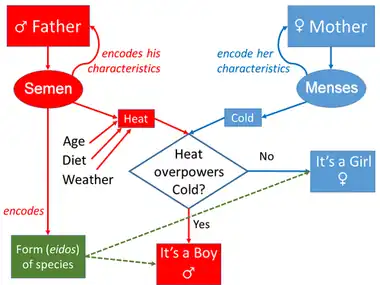 Aristotle's model of transmission of movements from parents to child, and of form from the father. The model is not fully symmetric. (from History of genetics)
 Charles Darwin's first sketch of an evolutionary tree from his First Notebook on Transmutation of Species (1837) (from History of biology)
 Mendelian inheritance states characteristics are discrete and are inherited by the parents. This image depicts a monohybrid cross and shows 3 generations: P1 generation (1), F1 generation (2), and F2 generation (3). Each organism inherits two alleles, one from each parent, that make up the genotype. The observed characteristic, the phenotype, is determined by the dominant allele in the genotype. In this monohybrid cross the dominant allele encodes for the colour red and the recessive allele encodes for the colour white. (from History of genetics)
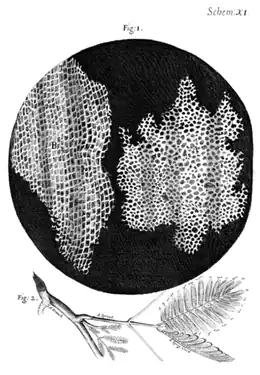 In Micrographia, Robert Hooke had applied the word cell to biological structures such as this piece of cork, but it was not until the 19th century that scientists considered cells the universal basis of life. (from History of biology)
 Wendell Stanley's crystallization of tobacco mosaic virus as a pure nucleoprotein in 1935 convinced many scientists that heredity might be explained purely through physics and chemistry. (from History of biology)

 2016 conservation indicator which includes the following indicators: marine protected areas, terrestrial biome protection (global and national), and species protection (global and national) (from Conservation biology)
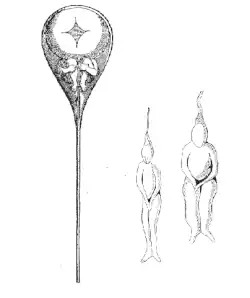
 A biomedical work by Ibn al-Nafis, an early adherent of experimental dissection who discovered the pulmonary and coronary circulation (from History of biology)
 A Genentech-sponsored sign declaring South San Francisco to be "The Birthplace of Biotechnology." (from History of biotechnology)
 Synthetic insulin crystals synthesized using recombinant DNA technology (from History of biotechnology)
 Inside of a 48-well thermal cycler, a device used to perform polymerase chain reaction on many samples at once (from History of biology)
 Innovative laboratory glassware and experimental methods developed by Louis Pasteur and other biologists contributed to the young field of bacteriology in the late 19th century. (from History of biology)
 Frontispiece to a 1644 version of the expanded and illustrated edition of Historia Plantarum, originally written by Theophrastus around 300 BCE (from History of biology)
 The "central dogma of molecular biology" (originally a "dogma" only in jest) was proposed by Francis Crick in 1958. This is Crick's reconstruction of how he conceived of the central dogma at the time. The solid lines represent (as it seemed in 1958) known modes of information transfer, and the dashed lines represent postulated ones. (from History of biology)
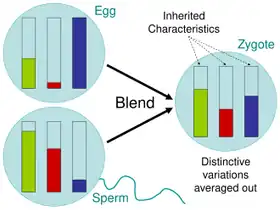 Blending Inheritance (from History of genetics)
 A pie chart image showing the relative biomass representation in a rain forest through a summary of children's perceptions from drawings and artwork (left), through a scientific estimate of actual biomass (middle), and by a measure of biodiversity (right). The biomass of social insects (middle) far outweighs the number of species (right). (from Conservation biology)
 Efforts are made to preserve the natural characteristics of Hopetoun Falls, Australia, without affecting visitors' access. (from Conservation biology)
 Gregor Mendel, "father of modern genetics" (from History of biology)
 Statue of Robert Koch in Berlin. Koch directly provided proof for the germ theory of diseases, therefore creating the scientific basis of public health, saving millions of lives. For his life's work Koch is seen as one of the founders of modern medicine. (from History of biology)
 August Weismann's germ plasm theory. The hereditary material, the germ plasm, is confined to the gonads. Somatic cells (of the body) develop afresh in each generation from the germ plasm. (from History of genetics)
 Carefully engineered strains of the bacterium Escherichia coli are crucial tools in biotechnology as well as many other biological fields. (from History of biology)
 Thomas Hunt Morgan discovered sex linked inheritance of the white eyed mutation in the fruit fly Drosophila in 1910, implying the gene was on the sex chromosome. (from History of genetics)
 In the course of his travels, Alexander von Humboldt mapped the distribution of plants across landscapes and recorded a variety of physical conditions such as pressure and temperature. (from History of biology)
 Diagram of Charles Darwin's pangenesis theory. Every part of the body emits tiny particles, gemmules, which migrate to the gonads and contribute to the fertilised egg and so to the next generation. The theory implied that changes to the body during an organism's life would be inherited, as proposed in Lamarckism. (from History of genetics)
 Cabinets of curiosities, such as that of Ole Worm, were centers of biological knowledge in the early modern period, bringing organisms from across the world together in one place. Before the Age of Exploration, naturalists had little idea of the sheer scale of biological diversity. (from History of biology)
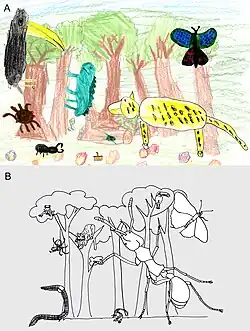 An art scape image showing the relative importance of animals in a rain forest through a summary of (a) child's perception compared with (b) a scientific estimate of the importance. The size of the animal represents its importance. The child's mental image places importance on big cats, birds, butterflies, and then reptiles versus the actual dominance of social insects (such as ants). (from Conservation biology)
 More conservation research is needed for understanding ecology and behaviour of the dhole in central China. (from Conservation biology)

 Some biodiversity loss is more insidious than others due to systemic neglect. For example, sport killing and wanton waste of tons of native fishes from unregulated 21st century bowfishing in the United States. New conservation movements are needed to deter irreparable biodiversity loss to fragile freshwater ecosystems. (from Conservation biology)
 Theodore Roosevelt and John Muir on Glacier Point in Yosemite National Park (from Conservation biology)
 Summary of 2006 IUCN Red List categories:EX (Extinct) — EW (Extinct in the Wild) — CR (Critically Endangered) — EN (Endangered) — VU (Vulnerable) — NT (Near Threatened) — LC (Least Concern) (from Conservation biology)
 The frontispiece to Erasmus Darwin's evolution-themed poem The Temple of Nature shows a goddess pulling back the veil from nature (in the person of Artemis). Allegory and metaphor have often played an important role in the history of biology. (from History of biology)
 Brewing was an early example of biotechnology (from History of biotechnology)
 Description of rare animals (写生珍禽图), by Huang Quan (903–965) during the Song dynasty (from History of biology)
Did you know -

- ... that the p19 protein (dimer pictured) evolved in an arms race between plants and viruses?
- ...that there are about a million nephrons in a human kidney?
- ... that the semi-aquatic grasshopper Cornops aquaticum is being trialled in South Africa as a biological control agent for the invasive water hyacinth?
Things you can do
|
|
Here are some Open Tasks :
|

Related portals
Biology portals
Categories

Anatomy - Anthropology - Astrobiology - Biochemistry - Bioengineering - Bioinformatics - Biotechnology - Botany - Cell biology - Conservation biology - Developmental biology - Ecology - Environmental science - Evolutionary biology - Genetics - Mathematical biology - Medicine - Microbiology - Immunology - Molecular biology - Mycology - Neuroscience - Paleontology - Palynology Parasitology - Pharmacology -
Phylogenetics - Physiology - Systems biology - Taxonomy - Toxicology - Virology - ZoologyMore topics
| Overview |
|  |
|---|---|---|
| Chemical basis | ||
| Cells | ||
| Genetics | ||
| Evolution | ||
| Diversity | ||
| Plant form, function | ||
| Animal form, function | ||
| Ecology | ||
| ||


| Fields, disciplines | |
|---|---|
| Theories, concepts | |
| Related | |
WikiProjects

WikiProjects connected with biology:
- Computational biology
- Conservation worldwide
- Ecology
- Extinction
- Ecoregions
- Evolutionary biology
- Game theory
- Genetics
- History of Science
- Marine life
- Medicine
- Microbiology
- Molecular and Cellular Biology
- Neuroscience
- Tree of Life
- Fungi
- Plants
- Arthropods
- Bivalves
- Cephalopods
- Gastropods
- Fishes
- Amphibians and Reptiles
- Birds
- Mammals
- Viruses
A complete list of scientific WikiProjects can be found here. See also Wikispecies, a Wikimedia project dedicated to classification of biological species.
Associated Wikimedia
The following Wikimedia Foundation sister projects provide more on this subject:
-
 Commons
Free media repository -
 Wikidata
Free knowledge base -
 Wikiquote
Collection of quotations -
 Wikisource
Free-content library -
 Wikiversity
Free learning tools -
 Wiktionary
Dictionary and thesaurus
-
 List of all portals
-

-

-

-

-

-

-

-

-

-
 Random portal
-
 WikiProject Portals
Shortcuts to this page: Biology portal • P:BIO