Portal:Paleontology

|
The Palaeontology Portal
Introduction Paleontology or palaeontology is the scientific study of the life of the past, mainly but not exclusively through the study of fossils. Paleontologists use fossils as a means to classify organisms, measure geologic time, and assess the interactions between prehistoric organisms and their natural environment. While paleontological observations are known from at least the 6th century BC, the foundation of paleontology as a science dates back to the work of Georges Cuvier in 1796. Cuvier demonstrated evidence for the concept of extinction and how the life of the past was not necessarily the same as that of the present. The field developed rapidly over the course of the following decades, and the French word paléontologie was introduced for the study in 1822, which was derived from the Ancient Greek word for 'ancient' and words describing relatedness and a field of study. Further advances in the field accompanied the work of Charles Darwin who popularized the concept of evolution. Together, evolution and extinction can be understood as complementary processes that shaped the history of life. Paleontology overlaps the most with the fields of geology and biology. It draws on technology and analysis of a wide range of sciences to apply them to the study of life and environments of the past, particularly for the subdisciplines of paleobiology and paleoecology that are analogous to biology and ecology. Paleontology also contributes to other sciences, being utilized for biostratigraphy to reconstruct the geologic time scale of Earth, or in studies on extinction to establish both external and internal factors that can lead to the disappearance of a species. Much of the history of life is now better understood because of advances in paleontology and the increase in interdisciplinary studies. Several improvements in understanding have occurred from the introduction of theoretical analysis to paleontology in the 1950s and 1960s which led to the rise of more focused fields of paleontology that assess the changing geography and climate of Earth, the phylogenetic relationships between different species, and the analysis of how fossilization occurs and what biases can impact the quality of the fossil record. (Full article...) Selected article on the prehistoric world and its legacies Did you know?

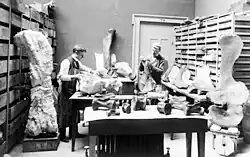
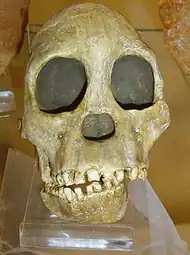
General images -The following are images from various paleontology-related articles on Wikipedia.
Selected article on paleontology in human science, culture and economics After the success of Spielberg's Jurassic Park, Joe Johnston expressed interest in directing a sequel, a film adaptation of The Lost World. Spielberg instead gave Johnston permission to direct the third film in the series, if there were to be one. Production of Jurassic Park III began on August 30, 2000. Upon its release, the film received mixed reviews, with many praising the visual effects and action scenes but finding the plot clichéd and unoriginal. Despite being less well-received than the previous films, Jurassic Park III was a box office success, grossing $368 million worldwide. (see more...) On this day...
Selected image
Categories Select [►] to view subcategories
Paleontology images TopicsGeneral - Paleontology - Fossil - Evolution - Extinction Quality ContentFeatured paleontology articles
- Achelousaurus
- Acrocanthosaurus
- Albertosaurus
- Allosaurus
- Amargasaurus
- Ankylosaurus
- Apatosaurus
- Archaeopteryx
- Baryonyx
- Carnotaurus
- Catopsbaatar
- Ceratosaurus
- Chicxulub Crater
- Compsognathus
- Cretaceous–Tertiary extinction event
- Daspletosaurus
- Deinocheirus
- Deinonychus
- Deinosuchus
- Dilophosaurus
- Dinosaur
- Diplodocus
- Dromaeosauroides
- Edmontosaurus
- Elasmosaurus
- Giganotosaurus
- Gorgosaurus
- Herrerasaurus
- Iguanodon
- Istiodactylus
- Lambeosaurus
- List of dinosaur genera
- Majungasaurus
- Massospondylus
- Megalodon
- Nemegtomaia
- Nigersaurus
- Opisthocoelicaudia
- Paranthodon
- Parasaurolophus
- Plateosaurus
- Psittacosaurus
- Seorsumuscardinus
- Spinosaurus
- Stegosaurus
- Stegoceras
- Styracosaurus
- Tarbosaurus
- Thescelosaurus
- Triceratops
- Tyrannosaurus
- Velociraptor
Things you can do
Current Paleontology FACs - None yet... WikiProjects
Related portalsAssociated WikimediaThe following Wikimedia Foundation sister projects provide more on this subject:
Discover Wikipedia using portals
|