The evolutionary ancestry of arthropods dates back to the Cambrian period. The group is generally regarded as monophyletic, and many analyses support the placement of arthropods with cycloneuralians (or their constituent clades) in a superphylum Ecdysozoa. Overall, however, the basal relationships of animals are not yet well resolved. Likewise, the relationships between various arthropod groups are still actively debated. Today, arthropods contribute to the human food supply both directly as food and more importantly, indirectly as pollinators of crops. Some species are known to spread severe disease to humans, livestock, and crops. (Full article...)
Selected articles -
Entries here consist of Good and Featured articles, which meet a core set of high editorial standards.
Image 1
An assortment of millipedes (not to scale)
Millipedes (originating from the Latinmille, "thousand", and pes, "foot") are a group of arthropods that are characterised by having two pairs of jointed legs on most body segments; they are known scientifically as the classDiplopoda, the name derived from this feature. Each double-legged segment is a result of two single segments fused together. Most millipedes have very elongated cylindrical or flattened bodies with more than 20 segments, while pill millipedes are shorter and can roll into a tight ball. Although the name "millipede" derives from Latin for "thousand feet", no species was known to have 1,000 or more until the discovery in 2020 of Eumillipes persephone, which can have over 1,300 legs. There are approximately 12,000 named species classified into 16 orders and around 140 families, making Diplopoda the largest class of myriapods, an arthropod subphylum which also includes centipedes and other multi-legged creatures.
Most millipedes are slow-moving detritivores, eating decaying leaves and other dead plant matter; however, some eat fungi or drink plant fluid. Millipedes are generally harmless to humans, although some can become household or garden pests. Millipedes can be an unwanted nuisance particularly in greenhouses where they can potentially cause severe damage to emergent seedlings. Most millipedes defend themselves with a variety of chemicals secreted from pores along the body, although the tiny bristle millipedes are covered with tufts of detachable bristles. Its primary defence mechanism is to curl into a tight coil, thereby protecting its legs and other vital delicate areas on the body behind a hard exoskeleton. Reproduction in most species is carried out by modified male legs called gonopods, which transfer packets of sperm to females.
First appearing in the Silurian period, millipedes are some of the oldest known land animals. Some members of prehistoric groups, such as Arthropleura, grew to over 2m (6+1⁄2ft); the largest modern species reach maximum lengths of 27 to 38cm (10+1⁄2 to 15in). The longest extant species is the giant African millipede (Archispirostreptus gigas). (Full article...)
Ochetellus is a genus of ants first described by Steve Shattuck in 1992. He placed it in the subfamily Dolichoderinae of the family Formicidae. The ants in this genus are small and black in colour; workers measure 1.75 to 3 millimetres (0.07 to 0.12in) in length, the males at around 1.6 millimetres (0.06in) are smaller, and the queens are the largest, reaching 4 millimetres (0.16in). There are seven described species and three described subspecies that mostly live in Australia in a wide variety of habitats, but some species are found in Asia. One species, Ochetellus glaber, has been introduced into New Zealand and the United States.
The colonies are found in rotten wood, in the ground, under rocks or stones and in urban areas. The ants are both diurnal and nocturnal and forage on trees, in low vegetation and into human homes, where they are regarded as pests. These ants eat a variety of foods, including fruits, insects, sucrose, nectar and bird feces. They visit various flowers and attend to a variety of butterfly larvae. The thorny devil, an Australian lizard, predominantly feeds on Ochetellus workers, and other ant species also prey on them. (Full article...)
Image 3
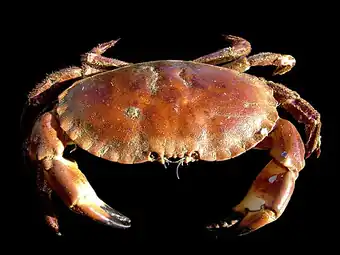
Cancer pagurus, the edible or brown crab (Brachyura) Crabs are decapodcrustaceans, either the Brachyura (the "true crabs") or various groups within the closely related Anomura (hermit crabs and allies), characterised by having a heavily armoured shell, their tail segments concealed under the body, the ability to run sideways, and the habit of hiding in rocky crevices. They do not form a single natural group or clade, but have convergently evolved multiple times from the ancestral decapod body plan through carcinisation, the process of creating this set of characteristics. As a group, they are thus polyphyletic, meaning they have multiple evolutionary origins.
Crabs make up about 20% of the marine crustaceans that are caught or farmed for human consumption. In British cuisine, dressed crab is a traditional seafood meal, while in Goa and Mozambique, crab curry is a typical dish. Crabs feature in Greek and Malay mythology, and as the astrological sign Cancer. They have appeared in art in media including pottery, paintings, blouse panels, and book illustrations. Hermit crabs are often kept in aquariums and as pets. A popular meme jokes that everything will evolve into crabs, based inaccurately on the genuine evolutionary trend within the decapods. (Full article...)
Erettopterus is a genus of large predatory eurypterid, an extinct group of aquatic arthropods. Fossils of Erettopterus have been discovered in deposits ranging from Early Silurian (the Rhuddanian age) to the Early Devonian (the Lochkovian age), and have been referred to several different species. Fossils have been recovered from three continents; Asia, Europe and North America. The genus name is composed by the Ancient Greek words ἐρέττω (eréttō), which means "rower", and πτερόν (pterón), which means "wing", and therefore, "rower wing".
Erettopterus is classified as part of the eurypterid family Pterygotidae, a family differentiated from other eurypterids by their flattened telsons (the most posterior segment of the body) and their modified chelicerae (frontal appendages), ending in well-developed chelae (claws). Although some pterygotid eurypterids, such as Jaekelopterus or Acutiramus grew to gigantic proportions, it is estimated that the largest species of Erettopterus, E. osiliensis, reached 90cm (35in). Fragmentary remains suggest much larger sizes, perhaps approaching the largest eurypterids. Erettopterus had a bilobed (divided into two lobes) telson, which is its main characteristic. The forms of chelicerae are very diverse between species, but they are generally very long with small curved teeth without serrations.
Studies on the chelicerae and compound eyes of Erettopterus have revealed that it was a predator with high visual acuity, but it was not as highly specialized or active as Jaekelopterus and Pterygotus, it was more like Slimonia acuminata, and probably used its enlarged chelicerae for grasping rather than a more specialized feeding. (Full article...)
Image 5
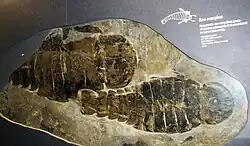
An image of the partial remains of an Eoscorpius specimen, created by Alexander Petrunkevitch
Eoscorpius is an extinct genus of scorpions. Several species have been formally described and named, while several other proposed species lack formal scientific names. The genus existed from the Early Carboniferous to the Asselian age of the Early Permian, its distribution spanning modern-day Asia, North America, and Europe. Its defining features include the subquadrate shape of its carapace, the placement of its median eyes on raised nodes, and two large ridges that differentiate the parts of its carapace. It has been noted for its extensive similarities to modern scorpions. Its habitat is believed to have included the extensive swampy, coal-producing forests that existed during the Carboniferous. Within these forests, there is evidence that it may have lived in the canopy and understory levels. (Full article...)
Image 6
Cimex lectularius
The Cimicidae are a family of small parasiticbugs that feed exclusively on the blood of warm-blooded animals. They are called cimicids or, loosely, bed bugs, though the latter term properly refers to the most well-known member of the family, Cimex lectularius, the common bed bug, and its tropical relation Cimex hemipterus. The family contains over 100 species. Cimicids appeared in the fossil record in the Cretaceous period. When bats evolved in the Eocene, Cimicids switched hosts and now feed mainly on bats or birds. Members of the group have colonised humans on three occasions.
Cimicids usually feed on their host's blood every three to seven days, crawling away from the host and hiding while they digest the blood, which may take several days. This means that they specialise in vertebrate hosts that return regularly to particular sites to nest, roost or sleep. Birds and bats suit these specific requirements, as do humans now that they live in dwellings, and these are the main hosts used by the bugs. Most cimicids are able to go for long periods without feeding, over a year in some instances.
Cimicids are typically small, oval, flattened, wingless insects. They are stimulated to appear from their hiding places by cues such as a slight rise in the temperature of their surroundings. Among the family's distinctive characteristics are traumatic insemination, in which the male fertilises the eggs by piercing the female's abdominal wall with his intromittent organ. They also have distinctive paired structures called mycetomes inside their bodies, in which they harbour bacterial symbionts: these may help them to obtain nutrients they cannot get from blood. Although the insects may acquire viruses and other pathogens while feeding, these do not normally replicate inside the insect, and the infections are not transmitted to new hosts. (Full article...)
Image 7
Fossils of P. anglicus
Pterygotus is an extinct genus of giant predatory eurypterid, a group of extinct aquatic arthropods. Fossils of Pterygotus have been discovered in deposits ranging in age from Middle Silurian to Late Devonian, and have been referred to several different species. Fossils have been recovered from five continents; Australia, Asia, Europe, North America and South America, which indicates that Pterygotus might have had a nearly cosmopolitan (worldwide) distribution. The type species, P. anglicus, was described by Swiss naturalist Louis Agassiz in 1839, who gave it the name Pterygotus, meaning "winged one". Agassiz mistakenly believed the remains were of a giant fish; he would only realize the mistake five years later in 1844.
Pterygotus was among the largest eurypterids. Isolated fossil remains of a large chelicera (frontal appendage) suggests that the largest known species, P. grandidentatus, reached a body length of 1.75 metres (5.7ft). Several other species, notably P. anglicus at 1.6 metres (5.2ft) was similarly gigantic. Pterygotus was surpassed in size by other giant eurypterids. Acutiramus was able to surpass 2 metres (6.6ft), and Jaekelopterus could reach 2.6 metres (8.5ft). Many species were considerably smaller than the largest species, such as P. kopaninensis at 50 centimetres (20in). Pterygotus may have weighed around 30 kilogramms.
Like its close relative Jaekelopterus, Pterygotus was a large and active predator noted for its robust and enlarged cheliceral claws that would have allowed it to puncture and grasp prey and a visual acuity (clarity of vision) comparable to that of modern predatory arthropods. (Full article...)
Grasshoppers are a group of insects belonging to the suborderCaelifera. They are amongst what are possibly the most ancient living groups of chewing herbivorous insects, dating back to the early Triassic, around 250 million years ago.
Grasshoppers are typically ground-dwelling insects with powerful hind legs which allow them to escape from threats by leaping vigorously. Their front legs are shorter and used for grasping food. As hemimetabolous insects, they do not undergo complete metamorphosis; they hatch from an egg into a nymph or "hopper" which undergoes five moults, becoming more similar to the adult insect at each developmental stage. The grasshopper hears through the tympanal organ which can be found in the first segment of the abdomen attached to the thorax; while its sense of vision is in the compound eyes, a change in light intensity is perceived in the simple eyes (ocelli). At high population densities and under certain environmental conditions, some grasshopper species can change colour and behavior and form swarms. Under these circumstances, they are known as locusts.
Grasshoppers are plant-eaters, with a few species at times becoming serious pests of cereals, vegetables and pasture, especially when they swarm in the millions as locusts and destroy crops over wide areas. They protect themselves from predators by camouflage; when detected, many species attempt to startle the predator with a brilliantly coloured wing flash while jumping and launching themselves into the air, usually flying for only a short distance. Other species such as the rainbow grasshopper have warning coloration which deters predators. Grasshoppers are affected by parasites and various diseases, and many predatory creatures feed on both nymphs and adults. The eggs are subject to attack by parasitoids and predators. Grasshoppers are diurnal insects, meaning they are most active during the day time. (Full article...)
Image 9
Carcinus maenas is a common littoralcrab. It is known by different names around the world. In the British Isles, it is generally referred to as the shore crab or green shore crab. In North America and South Africa, it bears the name European green crab. The European Green Crab is native to Europe and North Africa.
Carcinus maenas is a widespread invasive species, listed among the 100 of the World's Worst Invasive Alien Species. It is native to the north-east Atlantic Ocean and Baltic Sea, but has colonised similar habitats in Australia, South Africa, South America, and both Atlantic and Pacific Coasts of North America. It grows to a carapace width of 90mm (3+1⁄2in), and feeds on a variety of mollusks, worms, and small crustaceans, affecting a number of fisheries. Its successful dispersal has occurred by a variety of mechanisms, such as on ships' hulls, sea planes, packing materials, and bivalves moved for aquaculture. (Full article...)
Image 10
Pellenes nigrociliatus from Hesse, Germany, in 2009
Pellenes nigrociliatus is a jumping spider species in the genusPellenes. Originally described in 1875 with the name Attus nigrociliatus, it has been known by its current name since the year after. Measuring between 3.15 and 5.1mm (0.124 and 0.201in) in length, it is generally black and covered in white hairs. The part of its face known as its clypeus extends beyond its eyes and there is white or orange crescent-shaped spot also visible on its eye field. The top of its abdomen has a distinctive pattern of broad white stripes that cross in the middle. The female is larger and generally darker than the male. It has a wide range, being found across Europe and Asia from the Canary Islands to China. It lives in a wide range of dry habitats, including sandy slopes in chalky and rocky steppes, grasslands, sand dunes, and meadows of Miscanthus grasses. It nests in snail shells, such as those of Xerolenta obvia, that the female spider suspends from trees using braided silk threads. It constructs a door for the shells made from silk. (Full article...)
Earwigs make up the insectorderDermaptera. With about 2,000 species in 12 families, they are one of the smaller insect orders. Earwigs have characteristic cerci, a pair of forceps-like pincers on their abdomen, and membranous wings folded underneath short, rarely used forewings, hence the scientific order name, "skin wings". Some groups are tiny parasites on mammals and lack the typical pincers. Earwigs are found on all continents except Antarctica.
Earwigs are mostly nocturnal and often hide in small, moist crevices during the day, and are active at night, feeding on a wide variety of insects and plants. Damage to foliage, flowers, and various crops is commonly blamed on earwigs, especially the common earwig Forficula auricularia.
Earwigs have five molts in the year before they become adults. Many earwig species display maternal care, which is uncommon among insects. Female earwigs may care for their eggs; the ones that do will continue to watch over nymphs until their second molt. As the nymphs molt, sexual dimorphism such as differences in pincer shapes begins to show. (Full article...)
Image 12
The deathwatch beetle (Xestobium rufovillosum) is a species of woodboring beetle that sometimes infests the structural timbers of old buildings. The adult beetle is brown and averages 7mm (0.3in) in length. Eggs are laid in dark crevices in old wood inside buildings, trees, or tunnels left behind by previous larvae. The larvae bore into the timber, feeding for up to ten years before pupating, after which they emerge from the wood as adult beetles. Timber that has been damp and is affected by fungal decay is soft enough for the larvae to chew through. They obtain nourishment by using enzymes present in their gut to digest the cellulose and hemicellulose in the wood.
The larvae of deathwatch beetles weaken the structural timbers of a building by tunneling through them. Treatment with insecticides to kill the larvae is largely ineffective, and killing the adult beetles when they emerge in spring and early summer may be a better option. However, infestations by the beetles are often limited to historic buildings, because modern buildings tend to use softwoods for joists and rafters, rather than the aged oak timbers which the beetles prefer.
To attract mates, the adult insects create a tapping or ticking sound that can sometimes be heard in the rafters of old buildings on summer nights. For that reason, the deathwatch beetle is associated with quiet, sleepless nights, so it was named for the vigil (watch) being kept beside the dying or dead. By extension, there exists a superstition that the sounds are an omen of impending death. (Full article...)
Image 13
Andreacarus voalavo is a parasiticmite found on the Malagasy rodent Voalavo gymnocaudus. First described in 2007, it is closely related to Andreacarus gymnuromys and Andreacarus eliurus, which are found on other Malagasy rodents. The length of the idiosoma, the main body, is 630 to 670μm in females and 450 to 480μm in males. Unlike A.eliurus, this species lacks distinct sternal glands (secretory organs) between two lyrifissures (sensory organs) on the lower part of the female body. The pilus dentilis, a sensory organ on the chelicera, is serrate, which distinguishes it from A.gymnuromys. Females of A.gymnuromys also have a less ornamented sternal shield (covering part of the underparts) and shorter setae (bristles) on the upperparts. (Full article...)
It had several unique characteristics that differentiated it from many other arthropods, such as its long parabolic (nearly U-shaped) prosoma (head), its elongated first and second segments and the presence of paired "ridges" in the surface of its third to tenth tergites (dorsal halves of the segments). Furthermore, the opisthosoma (the "trunk") of Borchgrevinkium was triangular, and its telson (the posteriormost division of its body), short and wedge-shaped. It was a small animal, approximately 3 centimetres (1.2 inches) long.
The only known specimen of the genus was collected in 1956 and described in 1959 by the Russian paleontologistNestor Ivanovich Novojilov. He determined that it was a eurypterid and classified it in the familyMycteroptidae. However, its classification changed repeatedly over the years, being transferred from Eurypterida to Xiphosura and back to Eurypterida some time later. Borchgrevinkium is tentatively considered as a prosomapod, with more fossil material needed to ensure its current classification. (Full article...)
Image 15
Ypresiomyrma rebekkae fossils
Ypresiomyrma is an extinct genus of ants in the subfamily Myrmeciinae that was described in 2006. There are four species described; one species is from the Isle of Fur in Denmark, two are from the McAbee Fossil Beds in British Columbia, Canada, and the fourth from the Bol’shaya Svetlovodnaya fossil site in Russia. The queens of this genus are large, the mandibles are elongated and the eyes are well developed; a stinger is also present. The behaviour of these ants would have been similar to that of extant Myrmeciinae ants, such as solitary foraging for arthropod prey and never leaving pheromone trails. The alates were poor flyers due to their size, and birds and animals most likely preyed on these ants. Ypresiomyrma is not assigned to any tribe, and is instead generally regarded as incertae sedis within Myrmeciinae. However, some authors believe Ypresiomyrma should be assigned as incertae sedis within Formicidae. (Full article...)
Did you know ...?
Emerita analoga (Decapoda: Hippidae)
... that although the Pacific sand crab can only crawl and burrow backwards (pictured), it can also tread water?
... that the family placement for the fossil moth genus Dominickus was not noticed until entomologistNorman Tindale was looking at pictures of modern moths from Australia?
General images -
The following are images from various arthropod-related articles on Wikipedia.
Image 2Life restoration of Megachelicerax, the oldest arthropod known to bear true chelicerae, dating to just over 500 million years ago (from Chelicerata)
Image 3Decapods, from Ernst Haeckel's 1904 work Kunstformen der Natur (from Crustacean)
Image 4Ghost crab, showing a variety of integument types in its exoskeleton, with transparent biomineralization over the eyes, strong biomineralization over the pincers, and tough chitin fabric in the joints and the bristles on the legs (from Arthropod exoskeleton)
Image 6 Honeybee larvae have flexible but delicate unsclerotised cuticles. (from Arthropod exoskeleton)
Image 7Mature queen of a termite colony, showing how the unsclerotised cuticle stretches between the dark sclerites that failed to stretch as the abdomen grew to accommodate her ovaries (from Arthropod exoskeleton)
Image 8 This fully-grown robber crab has tough fabric forming its joints, delicate biomineralized cuticle over its sensory antennae, optic-quality over its eyes, and strong, calcite-reinforced chitin armouring its body and legs; its pincers can break into coconuts (from Arthropod exoskeleton)
Image 11Some of the various hypotheses of myriapod phylogeny. Morphological studies (trees a and b) support a sister grouping of Diplopoda and Pauropoda, while studies of DNA or amino acid similarities suggest a variety of different relationships, including the relationship of Pauropoda and Symphyla in tree c (from Myriapoda)
Image 13In honeypot antrepletes, the abdomens of the workers that hold the sugar solution grow vastly, but only the unsclerotised cuticle can stretch, leaving the unstretched sclerites as dark islands on the clear abdomen (from Arthropod exoskeleton)
Image 14Life restoration of Sanctacaris (Habeliida), one of the oldest known chelicerate relatives from the mid-Cambrian Burgess Shale, around 508 million years ago. (from Chelicerata)
Image 15This Zoea-stage larva is hardly recognisable as a crab, but each time it sheds its cuticle it remodels itself, eventually taking on its final crab form (from Arthropod exoskeleton)
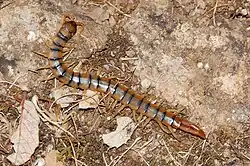
Image 16The house centipedeScutigera coleoptrata has rigid sclerites on each body segment. Supple chitin holds the sclerites together and connects the segments flexibly. Similar chitin connects the joints in the legs. Sclerotised tubular leg segments house the leg muscles, their nerves and attachments, leaving room for the passage of blood to and from the hemocoel (from Arthropod exoskeleton)
Image 24Formation of anterior segments across arthropod taxa based on gene expression and neuroanatomical observations, Note the chelicera(Ch) and chelifore(Chf) arose from somite 1 and thus correspond to the first antenna(An/An1) of other arthropods. (from Chelicerata)
Image 26Life restoration of species of Lunataspis a genus of xiphosuran (the broader group which includes horseshoe crabs), dating to the Late Ordovician, around 455-445 million years ago. (from Chelicerata)
The monarch butterfly (Danaus plexippus) is one of the best-known species of butterfly. Its wings feature an easily recognizable orange and black pattern, with a wingspan of 8.9–10.2 centimetres (3½–4 in).
Sexual dimorphism is the condition where the two sexes of the same species exhibit different characteristics. Differences may include secondary sex characteristics, size, weight, color, or markings, as well as behavioral and cognitive differences. In the butterfly species Colias dimera (also known as the Dimera sulphur), seen here mating in Venezuela, the male on the right is a brighter shade of yellow than the female.
The light blue soldier crab (Mictyris longicarpus) inhabits beaches in the Indo-Pacific region. Soldier crabs filter sand or mud for microorganisms. They congregate during the low tide, and bury themselves in a corkscrew pattern during high tide, or whenever they are threatened.
Danaus genutia, the common tiger or striped tiger, is a species of brush-footed butterfly found in Sri Lanka, India, Myanmar, south-eastern Asia and Australia. It prefers areas of moderate to heavy rainfall, and typical habitats include scrubby jungle, deciduous forests and fallow land near habitations. The insect sequesters toxins from plants, and advertises its unpalatability by having prominent markings and striking colour patterns. This adult male common tiger, of the subspecies D.g.genutia, was photographed in Kerala, India.
The Adonis blue (Polyommatus bellargus) is a butterfly in the family Lycaenidae, found in Europe and parts of West Asia. This photograph, taken in a chalk meadow at Yoesden Bank in Buckinghamshire, England, shows the underside of the folded wings of a male Adonis blue; the upper side is a bright, sky-blue.
Attacus taprobanis is a species of moth in the family Saturniidae native to southern India and Sri Lanka. This adult male, photographed in Kadavoor, Kerala, developed from a larva feeding on a mahogany tree. When ready to pupate, the larva formed a papery cocoon 7.5cm (3in) long interwoven with a leaf; before doing this, the larva had attached the leaf to the stem with a silken thread and cut the leaf stalk. The colours of the dying leaf provided camouflage for the pupa, and the adult insect emerged some 24 days later.
Xylotrupes socrates (Siamese rhinoceros beetle, or "fighting beetle"), male, on a banana leaf. This scarab beetle is particularly known for its role in insect fighting in Northern Laos and Thailand.
The Painted Lady (Vanessa cardui) is a well-known colourful butterfly, found on every continent except Antarctica. It occurs in any temperate zone, including mountains in the tropics. The species is resident only in warmer areas, but migrates in spring, and sometimes again in autumn.
A macro view of a Gonia capitatafly feeding on honey, showing its proboscis and pedipalps (the two appendages protruding from the proboscis), two types of insect mouthparts. The proboscis actually comprises the labium, a quadrupedal structure, and a sponge-like labellum at the end. Flies eat solid food by secreting saliva and dabbing it over the food item. As the saliva dissolves the food, the solution is then drawn up into the mouth as a liquid. The labellum's surface is covered by minute food channels which form a tube leading to the esophagus, and food is drawn up the channels by capillary action.
Two Eastern Lubber grasshoppers (Romalea guttata) mating. Native to the southeastern and south central portion of the United States, it is well known both for its size and its unique coloration. During reproduction, the male grasshopper introduces sperm into the ovipositor through its aedeagus (reproductive organ), and inserts its spermatophore, a package containing the sperm, into the female's ovipositor.
The citrus root weevil (Diaprepes abbreviatus) is a major agricultural pest weevil in several Caribbean countries and the U.S. state of Florida. The larvae feed on the roots of the host plant for several months. They often eat the taproot of the plant, which can kill it by depriving it of water and nutrients or by making it vulnerable to infection by fungi, or water moulds.
The Ozyptila praticola species of crab spider is found throughout Europe and the Middle East. They do not build webs to trap prey, but are active hunters. Crab spiders are so named because of their first two pairs of legs, which are held out to the side giving them a crab-like appearance. Also, like crabs, these spiders move sideways and backwards more easily than forwards.
Anthidium florentinum, a species of bee in the family Megachilidae. Bees are flying insects closely related to wasps and ants that are involved in pollination. There are nearly 20,000 known species of bees in seven recognized biological families. Bees are found on every continent except Antarctica, in every habitat on the planet that contains insect-pollinated flowering plants. Bees range in size from tiny stingless bee species whose workers are less than 2 millimetres (0.08in) long, to Megachile pluto, whose females can attain a length of 39 millimetres (1.54in).
The Globe Skimmer (Pantala flavescens) is the most widespread dragonfly species on the planet, found between about the 40th parallels of latitude, or where the annual mean temperature is above 20°C (68°F), except in Europe where there are only occasional sightings.
The orb-weaver spiders (family Araneidae) are the familiar builders of spiral wheel-shaped webs often found in gardens, fields and forests. The family is a large one, including over 2800 species in over 160 genera worldwide, making it the third largest known (behind Salticidae and Linyphiidae). The web has always been thought of as an engineering marvel.
A honeycomb is a mass of hexagonal prismaticwax cells built by honey bees in their hives to contain their larvae and stores of honey and pollen. Honey bees consume about 8.4lb (3.8kg) of honey to secrete 1lb (0.5kg) of wax. As such, many beekeepers attempt to conserve honeycombs where possible.
Gonepteryx rhamni, also known as the common brimstone, is a butterfly in the family Pieridae. It lives throughout the Palearctic zone and is commonly found across Europe, Asia and North Africa. The butterfly relies on two species of buckthorn as hosts for its eggs and larvae, which influences its geographic range and distribution as these plants are commonly found in wetlands. After spending the summer feeding, adults travel to woodland areas to spend seven months hibernating. In spring when their host plants have developed, they return to the wetlands to breed and lay eggs. Both the larval and adult forms of the species have protective coloration and behaviour that decreases their chances of being recognised and preyed upon. The adult common brimstone has sexual dichromism in its wing coloration and iridescence; the male (pictured) has yellow wings and iridescence, while females have greenish-white wings and are not iridescent.
Start a new article. Arthropods cover an huge range of taxa and other topics, so there will always be plenty of missing articles. Some which have been explicitly requested are listed here.
Expand an existing article. Existing articles are often incomplete and missing information on key aspects of the topic. It is particularly important that the most widely read articles be broad in their scope. Wikipedia:WikiProject Arthropods/Popular pages (updated monthly) shows the number of views each article gets, along with assessments of its quality and importance. Articles with higher importance ratings and greater numbers of views are the priority for article improvements, but almost all our articles would benefit from expansion. Stubs can be found in Category:Arthropod stubs and its subcategories.
Associated Wikimedia
The following Wikimedia Foundation sister projects provide more on this subject:













 Here are some tasks you can do:
 Commons
 Wikidata
 Wikiquote
 Wikisource
 Wikispecies
 Wikiversity
 Wikivoyage
 Wiktionary
 List of all portals






 Random portal
 WikiProject Portals