List of Sphenisciformes by population
| The population of birds |
|---|
 |

This is a list of Sphenisciformes species by global population. While numbers are estimates, they have been made by experts in their fields.
Sphenisciformes (from the Latin for "wedge-shaped") is the taxonomic order to which penguins belong. The IOC World Bird List recognizes 19 species of Sphenisciformes.[1] BirdLife International has assessed 18 species (95% of total species), all of which have had their population estimated. This list follows IUCN classifications for species names and taxonomy. Where IUCN classifications differ from other ornithological authorities, alternative names and taxonomies are noted.
A variety of methods are used for counting penguins, including the first census from space in April 2012, when imagery from Ikonos, QuickBird-2, and WorldView-2 satellites were used to count emperor penguins in Antarctica.[2] Most maritime surveys use strip transect and distance sampling to measure penguin species density; this is then extrapolated over the animal's range.[3] The Galapagos penguin has been counted annually since 1961 by the Galápagos National Park Service.[4] For more information on how these estimates were ascertained, see Wikipedia's articles on population biology and population ecology.
Extinct species from this order include the Waitaha penguin, which went extinct between 1300–1500 (soon after the Polynesian arrival to New Zealand)[5], and the Chatham penguin, which is only known through subfossils; however, an extant individual may have been kept in captivity by researchers sometime between 1867 and 1872.[6]
Species by global population
| Common name | Binomial name | Population | Status | Trend | Notes | Image |
|---|---|---|---|---|---|---|
| Galapagos penguin | Spheniscus mendiculus | 1,200[7] | EN[7] |  [7] |  | |
| Yellow-eyed penguin | Megadyptes antipodes | 2,600-3,000[8] | EN[8] | [8] |  | |
| Fiordland penguin | Eudyptes pachyrhynchus | 12,500-50,000[9] | VU[9] | [9] |  | |
| African penguin | Spheniscus demersus | 19,800[10] | CR[10] | [10] | Number of total adult birds is estimated to be 31,680.[10] |  |
| Humboldt penguin | Spheniscus humboldti | 23,800[11] | VU[11] | [11] | Values is considered the maximum estimate for breeding population.[11] |  |
| Snares penguin | Eudyptes robustus | 63,000[12] | VU[12] |  [12] |  | |
| Erect-crested penguin | Eudyptes sclateri | 150,000[13] | EN[13] | [13] | Population breeds in two locations: the Bounty Islands (26,000 pairs), & the Antipodes Islands (34,226 pairs).[13] |  |
| Northern rockhopper penguin | Eudyptes moseleyi | 413,700[14] | EN[14] | [14] |  | |
| Little penguin | Eudyptula minor | 469,760[15] | LC[15] | [15] |
 | |
| Emperor penguin | Aptenodytes forsteri | 513,000[16] | NT[16] | [16] | Estimate based on an approximate 256,500 breeding pairs counted from satellite images.[16] |  |
| Gentoo penguin | Pygoscelis papua | 774,000[17] | LC[17] | [17] |  | |
| Royal penguin | Eudyptes schlegeli | 1,340,000-1,660,000[18] | LC[18] | ?[18] | Best estimate for mature individuals is 1.5 million individuals. | 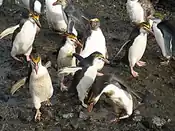 |
| King penguin | Aptenodytes patagonicus | 2,168,640-2,456,640[19] | LC[19] |  [19] |
Values are an estimate for mature individuals; IUCN reports an estimated "1.1 million annual breeding pairs (range 1,084,320-1,228,320)."[19] |  |
| Magellanic penguin | Spheniscus magellanicus | 2,200,000-3,200,000[20] | LC[20] | [20] |  | |
| Southern rockhopper penguin
(Western rockhopper penguin) |
Eudyptes chrysocome | 2,500,000[21] | VU[21] | [21] | IOC taxonomic guidance splits Eastern rockhopper penguin into its own species from this species.[1]
IUCN/BirdLife International currently retain both species within E. chrysocome.[22] |
 |
| Chinstrap penguin | Pygoscelis antarcticus | 8,000,000[23] | LC[23] | [23] | 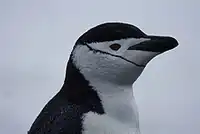 | |
| Adélie penguin | Pygoscelis adeliae | 10,000,000[24] | LC[24] | [24] |  | |
| Macaroni penguin | Eudyptes chrysolophus | 12,600,000[25] | VU[25] | [25] | Population is estimated at 6.3 million breeding pairs; main population centres at Isles Crozet (2.2 million pairs, with 1 million on Île des Pingouins), Heard Island (1 million pairs), Kerguelen (1.8 million pairs), & South Georgia (1 million pairs).[25] |  |
See also
References
- 1 2 "Kagu, Sunbittern, tropicbirds, loons, penguins – IOC World Bird List". www.worldbirdnames.org. Retrieved 2025-12-22.
- ↑ Dell'Amore, Christine (13 April 2012). "Emperor Penguins Counted From Space—A First". National Geographic News. National Geographic. Archived from the original on April 15, 2012. Retrieved 2012-12-22.
- ↑ Southwell, C.; Low, M. (2009). "Black and white or shades of grey? Detectability of Adélie penguins during shipboard surveys in the Antarctic pack-ice". Journal of Applied Ecology. 46: 136–143. doi:10.1111/j.1365-2664.2008.01584.x.
- ↑ "Annual Galapagos Penguin and Cormorant Census". GNP News. Proceso de Relaciones Públicas – Parque Nacional Galápagos – Ecuador. 2012. Archived from the original on 2013-03-07. Retrieved 2012-12-22.
- ↑ Fox, Rebecca (2008-11-20). "Ancient species of penguin found in DNA of bones". Otago Daily Times. Archived from the original on 2011-06-09. Retrieved 2008-11-20.
- ↑ Tennyson, A.J.D.; Millener, P.R. (1994). "Bird extinctions and fossil bones from Mangere Island, Chatham Islands". Notornis. 41: 165–178.
- 1 2 3 BirdLife International (2020). "Spheniscus mendiculus". IUCN Red List of Threatened Species. 2020 e.T22697825A182729677. doi:10.2305/IUCN.UK.2020-3.RLTS.T22697825A182729677.en. Retrieved 12 November 2021.
- 1 2 3 BirdLife International (2020). "Megadyptes antipodes". IUCN Red List of Threatened Species. 2020 e.T22697800A182703046. doi:10.2305/IUCN.UK.2020-3.RLTS.T22697800A182703046.en. Retrieved 12 November 2021.
- 1 2 3 BirdLife International (2020). "Eudyptes pachyrhynchus". IUCN Red List of Threatened Species. 2020 e.T22697776A182279725. doi:10.2305/IUCN.UK.2020-3.RLTS.T22697776A182279725.en. Retrieved 12 November 2021.
- 1 2 3 4 BirdLife International (2024). "Spheniscus demersus". IUCN Red List of Threatened Species. 2024 e.T22697810A256021744. doi:10.2305/IUCN.UK.2024-2.RLTS.T22697810A256021744.en. Retrieved 2025-12-22.
- 1 2 3 4 BirdLife International (2020). "Spheniscus humboldti". IUCN Red List of Threatened Species. 2020 e.T22697817A182714418. doi:10.2305/IUCN.UK.2020-3.RLTS.T22697817A182714418.en. Retrieved 12 November 2021.
- 1 2 3 BirdLife International (2018). "Eudyptes robustus". IUCN Red List of Threatened Species. 2018 e.T22697782A132602343. doi:10.2305/IUCN.UK.2018-2.RLTS.T22697782A132602343.en. Retrieved 12 November 2021.
- 1 2 3 4 BirdLife International (2020). "Eudyptes sclateri". IUCN Red List of Threatened Species. 2020 e.T22697789A131879000. doi:10.2305/IUCN.UK.2020-3.RLTS.T22697789A131879000.en. Retrieved 12 November 2021.
- 1 2 3 BirdLife International (2020). "Eudyptes moseleyi". IUCN Red List of Threatened Species. 2020 e.T22734408A184698049. doi:10.2305/IUCN.UK.2020-3.RLTS.T22734408A184698049.en. Retrieved 12 November 2021.
- 1 2 3 BirdLife International (2021) [errata version of 2020 assessment]. "Eudyptula minor". IUCN Red List of Threatened Species. 2020 e.T22697805A202126091. doi:10.2305/IUCN.UK.2020-3.RLTS.T22697805A202126091.en. Retrieved 2025-12-22.
- 1 2 3 4 BirdLife International (2020). "Aptenodytes forsteri". IUCN Red List of Threatened Species. 2020 e.T22697752A157658053. doi:10.2305/IUCN.UK.2020-3.RLTS.T22697752A157658053.en. Retrieved 12 November 2021.
- 1 2 3 BirdLife International (2020). "Pygoscelis papua". IUCN Red List of Threatened Species. 2020 e.T22697755A157664581. doi:10.2305/IUCN.UK.2020-3.RLTS.T22697755A157664581.en. Retrieved 12 November 2021.
- 1 2 3 BirdLife International (2022). "Eudyptes schlegeli". IUCN Red List of Threatened Species. 2022 e.T22697797A210894343. doi:10.2305/IUCN.UK.2022-1.RLTS.T22697797A210894343.en. Retrieved 2025-12-22.
- 1 2 3 4 BirdLife International (2020). "Aptenodytes patagonicus". IUCN Red List of Threatened Species. 2020 e.T22697748A184637776. doi:10.2305/IUCN.UK.2020-3.RLTS.T22697748A184637776.en. Retrieved 2025-12-22.
- 1 2 3 BirdLife International (2020). "Spheniscus magellanicus". IUCN Red List of Threatened Species. 2020 e.T22697822A157428850. doi:10.2305/IUCN.UK.2020-3.RLTS.T22697822A157428850.en. Retrieved 12 November 2021.
- 1 2 3 BirdLife International (2020). "Eudyptes chrysocome". IUCN Red List of Threatened Species. 2020 e.T22735250A182762377. doi:10.2305/IUCN.UK.2020-3.RLTS.T22735250A182762377.en. Retrieved 12 November 2021.
- ↑ Handbook of the Birds of the World and BirdLife International Digital Checklist of the Birds of the World: Version 10. BirdLife International. 2025.
- 1 2 3 BirdLife International (2020). "Pygoscelis antarcticus". IUCN Red List of Threatened Species. 2020 e.T22697761A184807209. doi:10.2305/IUCN.UK.2020-3.RLTS.T22697761A184807209.en. Retrieved 12 November 2021.
- 1 2 3 BirdLife International (2020). "Pygoscelis adeliae". IUCN Red List of Threatened Species. 2020 e.T22697758A157660553. doi:10.2305/IUCN.UK.2020-3.RLTS.T22697758A157660553.en. Retrieved 12 November 2021.
- 1 2 3 4 BirdLife International (2020). "Eudyptes chrysolophus". IUCN Red List of Threatened Species. 2020 e.T22697793A184720991. doi:10.2305/IUCN.UK.2020-3.RLTS.T22697793A184720991.en. Retrieved 12 November 2021.