List of Piciformes by population
| The population of birds |
|---|
 |

This is a list of Piciformes species by global population. While numbers are estimates, they have been made by the experts in their fields. For more information on how these estimates were ascertained, see Wikipedia's articles on population biology and population ecology.
This list is not comprehensive, as not all Piciformes have had their numbers quantified.
The IOC World Bird List (version 15.1) recognizes 448 species of Piciformes, one of which is extinct.[1][2] This list follows IUCN classifications for species names and taxonomy. Where IUCN classifications differ from other ornithological authorities, alternative names and taxonomies are noted.
One member of Piciformes is extinct:
- Bermuda flicker (Colaptes oceanicus) - likely went extinct by mid-17th century.[3]
Species by global population
| Common name | Binomial name | Population | Status | Trend | Notes | Image |
|---|---|---|---|---|---|---|
| Imperial woodpecker | Campephilus imperialis | 1-49[4] | CR[4] | ?[4] | May be extinct. Last confirmed record from 1956.[4] |  |
| Ivory-billed woodpecker | Campephilus principalis | 1-49[5] | CR[5] | ?[5] | May be extinct. Last confirmed record from 1944.[5] |  |
| Okinawa woodpecker | Dendrocopos noguchii | 75-400[6] | EN[6] |  [6] | Best estimate for number of mature individuals is 100–300.[6] |  |
| Scarlet-banded barbet | Capito wallacei | 250-999[7] | VU[7] |  [7] |  | |
| White-rumped woodpecker
(Zebra woodpecker) |
Meiglyptes tristis | 250-1,000[8] | EN[8] | [8] |
 | |
| Fernandina's flicker | Colaptes fernandinae | 600-800[9] | EN[9] | [9] |  | |
| Helmeted woodpecker | Celeus galeatus | 700-21,000[10] | VU[10] | [10] | Best estimate for number of mature individuals is 3,600. |  |
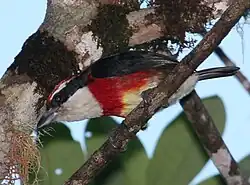
| Sira barbet | Capito fitzpatricki | 1,000-2,499[11] | NT[11] | [11] |
 | |
| Andaman woodpecker | Dryocopus hodgei | 1,000-2,499[12] | VU[12] | [12] |
 | |
| Knysna woodpecker | Campethera notata | 1,000-3,300[13] | NT[13] | [13] | Total population is estimated to be 1,500-5,000 individuals. |  |
| Yellow-faced flameback | Chrysocolaptes xanthocephalus | 1,100-5,500[14] | EN[14] | [14] |
Best estimate for number of mature individuals is 1,100-2,200.[14] |  |
| Three-toed jacamar | Jacamaralcyon tridactyla | 1,300-5,400[15] | NT[15] | [15] | Total population is estimated to be 1,962-8,028 individuals.[15] |  |
| Sulu pygmy woodpecker | Picoides ramsayi | 2,000-10,000[16] | VU[16] | [16] | Best estimate for number of mature individuals is 2,000-5,000.[16] |  |
| Yellow-browed toucanet | Aulacorhynchus huallagae | 2,500-9,999[17] | NT[17] | [17] |  | |
| Sumatran woodpecker | Picus dedemi | 2,500-9,999[18] | NT[18] | [18] |
||
| Zambian barbet
(Chaplin's barbet) |
Lybius chaplini | 4,500-5,200[19] | VU[19] | [19] |  | |
| Red-headed flameback | Chrysocolaptes erythrocephalus | 5,000-7,500[20] | NT[20] | [20] |
Total population is estimated to be 7,500-11,250 individuals.[20] | 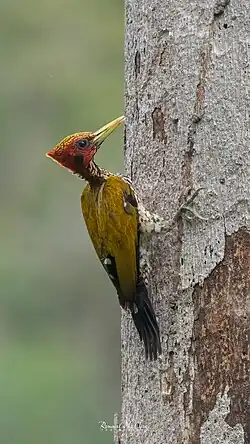 |
| Red-faced barbet | Lybius rubrifacies | 5,000-10,000[21] | NT[21] | [21] |
 | |
| Southern sooty woodpecker | Mulleripicus fuliginosus | 5,000-10,000[22] | VU[22] | [22] |
 | |
| Javan flameback | Chrysocolaptes strictus | 5,000-20,000[23] | NT[23] | [23] |
 | |
| Blue-chinned barbet
(Versicolored barbet) |
Eubucco glaucogularis | 5,000-40,000[24] | NT[24] | [24] |
Note than IUCN/BirdLife International splits versicolored barbet into three distinct species: blue-chinned, blue-cowled, and blue-moustached barbets.[25]
IOC maintains all three species within versicolored barbet (E. versicolor).[1] |
 |
| Kaempfer's woodpecker | Celeus obrieni | 6,000[26] | VU[26] | [26] |
 | |
| Five-coloured barbet | Capito quinticolor | 6,000-10,000[27] | NT[27] | [27] |  | |
| Spot-throated flameback | Dinopium everetti | 6,600-20,000[28] | NT[28] | [28] |
Total population is estimated to be 9,400-28,000 individuals.[28] |  |
| Sooty-capped puffbird | Nystactes noanamae | 8,000[29] | NT[29] | [29] |
Total population is estimated to be 12,000 individuals.[29] |  |
| Plate-billed mountain toucan | Andigena laminirostris | 10,000-19,999[30] | NT[30] | [30] |
 | |
| Arabian woodpecker | Dendroptes dorae | 10,000-19,999[31] | NT[31] | [31] | IUCN/BirdLife International maintain this species in genus Dendropicos. |  |
| White-mantled barbet | Capito hypoleucus | 10,000-19,999[32] | LC[32] | [32] |  | |
| Javan yellownape
(Checker-throated woodpecker) |
Chrysophlegma mentale | 10,000-20,000[33] | LC[33] | [33] |
 | |
| Great slaty woodpecker | Mulleripicus pulverulentus | 10,000-70,000[34] | VU[34] | [34] |  | |
| Guadeloupe woodpecker | Melanerpes herminieri | 16,000[35] | LC[35] |  [35] | Total population is estimated to be 24,000 individuals.[35] |  |
| Red-cockaded woodpecker | Leuconotopicus borealis | 19,000[36] | NT[36] | [36] |  | |
| Toucan barbet | Semnornis ramphastinus | 20,000-49,999[37] | NT[37] | [37] |
 | |
| Dusky-backed jacamar | Brachygalba salmoni | 20,000-49,999[38] | LC[38] | [38] |
 | |
| Grey-crowned woodpecker | Colaptes auricularis | 20,000-49,999[39] | LC[39] | [39] |  | |
| Blue-cowled barbet
(Versicolored barbet) |
Eubucco steerii | 20,000-49,999[40] | LC[40] | [40] |
Note than IUCN/BirdLife International splits versicolored barbet into three distinct species: blue-chinned, blue-cowled, and blue-moustached barbets.[25]
IOC maintains all three species within versicolored barbet (E. versicolor).[1] |
 |
| Strickland's woodpecker | Leuconotopicus stricklandi | 20,000-49,999[41] | LC[41] | [41] |  | |
| Grey-breasted woodpecker | Melanerpes hypopolius | 20,000-49,999[42] | LC[42] | [42] |  | |
| Golden-naped woodpecker | Melanerpes chrysauchen | 20,000-49,999[43] | LC[43] | [43] |
 | |
| Grey-cheeked nunlet | Nonnula frontalis | 20,000-49,999[44] | LC[44] | [44] |
 | |
| Stripe-cheeked woodpecker | Piculus callopterus | 20,000-49,999[45] | LC[45] | [45] |
 | |
| Prong-billed barbet | Semnornis frantzii | 20,000-49,999[46] | LC[46] | [46] |
 | |
| Grey-breasted mountain toucan | Andigena hypoglauca | 25,000-77,000[47] | LC[47] | [47] |
Total population is estimated to be 36,800-114,400 individuals.[47] |  |
| Guayaquil woodpecker | Campephilus gayaquilensis | 25,000-150,000[48] | LC[48] | [48] |
 | |
| Orange-fronted barbet | Capito squamatus | 37,000-63,000[49] | LC[49] | [49] |
 | |
| Brown-chested barbet | Capito brunneipectus | 37,000-265,000[50] | LC[50] | [50] |
||
| Coppery-chested jacamar | Galbula pastazae | 42,000[51] | LC[51] | [51] |  | |
| Yellow-browed woodpecker | Piculus aurulentus | 50,000-100,000[52] | LC[52] | [52] |
 | |
| Keel-billed toucan | Ramphastos sulfuratus | 50,000-499,999[53] | NT[53] | [53] |  | |
| Pale-billed woodpecker | Campephilus guatemalensis | 50,000-499,999[54] | LC[54] | [54] |  | |
| Spot-crowned barbet | Capito maculicoronatus | 50,000-499,999[55] | LC[55] | [55] |
 | |
| Chestnut-colored woodpecker | Celeus castaneus | 50,000-499,999[56] | LC[56] | [56] |  | |
| Cinnamon woodpecker | Celeus loricatus | 50,000-499,999[57] | LC[57] | [57] |
 | |
| Smoky-brown woodpecker | Leuconotopicus fumigatus | 50,000-499,999[58] | LC[58] | [58] |  | |
| White-whiskered puffbird | Malacoptila panamensis | 50,000-499,999[59] | LC[59] | [59] |  | |
| Golden-cheeked woodpecker | Melanerpes chrysogenys | 50,000-499,999[60] | LC[60] | [60] |  | |
| Hoffmann's woodpecker | Melanerpes hoffmannii | 50,000-499,999[61] | LC[61] | [61] |
 | |
| Black-cheeked woodpecker | Melanerpes pucherani | 50,000-499,999[62] | LC[62] | [62] |  | |
| Yucatan woodpecker | Melanerpes pygmaeus | 50,000-499,999[63] | LC[63] | [63] |
 | |
| Lanceolated monklet | Micromonacha lanceolata | 50,000-499,999[64] | LC[64] | [64] |
 | |
| Black-breasted puffbird | Notharchus pectoralis | 50,000-499,999[65] | LC[65] | [65] |
 | |
| Barred puffbird | Nystalus radiatus | 50,000-499,999[66] | LC[66] | [66] |
 | |
| Rufous-winged woodpecker | Piculus simplex | 50,000-499,999[67] | LC[67] | [67] |
 | |
| Fiery-billed araçari | Pteroglossus frantzii | 50,000-499,999[68] | LC[68] | [68] |
 | |
| Yellow-eared toucanet | Selenidera spectabilis | 50,000-499,999[69] | LC[69] | [69] |
 | |
| Lewis's woodpecker | Melanerpes lewis | 53,000-120,000[70] | LC[70] | [70] |
 | |
| Greater crescent-chested puffbird
(Crescent-chested puffbird) |
Malacoptila striata | 72,000-129,000[71] | LC[71] | [71] |
Total population is estimated to be 107,000 - 193,000 individuals.[71]
Note that IUCN/BirdLife International split crescent-chested puffbird into greater and lesser crescent-chested puffbird (M. minor; unknown population).[25] IOC maintains both species within M. striata.[2] |
 |
| Saffron toucanet | Pteroglossus bailloni | 100,000-499,999[72] | NT[72] | [72] |
 | |
| Arizona woodpecker | Leuconotopicus arizonae | 200,000[73] | LC[73] | [73] |
 | |
| Williamson's sapsucker | Sphyrapicus thyroideus | 210,000-400,000[74] | LC[74] | [74] |
 | |
| White-headed woodpecker | Leuconotopicus albolarvatus | 240,000[75] | LC[75] | [75] |
 | |
| Iberian green woodpecker | Picus sharpei | 488,000-938,000[76] | LC[76] | [76] |
 | |
| Spot-breasted woodpecker | Colaptes punctigula | 500,000-4,999,999[77] | LC[77] | [77] |
 | |
| Red-headed barbet | Eubucco bourcierii | 500,000-4,999,999[78] | LC[78] | [78] |
 | |
| Rufous-tailed jacamar | Galbula ruficauda | 500,000-4,999,999[79] | LC[79] | [79] |  | |
| Great jacamar | Jacamerops aureus | 500,000-4,999,999[80] | LC[80] | [80] |
 | |
| Red-crowned woodpecker | Melanerpes rubricapillus | 500,000-4,999,999[81] | LC[81] | [81] |
 | |
| White-necked puffbird | Notharchus hyperrhynchus | 500,000-4,999,999[82] | LC[82] | [82] |
 | |
| Golden-green woodpecker | Piculus chrysochloros | 500,000-4,999,999[83] | LC[83] | [83] |
 | |
| Olivaceous piculet | Picumnus olivaceus | 500,000-4,999,999[84] | LC[84] | [84] |
 | |
| Yellow-throated toucan | Ramphastos ambiguus | 500,000-4,999,999[85] | LC[85] | [85] |
 | |
| Red-rumped woodpecker | Veniliornis kirkii | 500,000-4,999,999[86] | LC[86] | [86] |
 | |
| Ochraceous piculet | Picumnus limae | 600,000-700,000[87] | LC[87] | [87] | Total population is estimated to be 1.0 million individuals.[87] |  |
| Middle spotted woodpecker | Dendrocoptes medius | 600,000-1,399,999[88] | LC[88] | [88] | IUCN/BirdLife International maintain this species in genus Leiopicus. |  |
| Gilded flicker | Colaptes chrysoides | 770,000[89] | LC[89] | [89] |
 | |
| Syrian woodpecker | Dendrocopos syriacus | 806,000-1,930,000[90] | LC[90] | ?[90] |  | |
| Nuttall's woodpecker | Dryobates nuttallii | 850,000[91] | LC[91] | [91] |
 | |
| Grey-faced woodpecker
(Grey-headed woodpecker) |
Picus canus | 913,000-1,520,000[92] | LC[92] | [92] | Note that IUCN/BirdLife International use the common name "grey-headed woodpecker" to refer to Dendropicos spodocephalus, or eastern grey woodpecker.[93] |  |
| Eurasian green woodpecker
(European green woodpecker) |
Picus viridis | 1,260,000-2,160,000[94] | LC[94] | [94] |
 | |
| White-backed woodpecker | Dendrocopos leucotos | 1,320,000-3,350,000[95] | LC[95] | [95] |  | |
| Gila woodpecker | Melanerpes uropygialis | 1,500,000[96] | LC[96] | [96] |
 | |
| Black-backed woodpecker | Picoides arcticus | 1,700,000[97] | LC[97] | [97] |
 | |
| Red-headed woodpecker | Melanerpes erythrocephalus | 1,800,000[98] | LC[99] | [99] |
While IUCN/BirdLife International do not report a population estimate, a population estimate for mature individuals is available from Partners in Flight.[98] |  |
| Red-naped sapsucker | Sphyrapicus nuchalis | 2,000,000[100] | LC[100] | [100] |
 | |
| Lesser spotted woodpecker | Dryobates minor | 2,100,000-4,799,999[101] | LC[101] | [101] |  | |
| Red-breasted sapsucker | Sphyrapicus ruber | 2,300,000[102] | LC[102] | [102] |
 | |
| Pileated woodpecker | Dryocopus pileatus | 2,600,000[103] | LC[103] | [103] |
IUCN/BirdLife International maintain this species in genus Hylatomus. |  |
| Black woodpecker | Dryocopus martius | 3,540,000-6,490,000[104] | LC[104] | [104] |  | |
| Eurasian wryneck | Jynx torquilla | 3,980,000-7,600,000[105] | LC[105] | [105] |  | |
| Three-toed woodpecker | Picoides tridactylus | 4,010,000-4,950,000[106] | LC[106] | ?[106] | Note that IOC taxonomy splits this species into Eurasian and American three-toed woodpecker (P.dorsalis).[2]
IUCN/BirdLife International maintain both species within P. tridactylus.[25] |
 |
| Crimson-crested woodpecker | Campephilus melanoleucos | 5,000,000-50,000,000[107] | LC[107] | [107] |
 | |
| Lineated woodpecker | Hylatomus lineatus | 5,000,000-50,000,000[108] | LC[108] | [108] |  | |
| White-fronted nunbird | Monasa morphoeus | 5,000,000-50,000,000[109] | LC[109] | [109] |
 | |
| Golden-fronted woodpecker | Melanerpes aurifrons | 5,300,000[110] | LC[110] | [110] |
 | |
| Ladder-backed woodpecker | Dryobates scalaris | 5,500,000[111] | LC[111] | |
Note that banner population estimate on IUCN reference is for U.S. & Canada only. |  |
| Acorn woodpecker | Melanerpes formicivorus | 7,500,000[112] | LC[112] | [112] |
Note that banner population estimate on IUCN reference is for U.S. & Canada only. |  |
| Hairy woodpecker | Leuconotopicus villosus | 8,900,000[113] | LC[113] | [113] |
 | |
| Yellow-shafted flicker
(Northern flicker) |
Colaptes auratus | 12,000,000[114] | LC[114] | [114] |
Note that IUCN/BirdLife International split northern flicker into yellow- and red-shafted flicker (C. cafer; unknown population).[25]
IOC maintains both species within C. auratus.[2] |
 |
| Downy woodpecker | Dryobates pubescens | 13,000,000[115] | LC[115] | [115] |
 | |
| Yellow-bellied sapsucker | Sphyrapicus varius | 14,000,000[116] | LC[116] | [116] |
 | |
| Red-bellied woodpecker | Melanerpes carolinus | 14,000,000-17,000,000[117] | LC[117] | [117] |
 | |
| Great spotted woodpecker | Dendrocopos major | 49,000,000-78,000,000[118] | LC[118] | [118] |  | |
Species without population estimates
| Common name | Binomial name | Population | Status | Trend | Notes | Image |
|---|---|---|---|---|---|---|
| Black-bodied woodpecker | Hylatomus schulzii | unknown[119] | NT[119] | [119] |  | |
| Speckle-chested piculet | Picumnus steindachneri | unknown[120] | NT[120] | [120] |  | |
| Emerald toucanet | Aulacorhynchus prasinus | unknown[121] | LC[121] | [121] |  | |
| Golden-olive woodpecker | Colaptes rubiginosus | unknown[122] | LC[122] | [122] |  | |
| Blue-moustached barbet | Eubucco versicolor | unknown[123] | LC[123] | [123] |
Note than IUCN/BirdLife International splits versicolored barbet into three distinct species: blue-chinned, blue-cowled, and blue-moustached barbets.[25]
IOC maintains all three species within versicolored barbet (E. versicolor).[1] |
 |
See also
References
- 1 2 3 4 "Jacamars, puffbirds, barbets, toucans, honeyguides – IOC World Bird List". www.worldbirdnames.org. Retrieved 2026-01-06.
- 1 2 3 4 "Woodpeckers – IOC World Bird List". www.worldbirdnames.org. Retrieved 2026-01-05.
- ↑ BirdLife International (2022). "Colaptes oceanicus". IUCN Red List of Threatened Species. 2022 e.T62322970A208124384. doi:10.2305/IUCN.UK.2022-1.RLTS.T62322970A208124384.en.
- 1 2 3 4 BirdLife International (2020). "Campephilus imperialis". IUCN Red List of Threatened Species. 2020 e.T22681417A179185354. doi:10.2305/IUCN.UK.2020-3.RLTS.T22681417A179185354.en. Retrieved 19 November 2021.
- 1 2 3 4 BirdLife International (2020). "Campephilus principalis". IUCN Red List of Threatened Species. 2020 e.T22681425A182588014. doi:10.2305/IUCN.UK.2020-3.RLTS.T22681425A182588014.en. Retrieved 19 November 2021.
- 1 2 3 4 BirdLife International (2024). "Dendrocopos noguchii". IUCN Red List of Threatened Species. 2024 e.T22681531A269626123. doi:10.2305/IUCN.UK.2024-2.RLTS.T22681531A269626123.en.
- 1 2 3 BirdLife International (2023). "Capito wallacei". IUCN Red List of Threatened Species. 2023 e.T22729471A223354978. doi:10.2305/IUCN.UK.2023-1.RLTS.T22729471A223354978.en.
- 1 2 3 BirdLife International (2025). "Meiglyptes tristis". IUCN Red List of Threatened Species. 2025 e.T22727198A273765197. doi:10.2305/IUCN.UK.2025-2.RLTS.T22727198A273765197.en.
- 1 2 3 BirdLife International (2021). "Colaptes fernandinae". IUCN Red List of Threatened Species. 2021 e.T22681293A179186511. doi:10.2305/IUCN.UK.2021-3.RLTS.T22681293A179186511.en.
- 1 2 3 BirdLife International. (2020). "Hylatomus galeatus". IUCN Red List of Threatened Species. 2020 e.T22681360A177522676. doi:10.2305/IUCN.UK.2020-3.RLTS.T22681360A177522676.en. Retrieved 26 August 2025.
- 1 2 3 BirdLife International (2020). "Capito fitzpatricki". IUCN Red List of Threatened Species. 2020 e.T45359950A179374196. doi:10.2305/IUCN.UK.2020-3.RLTS.T45359950A179374196.en.
- 1 2 3 BirdLife International (2017). "Dryocopus hodgei". IUCN Red List of Threatened Species. 2017 e.T22681379A118582685. doi:10.2305/IUCN.UK.2017-3.RLTS.T22681379A118582685.en.
- 1 2 3 BirdLife International (2017). "Campethera notata". IUCN Red List of Threatened Species. 2017 e.T22680910A118435157. doi:10.2305/IUCN.UK.2017-3.RLTS.T22680910A118435157.en. Retrieved 19 November 2021.
- 1 2 3 4 BirdLife International (2025). "Chrysocolaptes xanthocephalus". IUCN Red List of Threatened Species. 2025 e.T22726572A210185707. doi:10.2305/IUCN.UK.2025-2.RLTS.T22726572A210185707.en.
- 1 2 3 4 BirdLife International (2020). "Jacamaralcyon tridactyla". IUCN Red List of Threatened Species. 2020 e.T22682186A153924733. doi:10.2305/IUCN.UK.2020-3.RLTS.T22682186A153924733.en. Retrieved 19 November 2021.
- 1 2 3 4 BirdLife International (2025). "Picoides ramsayi". IUCN Red List of Threatened Species. 2025 e.T22681052A273877341. doi:10.2305/IUCN.UK.2025-2.RLTS.T22681052A273877341.en.
- 1 2 3 BirdLife International (2023). "Aulacorhynchus huallagae". IUCN Red List of Threatened Species. 2023 e.T22681981A221630107. doi:10.2305/IUCN.UK.2023-1.RLTS.T22681981A221630107.en.
- 1 2 3 BirdLife International (2023). "Picus dedemi". IUCN Red List of Threatened Species. 2023 e.T22726521A226542089. doi:10.2305/IUCN.UK.2023-1.RLTS.T22726521A226542089.en.
- 1 2 3 BirdLife International (2025). "Lybius chaplini". IUCN Red List of Threatened Species. 2025 e.T22681832A260801167. doi:10.2305/IUCN.UK.2025-2.RLTS.T22681832A260801167.en.
- 1 2 3 4 BirdLife International (2022). "Chrysocolaptes erythrocephalus". IUCN Red List of Threatened Species. 2022 e.T22726579A209908946. doi:10.2305/IUCN.UK.2022-1.RLTS.T22726579A209908946.en.
- 1 2 3 BirdLife International (2025). "Lybius rubrifacies". IUCN Red List of Threatened Species. 2025 e.T22681837A259161801. doi:10.2305/IUCN.UK.2025-2.RLTS.T22681837A259161801.en.
- 1 2 3 BirdLife International (2023). "Mulleripicus fuliginosus". IUCN Red List of Threatened Species. 2023 e.T22727234A231681827. doi:10.2305/IUCN.UK.2023-1.RLTS.T22727234A231681827.en.
- 1 2 3 BirdLife International (2024). "Chrysocolaptes strictus". IUCN Red List of Threatened Species. 2024 e.T22726560A241830279. doi:10.2305/IUCN.UK.2024-2.RLTS.T22726560A241830279.en.
- 1 2 3 BirdLife International (2021). "Eubucco glaucogularis". IUCN Red List of Threatened Species. 2021 e.T22727080A174138814. doi:10.2305/IUCN.UK.2021-3.RLTS.T22727080A174138814.en.
- 1 2 3 4 5 6 Handbook of the Birds of the World and BirdLife International Digital Checklist of the Birds of the World: Version 10. BirdLife International. October 2025.
- 1 2 3 BirdLife International (2018). "Celeus obrieni". IUCN Red List of Threatened Species. 2018 e.T22731646A131330745. doi:10.2305/IUCN.UK.2018-2.RLTS.T22731646A131330745.en.
- 1 2 3 BirdLife International (2020). "Capito quinticolor". IUCN Red List of Threatened Species. 2020 e.T22681920A180503387. doi:10.2305/IUCN.UK.2020-3.RLTS.T22681920A180503387.en. Retrieved 19 November 2021.
- 1 2 3 4 BirdLife International (2023). "Dinopium everetti". IUCN Red List of Threatened Species. 2023 e.T22727192A226546716. doi:10.2305/IUCN.UK.2023-1.RLTS.T22727192A226546716.en.
- 1 2 3 4 BirdLife International (2021). "Nystactes noanamae". IUCN Red List of Threatened Species. 2021 e.T22682255A179372335. doi:10.2305/IUCN.UK.2021-3.RLTS.T22682255A179372335.en.
- 1 2 3 BirdLife International (2023). "Andigena laminirostris". IUCN Red List of Threatened Species. 2023 e.T22682050A217847986. doi:10.2305/IUCN.UK.2023-1.RLTS.T22682050A217847986.en.
- 1 2 3 BirdLife International. (2017). "Dendropicos dorae". IUCN Red List of Threatened Species. 2017 e.T22681095A119106114. doi:10.2305/IUCN.UK.2017-3.RLTS.T22681095A119106114.en. Retrieved 26 August 2025.
- 1 2 3 BirdLife International (2023). "Capito hypoleucus". IUCN Red List of Threatened Species. 2023 e.T22681914A223344582. doi:10.2305/IUCN.UK.2023-1.RLTS.T22681914A223344582.en.
- 1 2 3 BirdLife International (2025). "Chrysophlegma mentale". IUCN Red List of Threatened Species. 2025 e.T62049548A273958880. doi:10.2305/IUCN.UK.2025-2.RLTS.T62049548A273958880.en.
- 1 2 3 BirdLife International (2023). "Mulleripicus pulverulentus". IUCN Red List of Threatened Species. 2023 e.T22681585A241500854. doi:10.2305/IUCN.UK.2023-1.RLTS.T22681585A241500854.en.
- 1 2 3 4 BirdLife International (2019). "Melanerpes herminieri". IUCN Red List of Threatened Species. 2019 e.T22680804A153884262. doi:10.2305/IUCN.UK.2019-3.RLTS.T22680804A153884262.en. Retrieved 19 November 2021.
- 1 2 3 BirdLife International. (2020). "Leuconotopicus borealis". IUCN Red List of Threatened Species. 2020 e.T22681158A179376787. doi:10.2305/IUCN.UK.2020-3.RLTS.T22681158A179376787.en. Retrieved 26 August 2025.
- 1 2 3 BirdLife International (2023). "Semnornis ramphastinus". IUCN Red List of Threatened Species. 2023 e.T22681956A223103117. doi:10.2305/IUCN.UK.2023-1.RLTS.T22681956A223103117.en.
- 1 2 3 BirdLife International (2020). "Brachygalba salmoni". IUCN Red List of Threatened Species. 2020 e.T22682174A163584828. doi:10.2305/IUCN.UK.2020-3.RLTS.T22682174A163584828.en.
- 1 2 3 BirdLife International (2020). "Colaptes auricularis". IUCN Red List of Threatened Species. 2020 e.T22681250A141037692. doi:10.2305/IUCN.UK.2020-3.RLTS.T22681250A141037692.en. Retrieved 19 November 2021.
- 1 2 3 BirdLife International (2020). "Eubucco steerii". IUCN Red List of Threatened Species. 2020 e.T22727074A180805624. doi:10.2305/IUCN.UK.2020-3.RLTS.T22727074A180805624.en.
- 1 2 3 BirdLife International. (2020). "Leuconotopicus stricklandi". IUCN Red List of Threatened Species. 2020 e.T22681161A141044492. doi:10.2305/IUCN.UK.2020-3.RLTS.T22681161A141044492.en. Retrieved 26 August 2025.
- 1 2 3 BirdLife International (2020). "Melanerpes hypopolius". IUCN Red List of Threatened Species. 2020 e.T22680843A152214248. doi:10.2305/IUCN.UK.2020-3.RLTS.T22680843A152214248.en. Retrieved 19 November 2021.
- 1 2 3 BirdLife International (2020). "Melanerpes chrysauchen". IUCN Red List of Threatened Species. 2020 e.T22733729A168643045. doi:10.2305/IUCN.UK.2020-3.RLTS.T22733729A168643045.en.
- 1 2 3 BirdLife International (2020). "Nonnula frontalis". IUCN Red List of Threatened Species. 2020 e.T22682310A167876997. doi:10.2305/IUCN.UK.2020-3.RLTS.T22682310A167876997.en.
- 1 2 3 BirdLife International (2020). "Piculus callopterus". IUCN Red List of Threatened Species. 2020 e.T22681231A141040389. doi:10.2305/IUCN.UK.2020-3.RLTS.T22681231A141040389.en.
- 1 2 3 BirdLife International (2022). "Semnornis frantzii". IUCN Red List of Threatened Species. 2022 e.T22681953A163575148. doi:10.2305/IUCN.UK.2022-2.RLTS.T22681953A163575148.en.
- 1 2 3 4 BirdLife International (2023). "Andigena hypoglauca". IUCN Red List of Threatened Species. 2023 e.T22682055A221678095. doi:10.2305/IUCN.UK.2023-1.RLTS.T22682055A221678095.en.
- 1 2 3 BirdLife International (2022). "Campephilus gayaquilensis". IUCN Red List of Threatened Species. 2022 e.T22681408A172054663. doi:10.2305/IUCN.UK.2022-1.RLTS.T22681408A172054663.en.
- 1 2 3 BirdLife International (2020). "Capito squamatus". IUCN Red List of Threatened Species. 2020 e.T22681911A180498468. doi:10.2305/IUCN.UK.2020-3.RLTS.T22681911A180498468.en.
- 1 2 3 BirdLife International (2020). "Capito brunneipectus". IUCN Red List of Threatened Species. 2020 e.T22681929A173840010. doi:10.2305/IUCN.UK.2020-3.RLTS.T22681929A173840010.en.
- 1 2 3 BirdLife International (2022). "Galbula pastazae". IUCN Red List of Threatened Species. 2022 e.T22682206A209328844. doi:10.2305/IUCN.UK.2022-1.RLTS.T22682206A209328844.en.
- 1 2 3 BirdLife International (2025). "Piculus aurulentus". IUCN Red List of Threatened Species. 2025 e.T22681246A277476699. doi:10.2305/IUCN.UK.2025-2.RLTS.T22681246A277476699.en.
- 1 2 3 BirdLife International (2021). "Ramphastos sulfuratus". IUCN Red List of Threatened Species. 2021 e.T22682102A168670038. doi:10.2305/IUCN.UK.2021-3.RLTS.T22682102A168670038.en.
- 1 2 3 BirdLife International (2020). "Campephilus guatemalensis". IUCN Red List of Threatened Species. 2020 e.T22681402A140973431. doi:10.2305/IUCN.UK.2020-3.RLTS.T22681402A140973431.en. Retrieved 19 November 2021.
- 1 2 3 BirdLife International (2020). "Capito maculicoronatus". IUCN Red List of Threatened Species. 2020 e.T22681908A163576047. doi:10.2305/IUCN.UK.2020-3.RLTS.T22681908A163576047.en.
- 1 2 3 BirdLife International. (2020). "Celeus castaneus". IUCN Red List of Threatened Species. 2020 e.T22681327A140988137. doi:10.2305/IUCN.UK.2020-3.RLTS.T22681327A140988137.en. Retrieved 26 August 2025.
- 1 2 3 BirdLife International (2020). "Celeus loricatus". IUCN Red List of Threatened Species. 2020 e.T22681317A140990118. doi:10.2305/IUCN.UK.2020-3.RLTS.T22681317A140990118.en.
- 1 2 3 BirdLife International. (2020). "Leuconotopicus fumigatus". IUCN Red List of Threatened Species. 2020 e.T22681193A141047835. doi:10.2305/IUCN.UK.2020-3.RLTS.T22681193A141047835.en. Retrieved 26 August 2025.
- 1 2 3 BirdLife International (2020). "Malacoptila panamensis". IUCN Red List of Threatened Species. 2020 e.T22682292A152233419. doi:10.2305/IUCN.UK.2020-3.RLTS.T22682292A152233419.en. Retrieved 19 November 2021.
- 1 2 3 BirdLife International (2020). "Melanerpes chrysogenys". IUCN Red List of Threatened Species. 2020 e.T22680840A168644246. doi:10.2305/IUCN.UK.2020-3.RLTS.T22680840A168644246.en. Retrieved 19 November 2021.
- 1 2 3 BirdLife International (2020). "Melanerpes hoffmannii". IUCN Red List of Threatened Species. 2020 e.T22680865A168648733. doi:10.2305/IUCN.UK.2020-3.RLTS.T22680865A168648733.en.
- 1 2 3 BirdLife International (2020). "Melanerpes pucherani". IUCN Red List of Threatened Species. 2020 e.T22680816A152197151. doi:10.2305/IUCN.UK.2020-3.RLTS.T22680816A152197151.en. Retrieved 19 November 2021.
- 1 2 3 BirdLife International (2020). "Melanerpes pygmaeus". IUCN Red List of Threatened Species. 2020 e.T22680847A152236342. doi:10.2305/IUCN.UK.2020-3.RLTS.T22680847A152236342.en.
- 1 2 3 BirdLife International (2020). "Micromonacha lanceolata". IUCN Red List of Threatened Species. 2020 e.T22682298A167875309. doi:10.2305/IUCN.UK.2020-3.RLTS.T22682298A167875309.en.
- 1 2 3 BirdLife International (2020). "Notharchus pectoralis". IUCN Red List of Threatened Species. 2020 e.T22682240A167869450. doi:10.2305/IUCN.UK.2020-3.RLTS.T22682240A167869450.en.
- 1 2 3 BirdLife International (2020). "Nystalus radiatus". IUCN Red List of Threatened Species. 2020 e.T22682261A167866969. doi:10.2305/IUCN.UK.2020-3.RLTS.T22682261A167866969.en.
- 1 2 3 BirdLife International (2020). "Piculus simplex". IUCN Red List of Threatened Species. 2020 e.T22681228A141041150. doi:10.2305/IUCN.UK.2020-3.RLTS.T22681228A141041150.en.
- 1 2 3 BirdLife International (2022). "Pteroglossus frantzii". IUCN Red List of Threatened Species. 2022 e.T22682028A168668139.
- 1 2 3 BirdLife International (2022). "Selenidera spectabilis". IUCN Red List of Threatened Species. 2022 e.T22682071A168669309.
- 1 2 3 BirdLife International (2024). "Melanerpes lewis". IUCN Red List of Threatened Species. 2024 e.T22680801A264598031. doi:10.2305/IUCN.UK.2024-2.RLTS.T22680801A264598031.en.
- 1 2 3 4 BirdLife International (2020). "Malacoptila striata". IUCN Red List of Threatened Species. 2020 e.T45359046A173358004. doi:10.2305/IUCN.UK.2020-3.RLTS.T45359046A173358004.en.
- 1 2 3 BirdLife International (2023). "Pteroglossus bailloni". IUCN Red List of Threatened Species. 2023 e.T22682044A221753229. doi:10.2305/IUCN.UK.2023-1.RLTS.T22682044A221753229.en.
- 1 2 3 BirdLife International (2020). "Leuconotopicus arizonae". IUCN Red List of Threatened Species. 2020 e.T22729044A141045072. doi:10.2305/IUCN.UK.2020-3.RLTS.T22729044A141045072.en.
- 1 2 3 BirdLife International (2024). "Sphyrapicus thyroideus". IUCN Red List of Threatened Species. 2024 e.T22680877A264597479. doi:10.2305/IUCN.UK.2024-2.RLTS.T22680877A264597479.en.
- 1 2 3 BirdLife International (2025). "Leuconotopicus albolarvatus". IUCN Red List of Threatened Species. 2025 e.T22681169A141042616. doi:10.2305/IUCN.UK.2025-2.RLTS.T22681169A141042616.en.
- 1 2 3 BirdLife International (2020). "Picus sharpei". IUCN Red List of Threatened Species. 2020 e.T22725015A183577281. doi:10.2305/IUCN.UK.2020-3.RLTS.T22725015A183577281.en.
- 1 2 3 BirdLife International (2020). "Colaptes punctigula". IUCN Red List of Threatened Species. 2020 e.T22681272A168657446. doi:10.2305/IUCN.UK.2020-3.RLTS.T22681272A168657446.en.
- 1 2 3 BirdLife International (2020). "Eubucco bourcierii". IUCN Red List of Threatened Species. 2020 e.T22681939A163577632. doi:10.2305/IUCN.UK.2020-3.RLTS.T22681939A163577632.en.
- 1 2 3 BirdLife International (2020). "Galbula ruficauda". IUCN Red List of Threatened Species. 2020 e.T22682200A163585918. doi:10.2305/IUCN.UK.2020-3.RLTS.T22682200A163585918.en. Retrieved 19 November 2021.
- 1 2 3 BirdLife International (2020). "Jacamerops aureus". IUCN Red List of Threatened Species. 2020 e.T22682224A163587524. doi:10.2305/IUCN.UK.2020-3.RLTS.T22682224A163587524.en.
- 1 2 3 BirdLife International (2020). "Melanerpes rubricapillus". IUCN Red List of Threatened Species. 2020 e.T22680850A168646628. doi:10.2305/IUCN.UK.2020-3.RLTS.T22680850A168646628.en.
- 1 2 3 BirdLife International (2020). "Notharchus hyperrhynchus". IUCN Red List of Threatened Species. 2020 e.T22733880A167867987. doi:10.2305/IUCN.UK.2020-3.RLTS.T22733880A167867987.en.
- 1 2 3 BirdLife International (2020). "Piculus chrysochloros". IUCN Red List of Threatened Species. 2020 e.T22681243A168653734. doi:10.2305/IUCN.UK.2020-3.RLTS.T22681243A168653734.en.
- 1 2 3 BirdLife International (2020). "Picumnus olivaceus". IUCN Red List of Threatened Species. 2020 e.T22680774A168642156. doi:10.2305/IUCN.UK.2020-3.RLTS.T22680774A168642156.en.
- 1 2 3 BirdLife International (2023). "Ramphastos ambiguus". IUCN Red List of Threatened Species. 2023 e.T22727999A221585147. doi:10.2305/IUCN.UK.2023-1.RLTS.T22727999A221585147.en.
- 1 2 3 BirdLife International (2021). "Veniliornis kirkii". IUCN Red List of Threatened Species. 2021 e.T22681212A168651140. doi:10.2305/IUCN.UK.2021-3.RLTS.T22681212A168651140.en.
- 1 2 3 4 BirdLife International (2023). "Picumnus limae". IUCN Red List of Threatened Species. 2023 e.T232769053A232904896. doi:10.2305/IUCN.UK.2023-1.RLTS.T232769053A232904896.en.
- 1 2 3 BirdLife International (2018). "Leiopicus medius". IUCN Red List of Threatened Species. 2018 e.T22681114A132055069. doi:10.2305/IUCN.UK.2018-2.RLTS.T22681114A132055069.en.
- 1 2 3 BirdLife International (2025). "Colaptes chrysoides". IUCN Red List of Threatened Species. 2025 e.T22681290A140990981. doi:10.2305/IUCN.UK.2025-2.RLTS.T22681290A140990981.en.
- 1 2 3 BirdLife International (2024). "Dendrocopos syriacus". IUCN Red List of Threatened Species. 2024 e.T22681127A264540205. doi:10.2305/IUCN.UK.2024-2.RLTS.T22681127A264540205.en.
- 1 2 3 BirdLife International (2025). "Dryobates nuttallii". IUCN Red List of Threatened Species. 2025 e.T22681149A281011098. doi:10.2305/IUCN.UK.2025-2.RLTS.T22681149A281011098.en.
- 1 2 3 BirdLife International (2024). "Picus canus". IUCN Red List of Threatened Species. 2024 e.T22726503A264583951. doi:10.2305/IUCN.UK.2024-2.RLTS.T22726503A264583951.en.
- ↑ BirdLife International (2024). "Dendropicos spodocephalus". IUCN Red List of Threatened Species. 2024 e.T22681018A263980502. doi:10.2305/IUCN.UK.2024-2.RLTS.T22681018A263980502.en.
- 1 2 3 BirdLife International (2024). "Picus viridis". IUCN Red List of Threatened Species. 2024 e.T22725022A264587872. doi:10.2305/IUCN.UK.2024-2.RLTS.T22725022A264587872.en.
- 1 2 3 BirdLife International (2020). "Dendrocopos leucotos". IUCN Red List of Threatened Species. 2020 e.T22727124A181844246. doi:10.2305/IUCN.UK.2020-3.RLTS.T22727124A181844246.en. Retrieved 19 November 2021.
- 1 2 3 BirdLife International (2025). "Melanerpes uropygialis". IUCN Red List of Threatened Species. 2025 e.T22680853A152355217. doi:10.2305/IUCN.UK.2025-2.RLTS.T22680853A152355217.en.
- 1 2 3 BirdLife International (2025). "Picoides arcticus". IUCN Red List of Threatened Species. 2025 e.T22681181A141042170. doi:10.2305/IUCN.UK.2025-2.RLTS.T22681181A141042170.en.
- 1 2 "Avian Conservation Assessment Database Scores – Partners in Flight Databases". Retrieved 2026-01-04.
- 1 2 BirdLife International (2018). "Melanerpes erythrocephalus". IUCN Red List of Threatened Species. 2018 e.T22680810A131390783. doi:10.2305/IUCN.UK.2018-2.RLTS.T22680810A131390783.en.
- 1 2 3 BirdLife International (2018). "Sphyrapicus nuchalis". IUCN Red List of Threatened Species. 2018 e.T22680871A130036052. doi:10.2305/IUCN.UK.2018-2.RLTS.T22680871A130036052.en.
- 1 2 3 BirdLife International. (2018). "Dryobates minor". IUCN Red List of Threatened Species. 2018 e.T22681076A130037386. doi:10.2305/IUCN.UK.2018-2.RLTS.T22681076A130037386.en. Retrieved 26 August 2025.
- 1 2 3 BirdLife International (2018). "Sphyrapicus ruber". IUCN Red List of Threatened Species. 2018 e.T22680874A130036416. doi:10.2305/IUCN.UK.2018-2.RLTS.T22680874A130036416.en.
- 1 2 3 BirdLife International (2025). "Hylatomus pileatus". IUCN Red List of Threatened Species. 2025 e.T22681363A140984457. doi:10.2305/IUCN.UK.2025-2.RLTS.T22681363A140984457.en.
- 1 2 3 BirdLife International (2024). "Dryocopus martius". IUCN Red List of Threatened Species. 2024 e.T22681382A264542554. doi:10.2305/IUCN.UK.2024-2.RLTS.T22681382A264542554.en.
- 1 2 3 BirdLife International (2025). "Jynx torquilla". IUCN Red List of Threatened Species. 2025 e.T22680683A157474468. doi:10.2305/IUCN.UK.2025-2.RLTS.T22680683A157474468.en.
- 1 2 3 BirdLife International (2025). "Picoides tridactylus". IUCN Red List of Threatened Species. 2025 e.T22727137A281856721. doi:10.2305/IUCN.UK.2025-2.RLTS.T22727137A281856721.en.
- 1 2 3 BirdLife International (2020). "Campephilus melanoleucos". IUCN Red List of Threatened Species. 2020 e.T22681405A168662192. doi:10.2305/IUCN.UK.2020-3.RLTS.T22681405A168662192.en.
- 1 2 3 BirdLife International (2025). "Hylatomus lineatus". IUCN Red List of Threatened Species. 2025 e.T22726489A140986116. doi:10.2305/IUCN.UK.2025-2.RLTS.T22726489A140986116.en.
- 1 2 3 BirdLife International (2020). "Monasa morphoeus". IUCN Red List of Threatened Species. 2020 e.T22682331A167878375. doi:10.2305/IUCN.UK.2020-3.RLTS.T22682331A167878375.en.
- 1 2 3 BirdLife International (2025). "Melanerpes aurifrons". IUCN Red List of Threatened Species. 2025 e.T22680862A152409574. doi:10.2305/IUCN.UK.2025-2.RLTS.T22680862A152409574.en.
- 1 2 BirdLife International (2024). "Dryobates scalaris". IUCN Red List of Threatened Species. 2024 e.T22681152A264594002. doi:10.2305/IUCN.UK.2024-2.RLTS.T22681152A264594002.en.
- 1 2 3 BirdLife International (2024). "Melanerpes formicivorus". IUCN Red List of Threatened Species. 2024 e.T22680813A264597214. doi:10.2305/IUCN.UK.2024-2.RLTS.T22680813A264597214.en.
- 1 2 3 BirdLife International (2020). "Leuconotopicus villosus". IUCN Red List of Threatened Species. 2020 e.T22681166A141046523. doi:10.2305/IUCN.UK.2020-3.RLTS.T22681166A141046523.en.
- 1 2 3 BirdLife International (2025). "Colaptes auratus". IUCN Red List of Threatened Species. 2025 e.T22726404A141035746. doi:10.2305/IUCN.UK.2025-2.RLTS.T22726404A141035746.en.
- 1 2 3 BirdLife International (2025). "Dryobates pubescens". IUCN Red List of Threatened Species. 2025 e.T22681155A141048303. doi:10.2305/IUCN.UK.2025-2.RLTS.T22681155A141048303.en.
- 1 2 3 BirdLife International (2025). "Sphyrapicus varius". IUCN Red List of Threatened Species. 2025 e.T22680868A152410836. doi:10.2305/IUCN.UK.2025-2.RLTS.T22680868A152410836.en.
- 1 2 3 BirdLife International (2024). "Melanerpes carolinus". IUCN Red List of Threatened Species. 2024 e.T22680856A264595779. doi:10.2305/IUCN.UK.2024-2.RLTS.T22680856A264595779.en.
- 1 2 3 BirdLife International (2025). "Dendrocopos major". IUCN Red List of Threatened Species. 2025 e.T22681124A280946929. doi:10.2305/IUCN.UK.2025-2.RLTS.T22681124A280946929.en.
- 1 2 3 BirdLife International. (2022). "Hylatomus schulzii". IUCN Red List of Threatened Species. 2022 e.T22681373A136694900. doi:10.2305/IUCN.UK.2022-2.RLTS.T22681373A136694900.en. Retrieved 26 August 2025.
- 1 2 3 BirdLife International (2023). "Picumnus steindachneri". IUCN Red List of Threatened Species. 2023 e.T22680733A221443253. doi:10.2305/IUCN.UK.2023-1.RLTS.T22680733A221443253.en.
- 1 2 3 BirdLife International (2022). "Aulacorhynchus prasinus". IUCN Red List of Threatened Species. 2022 e.T22726170A168664135.
- 1 2 3 BirdLife International (2020). "Colaptes rubiginosus". IUCN Red List of Threatened Species. 2020 e.T61533973A141039580. doi:10.2305/IUCN.UK.2020-3.RLTS.T61533973A141039580.en. Retrieved 19 November 2021.
- 1 2 3 BirdLife International (2024). "Eubucco versicolor". IUCN Red List of Threatened Species. 2024 e.T22727063A264003849. doi:10.2305/IUCN.UK.2024-2.RLTS.T22727063A264003849.en.