List of Galliformes by population
| The population of birds |
|---|
 |

This is a list of Galliformes species by global population. While numbers are estimates, they have been made by the experts in their fields. For more information on how these estimates were ascertained, see Wikipedia's articles on population biology and population ecology.
Not all Galliformes have had their populations quantified, but species without population estimates are included in a secondary table below.
The IOC World Bird List (version 15.1) recognizes 307 species of Galliformes, one of which is extinct.[1][2] As of January 2026, the IUCN has assessed 303 of these species (excepting red grouse, chestnut-headed chachalaca, Yungas guan, and Dulit partridge).
This list follows IUCN classifications for species names and taxonomy. Where IUCN classifications differ from other ornithological authorities, alternative names and taxonomies are noted.
One member of Galliformes is extinct:
- New Zealand quail (Coturnix novaezelandiae) - last individual died in 1875.[3]
Species by global population
| Common name | Binomial name | Population | Status | Trend | Notes | Image |
|---|---|---|---|---|---|---|
| Vietnam pheasant
(Edward's pheasant) |
Lophura edwardsi | 0-49[4] | CR[4] | ?[4] | May be extinct in the wild. Last confirmed records are from 2000.[4]
Note that the Vietnamese pheasant (L.e. hatinhensis) was once considered a separate species, but is now treated as a subspecies by both the IOC and IUCN/BirdLife International.[2][5] |
 |
| Himalayan quail | Ophrysia superciliosa | 1-49[6] | CR[6] | ?[6] |  | |
| Manipur bush quail | Perdicula manipurensis | 1-200[7] | CR[7] | ?[7] | No confirmed sightings since 1932, with unconfirmed reports from 1998 and 2006.[7] |  |
| Sira curassow | Pauxi koepckeae | 50-400[8] | CR[8] |  [8] |
Best estimate for number of mature individuals in 90-250.[8] | |
| Alagoas curassow | Mitu mitu | 140[9] | EW[9] | N/A | Total world population now held in two aviaries; only ~100 individuals are completely M.mitu, with the rest being hybrids (M. mitu × M. tuberosum).[9] |  |
| Trinidad piping guan | Pipile pipile | 150-330[10] | CR[10] |  [10] | Total population is estimated to be 250-500 individuals.[10] |  |
| White-winged guan | Penelope albipennis | 200[11] | EN[11] |  [11] | Total population is estimated to be 300 individuals.[11] |  |
| Djibouti spurfowl | Pternistis ochropectus | 200-500[12] | CR[12] | [12] | Total population is estimated to be 300-750 individuals.[12] |  |
| Tongan scrubfowl
(Tongan megapode) |
Megapodius pritchardii | 250-999[13] | VU[13] | [13] |  | |
| Red-knobbed curassow
(Red-billed curassow) |
Crax blumenbachii | 480[14] | EN[14] | [14] |  | |
| Horned guan | Oreophasis derbianus | 600-1,700[15] | EN[15] | [15] | Total population is estimated to be 1,000-2,499 individuals.[15] |  |
| Tanimbar scrubfowl
(Tanimbar megapode) |
Megapodius tenimberensis | 670-6,700[16] | VU[16] | [16] | Total population is estimated to be 1,000-10,000 individuals.[16] |  |
| Mount Cameroon spurfowl | Pternistis camerunensis | 700-1,500[17] | EN[17] | [17] | Total population is estimated to be 1,000-3,000 individuals.[17] | |
| Nicobar scrubfowl
(Nicobar megapode) |
Megapodius nicobariensis | 750-1,500[18] | VU[18] | [18] |
 | |
| Hainan peacock-pheasant | Polyplectron katsumatae | 800-2,000[19] | EN[19] | [19] | Preliminary estimate.[19] |  |
| Malaysian crested argus | Rheinardia nigrescens | 900-3,000[20] | NT[20] | [20] |
Best estimate for number of mature individuals is 1,100-2,000.[20] |  |
| Waigeo brushturkey | Aepypodius bruijnii | 977[21] | EN[21] | [21] | Minimum estimate. Total population is estimated to be 1,400 individuals.[21] |  |
| Wattled curassow | Crax globulosa | 1,000-2,499[22] | EN[22] | [22] | Total population is estimated to be 2,400 individuals.[22] |  |
| Cauca guan | Penelope perspicax | 1,000-2,499[23] | VU[23] | [23] |  | |
| Swierstra's spurfowl | Pternistis swierstrai | 1,000-2,499[24] | VU[24] | [24] |
 | |
| Horned curassow | Pauxi unicornis | 1,000-4,999[25] | EN[25] | [25] |  | |
| Blue-knobbed curassow
(Blue-billed curassow) |
Crax alberti | 1,000-5,500[26] | CR[26] | [26] | Best estimate for number of mature individuals in 1,250-3,100.[26] |  |
| Chestnut-bellied guan | Penelope ochrogaster | 1,000-15,000[27] | VU[27] | [27] | Total population is estimated to be 1,723-21,827 individuals.[27] |  |
| Tacarcuna wood quail | Odontophorus dialeucos | 1,400[28] | LC[28] | [28] | Total population is estimated to be 2,118 individuals.[28] | |
| Black-fronted piping guan | Pipile jacutinga | 1,500-7,000[29] | EN[29] | [29] | Total population is estimated to be 2,500-9,999 individuals.[29] |  |
| Ocellated quail | Cyrtonyx ocellatus | 1,500-7,000[30] | VU[30] | [30] |
Total population is estimated to be 2,500-9,999 individuals.[30] |  |
| Rufous-headed chachalaca | Ortalis erythroptera | 1,500-7,000[31] | VU[31] | [31] | Total population is estimated to be 2,500-9,999 individuals.[31] | 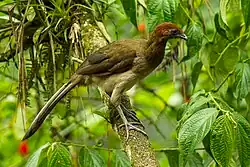 |
| Gunnison grouse
(Gunnison sage-grouse) |
Centrocercus minimus | 1,770-8,400[32] | EN[32] | [32] |  | |
| Bearded guan | Penelope barbata | 1,800-6,500[33] | NT[33] | [33] | Total population is estimated to be 2,770-9,650 individuals.[33] |  |
| Udzungwa forest partridge | Xenoperdix udzungwensis | 2,000-2,700[34] | EN[34] | [34] | Total population is estimated to be 3,000-4,000 individuals.[34] | |
| Malayan peacock-pheasant | Polyplectron malacense | 2,500-9,999[35] | EN[35] | [35] | Estimate is outdated, and does not rely on a density estimate.[35] |  |
| Hainan partridge | Arborophila ardens | 2,500-9,999[36] | VU[36] | [36] |  | |
| Sichuan partridge | Arborophila rufipectus | 2,500-9,999[37] | VU[37] | [37] |  | |
| Cheer pheasant | Catreus wallichi | 2,500-9,999[38] | VU[38] | [38] |  | |
| Gorgeted wood quail | Odontophorus strophium | 2,500-9,999[39] | VU[39] | [39] | Total population is estimated to be 5,900 individuals.[39] |  |
| Mrs. Hume's pheasant | Syrmaticus humiae | 2,500-9,999[40] | VU[40] | [40] | Best estimate for number of mature individuals is 7,500.[40] |  |
| Reeves's pheasant | Syrmaticus reevesii | 2,500-9,999[41] | VU[41] | [41] | Total population is estimated to be 3,500-15,000 individuals.[41] |  |
| Blyth's tragopan | Tragopan blythii | 2,500-9,999[42] | VU[42] | [42] | Total population is estimate to be 3,500-15,000 individuals.[42] |  |
| Cabot's tragopan | Tragopan caboti | 2,500-9,999[43] | VU[43] | [43] | Total population is estimated to be 3,500-15,000 individuals.[43] |  |
| Congo peafowl | Afropavo congensis | 2,500-9,999[44] | NT[44] | [44] | Total population is estimated to be 3,500-15,000 individuals.[44] |  |
| Biak scrubfowl | Megapodius geelvinkianus | 2,500-9,999[45] | NT[45] | [45] | Best estimate for number of mature individuals is 4,950.[45] |  |
| Orange-necked partridge | Arborophila davidi | 2,500-9,999[46] | NT[46] | [46] | Total population is estimated to be 10,000 individuals.[46] |  |
| Mountain peacock-pheasant | Polyplectron inopinatum | 2,500-20,000[47] | NT[47] | [47] | Best estimate for number of mature individuals is 2,500-9,999.[47] |  |
| Micronesian scrubfowl
(Micronesian megapode) |
Megapodius laperouse | 2,600-15,400[48] | NT[48] | ?[48] | Best estimate for number of mature individuals is 4,500. |  |
| Western tragopan | Tragopan melanocephalus | 3,200-9,500[49] | VU[49] | [49] |
 | |
| Swinhoe's pheasant | Lophura swinhoii | 3,300-6,700[50] | NT[50] | [50] | Total population is estimated to be 5,000-10,000 individuals.[50] |  |
| Chestnut-headed partridge | Arborophila cambodiana | 3,500-12,000[51] | NT[51] | [51] |  | |
| Helmeted curassow | Pauxi pauxi | 3,500-12,500[52] | VU[52] | [52] |  | |
| Bearded wood partridge | Dendrortyx barbatus | 3,600[53] | VU[53] | [53] | Total population is estimated to be less than 5,400 individuals.[53] |  |
| White-faced partridge
(Grey-breasted partridge) |
Arborophila orientalis | 4,000-20,000[54] | VU[54] | [54] |
Best estimate for number of mature individuals is 10,000-20,000.[54] |  |
| Brown eared-pheasant | Crossoptilon mantchuricum | 5,000-15,000[55] | LC[55] | [55] |  | |
| Vanuatu scrubfowl
(Vanuatu megapode) |
Megapodius layardi | 5,000-20,000[56] | LC[56] | [56] | 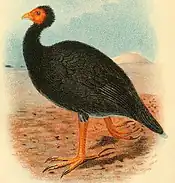 | |
| Bornean peacock-pheasant | Polyplectron schleiermacheri | 5,000-25,000[57] | EN[57] | [57] |  | |
| Dusky scrubfowl
(Dusky megapode) |
Megapodius freycinet | 5,000-100,000[58] | LC[58] | [58] | Best estimate for number of mature individuals is 10,000-50,000.[58] |  |
| Germain's peacock-pheasant | Polyplectron germaini | 5,400-27,000[59] | VU[59] | [59] | Best estimate for number of mature individuals is 7,500-15,000.[59] |  |
| Chinese monal | Lophophorus lhuysii | 6,000-10,000[60] | VU[60] | [60] | Total population is estimated to be 9,000-15,000 individuals.[60] |  |
| Harwood's spurfowl | Pternistis harwoodi | 6,000-15,000[61] | NT[61] | [61] | Total population is estimated to be 10,000-19,999 individuals.[61] | |
| Plumed guineafowl | Guttera plumifera | 6,700-67,000[62] | LC[62] | [62] |
Total population is estimated to be 10,000-100,000 individuals.[62] | 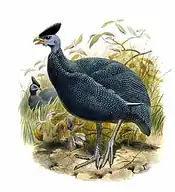 |
| Wattled brushturkey | Aepypodius arfakianus | 6,700-670,000[63] | LC[63] | [63] |
 | |
| New Guinea scrubfowl | Megapodius decollatus | 6,700-670,000[64] | LC[64] | [64] |
||
| Melanesian scrubfowl
(Melanesian megapode) |
Megapodius eremita | 6,700-670,000[65] | LC[65] | [65] |
 | |
| Yellow-legged brushturkey
(Black-billed brushturkey) |
Talegalla fuscirostris | 6,700-670,000[66] | LC[66] | [66] |
 | |
| Red-legged brushturkey
(Collared brushturkey) |
Talegalla jobiensis | 6,700-670,000[67] | LC[67] | [67] |
 | |
| Baudo guan | Penelope ortoni | 7,000-21,000[68] | EN[68] | [68] | Total population is estimated to be 10,000-32,000 individuals.[68] |  |
| Chinese grouse | Tetrastes sewerzowi | 7,300-95,000[69] | NT[69] | [69] |
Best estimate for number of mature individuals is 10,000-25,000. |  |
| Swamp francolin | Ortygornis gularis | 7,500-20,000[70] | NT[70] | [70] |  | |
| Grey-striped spurfowl | Pternistis griseostriatus | 7,500-35,000[71] | LC[71] | [71] |
 | |
| Maleo | Macrocephalon maleo | 8,000-14,000[72] | CR[72] | [72] |  | |
| Dark-backed wood quail | Odontophorus melanonotus | 9,200-13,800[73] | LC[73] | [73] |  | |
| Chestnut-necklaced partridge | Tropicoperdix charltonii | < 10,000[74] | VU[74] | [74] |
Value given may be an underestimate.[74] |  |
| Yellow-knobbed curassow | Crax daubentoni | >10,000[75] | NT[75] | [75] | Population is "likely substantially larger [than surveyed Colombian population], exceeding 10,000 mature individuals."[75] |  |
| Tibetan eared-pheasant | Crossoptilon harmani | >10,000[76] | LC[76] | [76] |
Population size has not been formally quantified, but "probably (perhaps greatly) exceeds 10,000 mature individuals."[76] |  |
| Green peafowl | Pavo muticus | 10,000-19,999[77] | EN[77] | [77] | Total population is estimated to be 15,000-30,000 individuals.[77] |  |
| Sula scrubfowl
(Sula megapode) |
Megapodius bernsteinii | 10,000-19,999[78] | VU[78] | [78] | Total population is estimated to be 15,000-30,000 individuals.[78] |  |
| Black partridge | Melanoperdix niger | 10,000-19,999[79] | VU[79] | [79] | Value is outdated, and is likely now an overestimate.[79] |  |
| Caucasian snowcock | Tetraogallus caucasicus | 10,000-32,400[80] | LC[80] | [80] |  | |
| Siamese fireback | Lophura diardi | 10,000-99,999[81] | NT[81] | [81] | Population "probably numbers in the tens of thousands."[81] |  |
| Caspian snowcock | Tetraogallus caspius | 15,000-38,000[82] | LC[82] | [82] | Preliminary estimate based on extrapolating European population data.[82] |  |
| Malleefowl | Leipoa ocellata | 20,000-30,000[83] | VU[83] | [83] | Best estimate for number of mature individuals in 25,000.[83] |  |
| Moluccan scrubfowl
(Moluccan megapode) |
Eulipoa wallacei | 20,000-49,999[84] | VU[84] | [84] | Values given are from 1997 estimate. Population is highly uncertain following recent declines. Total population may actually be less than 20,000 mature individuals if recent estimates are accurate. | 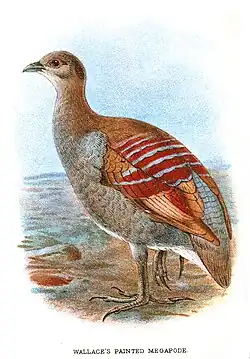 |
| Highland guan | Penelopina nigra | 20,000-49,999[85] | VU[85] | [85] |  | |
| Palawan peacock-pheasant | Polyplectron napoleonis | 20,000-49,999[86] | VU[86] | [86] |  | |
| Taiwan partridge | Arborophila crudigularis | 20,000-49,999[87] | NT[87] | [87] | Total population is estimated to be 30,000-75,000 individuals.[87] |  |
| Ocellated turkey | Meleagris ocellata | 20,000-49,999[88] | NT[88] | [88] |  | |
| Long-tailed wood partridge | Dendrortyx macroura | 20,000-49,999[89] | LC[89] | [89] |  | |
| Elliot's pheasant | Syrmaticus ellioti | 20,000-100,000[90] | LC[90] | [90] | 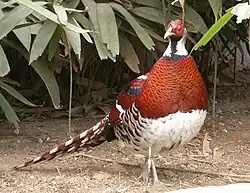 | |
| Mikado pheasant | Syrmaticus mikado | 20,000-100,000[91] | LC[91] | [91] |  | |
| Lesser prairie chicken | Tympanuchus pallidicinctus | 22,000-41,000[92] | VU[92] | [92] | Values given are for total population.[92] |  |
| Caucasian grouse | Lyrurus mlokosiewiczi | 28,000-58,000[93] | NT[93] | [93] | Total population is estimated to be 42,700-87,300 individuals.[93] |  |
| Salvin's curassow | Mitu salvini | 33,000[94] | LC[94] | [94] | Total population is estimated to approach 50,000 individuals.[94] |  |
| White-breasted guineafowl | Agelastes meleagrides | 39,000-93,000[95] | VU[95] | [95] | Total population is estimated to be 59,100-139,500 individuals.[95] |  |
| Great curassow | Crax rubra | 40,000-50,000[96] | VU[96] | [96] | Total population is estimated to be 50,000-499,999 individuals, but true population is expected to be at the lower end of this range.[96] |  |
| Band-tailed guan | Penelope argyrotis | 45,000[97] | LC[97] | [97] |
Total population is estimated to be 70,000 individuals.[97] |  |
| Nahan's partridge | Ptilopachus nahani | 50,000-99,999[98] | VU[98] | [98] | Values given are for total population.[98] |  |
| Black-fronted wood quail | Odontophorus atrifrons | 50,000-99,999[99] | LC[99] | [99] | Total population is estimated to be 104,000 individuals.[99] |  |
| Collared partridge
(White-necklaced partridge) |
Arborophila gingica | 50,000-250,000[100] | NT[100] | [100] |
 | |
| Copper pheasant | Syrmaticus soemmerringii | 50,000-300,000[101] | LC[101] | ?[101] |  | |
| Black-eared wood quail | Odontophorus melanotis | 50,000-499,999[102] | NT[102] | [102] |
 | |
| Crested guan | Penelope purpurascens | 50,000-499,999[103] | NT[103] | [103] |  | |
| Tawny-faced quail | Rhynchortyx cinctus | 50,000-499,999[104] | NT[104] | [104] |
 | |
| Black guan | Chamaepetes unicolor | 50,000-499,999[105] | LC[105] | [105] |
 | |
| Black-throated bobwhite
(Yucatan bobwhite) |
Colinus nigrogularis | 50,000-499,999[106] | LC[106] | [106] |  | |
| Buffy-crowned wood partridge | Dendrortyx leucophrys | 50,000-499,999[107] | LC[107] | [107] |  | |
| Singing quail | Dactylortyx thoracicus | 50,000-499,999[108] | LC[108] | [108] |  | |
| Spotted wood quail | Odontophorus guttatus | 50,000-499,999[109] | LC[109] | [109] |  | |
| Black-breasted wood quail | Odontophorus leucolaemus | 50,000-499,999[110] | LC[110] | [110] |
 | |
| Banded quail | Philortyx fasciatus | 50,000-499,999[111] | LC[111] | [111] |  | |
| West Mexican chachalaca | Ortalis poliocephala | 50,000-500,000[112] | LC[112] | [112] |  | |
| Rufous-bellied chachalaca | Ortalis wagleri | 50,000-500,000[113] | LC[113] | [113] |  | |
| Siberian grouse | Falcipennis falcipennis | 55,000-135,000[114] | LC[114] | [114] |
Total population is estimated to be 68,400-168,000 individuals.[114] |  |
| Temminck's tragopan | Tragopan temminckii | 67,000-340,000[115] | LC[115] | [115] |  | |
| Rock partridge | Alectoris graeca | 79,600-154,200[116] | NT[116] | [116] |  | |
| Chestnut-breasted partridge | Arborophila mandellii | 80,000-140,000[117] | NT[117] | [117] |  | |
| Great argus | Argusianus argus | >100,000[118] | VU[118] | [118] | Value given is for total population.[118] |  |
| Spot-bellied bobwhite | Colinus leucopogon | 100,000-499,999[119] | LC[119] | [119] |
 | |
| Rufous-breasted wood quail | Odontophorus speciosus | 100,000-499,999[120] | LC[120] | [120] |
 | |
| Buff-browed chachalaca | Ortalis superciliaris | 100,000-499,999[121] | LC[121] | [121] |
_-_Buff-browed_Chachalaca%253B_Rio_Mearim%252C_Arari%252C_Maranh%C3%A3o%252C_Brazil.jpg) | |
| Black guineafowl | Agelastes niger | 100,000-500,000[122] | LC[122] | [122] |
Values given are for total population.[122] |  |
| Orange-footed scrubfowl | Megapodius reinwardt | 100,000-1,000,000[123] | LC[123] | [123] |  | |
| See-see partridge | Ammoperdix griseogularis | 150,000-249,999[124] | LC[124] | ?[124] |  | |
| Chestnut wood quail | Odontophorus hyperythrus | 157,300-484,000[125] | LC[125] | [125] |  | |
| Crestless curassow | Mitu tomentosum | 180,000-1,480,000[126] | LC[126] | [126] |
Total population is estimated to be 275,000-2,225,000 individuals.[126] |  |
| Dusky grouse | Dendragapus obscurus | 200,000[127] | LC[127] | [127] |
 | |
| Mountain quail | Oreortyx pictus | 260,000[128] | LC[128] | [128] |
 | |
| Sage grouse
(Greater sage-grouse) |
Centrocercus urophasianus | 289,000-550,000[129] | VU[129] | [129] |
Best estimate for number of mature individuals is 350,000.[129] |  |
| Black francolin | Francolinus francolinus | 300,000-849,999[130] | LC[130] | [130] |
 | |
| Razor-billed curassow | Mitu tuberosum | 300,000-2,000,000[131] | NT[131] | [131] |
Total population is estimated to be 500,000 - 3,000,000 individuals.[131] |  |
| Greater prairie chicken | Tympanuchus cupido | 360,000[132] | NT[132] | [132] |  | |
| Elegant quail | Callipepla douglasii | 500,000-4,999,999[133] | LC[133] | [133] |  | |
| Grey-headed chachalaca | Ortalis cinereiceps | 500,000-5,000,000[134] | LC[134] | [134] |
 | |
| Sharp-tailed grouse | Tympanuchus phasianellus | 760,000[135] | LC[135] | [135] |
 | |
| Sooty grouse | Dendragapus fuliginosus | 2,000,000[136] | LC[136] | [136] |
 | |
| White-tailed ptarmigan | Lagopus leucura | 2,000,000[137] | LC[137] | [137] |
 | |
| Plain chachalaca | Ortalis vetula | 2,000,000[138] | LC[138] | [138] | 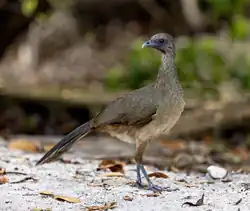 | |
| Rusty-margined guan | Penelope superciliaris | 2,000,000-20,000,000[139] | NT[139] | [139] |
Total population is estimated to be 4,000,000 - 29,000,000 individuals.[139] |  |
| Grey partridge | Perdix perdix | 3,300,000-5,300,000[140] | LC[140] | [140] |  | |
| Western capercaillie | Tetrao urogallus | 3,980,000-8,550,000[141] | LC[141] | [141] |  | |
| Chukar
(Chukar partridge) |
Alectoris chukar | 5,000,000-34,999,999[142] | LC[142] | [142] |  | |
| Crested bobwhite | Colinus cristatus | 5,000,000-49,999,999[143] | LC[143] | [143] |
 | |
| Scaled quail | Callipepla squamata | 5,100,000[144] | LC[144] | [144] |
 | |
| Northern bobwhite | Colinus virginianus | 5,800,000[145] | NT[145] | [145] |
 | |
| California quail | Callipepla californica | 5,800,000[146] | LC[146] | [146] |
 | |
| Gambel's quail | Callipepla gambelii | 5,800,000[147] | LC[147] | [147] |
 | |
| Wild turkey | Meleagris gallopavo | 6,900,000[148] | LC[149] | [149] |
IUCN/BirdLife International do not report a sample size estimate.[149]
Reported value comes from Partners in Flight Database.[148] |
 |
| Black grouse | Lyrurus tetrix | 6,940,000-10,700,000[150] | LC[150] | [150] | Preliminary global estimate extrapolated from European population.[150] |  |
| Red-legged partridge | Alectoris rufa | 9,950,000-13,700,000[151] | NT[151] | [151] |  | |
| Spruce grouse | Canachites canadensis | 11,000,000[152] | LC[152] | [152] |
 | |
| Rock ptarmigan | Lagopus muta | 11,500,000-14,300,000[153] | LC[153] | ?[153] |  | |
| Hazel grouse | Tetrastes bonasia | 13,400,000-23,200,000[154] | LC[154] | [154] | Preliminary global estimate extrapolated from European population.[154] |  |
| Common quail | Coturnix coturnix | 15,000,000-35,000,000[155] | LC[155] | [155] | Preliminary global estimate extrapolated from European population.[155] |  |
| Ruffed grouse | Bonasa umbellus | 18,000,000[156] | LC[156] | [156] |
 | |
| Willow grouse
(Willow ptarmigan) |
Lagopus lagopus | 39,000,000-43,000,000[157] | LC[157] | [157] | Preliminary global estimate extrapolated from European, United States, Canadian populations.[157]
Note that IOC taxonomy splits an additional species, the red grouse (L. scotica), from this species.[2] IUCN/BirdLife International maintain both species within L. lagopus.[5] |
 |
| Common pheasant | Phasianus colchicus | 50,000,000-100,000,000[158] | LC[158] | ?[158] | Values given are for population in native range. Population of the species in its introduced range is estimated to be 25,000,000-50,000,000 individuals.[158] |  |
Species without population estimates
| Common name | Binomial name | Population | Status | Trend | Notes | Image |
|---|---|---|---|---|---|---|
| Dulit partridge | Rhizothera dulitensis | unknown[159] | DD[159] | ?[159] | Species has not been seen since 1902.[159] |  |
| Malayan crestless fireback
(Crestless fireback) |
Lophura erythrophthalma | unknown[160] | CR[160] | [160] |  | |
| Annamite crested argus
(Crested argus; Vietnamese crested argus) |
Rheinardia ocellata | unknown[161] | CR[161] | [161] | Population is decreasing incredibly rapidly, with an estimated loss of 80% of the population over three generations.[161] |  |
| Bornean crestless fireback | Lophura pyronota | unknown[162] | EN[162] | [162] |
 | |
| Bare-faced curassow | Crax fasciolata | unknown[163] | VU[163] | [163] |
 | |
| Bulwer's pheasant | Lophura bulweri | unknown[164] | VU[164] | [164] |  | |
| Bornean crested fireback | Lophura ignita | unknown[165] | VU[165] | [165] |
 | |
| Malayan crested fireback | Lophura rufa | unknown[166] | VU[166] | [166] |
 | |
| White-browed guan | Penelope jacucaca | unknown[167] | VU[167] | [167] |  | |
| White-crested guan | Penelope pileata | unknown[168] | VU[168] | [168] |  | |
| Red-throated piping guan | Pipile cujubi | unknown[169] | VU[169] | [169] |  | |
| Crested partridge | Rollulus rouloul | unknown[170] | VU[170] | [170] |
 | |
| Ferruginous partridge | Caloperdix oculeus | unknown[171] | NT[171] | [171] |
 | |
| Japanese quail | Coturnix japonica | unknown[172] | NT[172] | [172] |
 | |
| Salvadori's pheasant | Lophura inornata | unknown[173] | NT[173] | [173] | Hoogerwerf's pheasant (L. i. hoogerwerfi) was previously considered to be a separate species, but is now treated as a subspecies of this one by both the IOC and IUCN/BirdLife International.[2][5] |  |
| Venezuelan wood quail | Odontophorus columbianus | unknown[174] | NT[174] | [174] |  | |
| White-throated piping guan | Pipile grayi | unknown[175] | NT[175] | [175] |
 | |
| Long-billed partridge | Rhizothera longirostris | unknown[176] | NT[176] | [176] |
 | |
| Moorland francolin | Scleroptila psilolaema | unknown[177] | NT[177] | [177] |
 | |
| Sabah partridge | Tropicoperdix graydoni | unknown[178] | NT[178] | [178] |
 | |
| Wattled guan | Aburria aburri | unknown[179] | LC[179] | [179] |  | |
| Vulturine guineafowl | Acryllium vulturinum | unknown[180] | LC[180] | [180] |
 | |
| Barbary partridge | Alectoris barbara | unknown[181] | LC[181] | ?[181] | European subpopulation is estimated to be 15,500-41,000 mature individuals.[181] |  |
| Przevalski's partridge | Alectoris magna | unknown[182] | LC[182] | [182] |
 | |
| Arabian partridge | Alectoris melanocephala | unknown[183] | LC[183] | [183] |
 | |
| Philby's partridge | Alectoris philbyi | unknown[184] | LC[184] | [184] |
 | |
| Australian brushturkey | Alectura lathami | unknown[185] | LC[185] | [185] |
 | |
| Sand partridge | Ammoperdix heyi | unknown[186] | LC[186] | [186] |
 | |
| White-cheeked partridge | Arborophila atrogularis | unknown[187] | LC[187] | [187] |
 | |
| Bar-backed partridge | Arborophila brunneopectus | unknown[188] | LC[188] | [188] |
 | |
| Malay partridge
(Malayan partridge) |
Arborophila campbelli | unknown[189] | LC[189] | [189] |
 | |
| Bornean partridge
(Red-breasted partridge) |
Arborophila hyperythra | unknown[190] | LC[190] | [190] |
 | |
| Chestnut-bellied partridge | Arborophila javanica | unknown[191] | LC[191] | [191] |
 | |
| Tan-breasted partridge
(Roll's partridge) |
Arborophila rolli | unknown[192] | LC[192] | [192] |
||
| Red-billed partridge | Arborophila rubrirostris | unknown[193] | LC[193] | [193] |
 | |
| Rufous-throated partridge | Arborophila rufogularis | unknown[194] | LC[194] | [194] |
 | |
| Sumatran partridge | Arborophila sumatrana | unknown[195] | LC[195] | [195] |
 | |
| Hill partridge | Arborophila torqueola | unknown[196] | LC[196] | [196] |
 | |
| Mountain bamboo partridge | Bambusicola fytchii | unknown[197] | LC[197] | [197] |
 | |
| Taiwan bamboo partridge | Bambusicola sonorivox | unknown[198] | LC[198] | [198] |
 | |
| Chinese bamboo partridge | Bambusicola thoracicus | unknown[199] | LC[199] | [199] |
 | |
| White-throated francolin | Campocolinus albogularis | unknown[200] | LC[200] | [200] |
 | |
| Coqui francolin | Campocolinus coqui | unknown[201] | LC[201] | [201] |
 | |
| Schlegel's francolin | Campocolinus schlegelii | unknown[202] | LC[202] | [202] |
||
| Sickle-winged guan | Chamaepetes goudotii | unknown[203] | LC[203] | [203] |
 | |
| Lady Amherst's pheasant | Chrysolophus amherstiae | unknown[204] | LC[204] | [204] |
 | |
| Golden pheasant | Chrysolophus pictus | unknown[205] | LC[205] | [205] |
 | |
| Blue eared-pheasant | Crossoptilon auritum | unknown[206] | LC[206] | [206] |
 | |
| Rain quail | Coturnix coromandelica | unknown[207] | LC[207] | [207] |
 | |
| Harlequin quail | Coturnix delegorguei | unknown[208] | LC[208] | [208] |
 | |
| Stubble quail | Coturnix pectoralis | unknown[209] | LC[209] | [209] |
 | |
| Black curassow | Crax alector | unknown[210] | LC[210] | [210] |
 | |
| White eared-pheasant | Crossoptilon crossoptilon | unknown[211] | LC[211] | [211] |  | |
| Montezuma quail | Cyrtonyx montezumae | unknown[212] | LC[212] | [212] |
 | |
| Painted francolin | Francolinus pictus | unknown[213] | LC[213] | [213] |
 | |
| Chinese francolin | Francolinus pintadeanus | unknown[214] | LC[214] | [214] |
 | |
| Sri Lanka spurfowl | Galloperdix bicalcarata | unknown[215] | LC[215] | [215] |
 | |
| Painted spurfowl | Galloperdix lunulata | unknown[216] | LC[216] | [216] |
 | |
| Red spurfowl | Galloperdix spadicea | unknown[217] | LC[217] | [217] |
 | |
| Red junglefowl | Gallus gallus | unknown[218] | LC[218] | [218] |  | |
| Sri Lanka junglefowl | Gallus lafayettii | unknown[219] | LC[219] | [219] |
 | |
| Grey junglefowl | Gallus sonneratii | unknown[220] | LC[220] | [220] |
 | |
| Green junglefowl | Gallus varius | unknown[221] | LC[221] | [221] |
 | |
| Southern crested guineafowl | Guttera edouardi | unknown[222] | LC[222] | [222] |
 | |
| Eastern crested guineafowl | Guttera pucherani | unknown[223] | LC[223] | [223] |
 | |
| Western crested guineafowl | Guttera verreauxi | unknown[224] | LC[224] | [224] |
 | |
| Crimson-headed partridge | Haematortyx sanguiniceps | unknown[225] | LC[225] | [225] |  | |
| Blood pheasant | Ithaginis cruentus | unknown[226] | LC[226] | [226] |
 | |
| Snow partridge | Lerwa lerwa | unknown[227] | LC[227] | [227] |
 | |
| Himalayan monal | Lophophorus impejanus | unknown[228] | LC[228] | [228] |
 | |
| Kalij pheasant | Lophura leucomelanos | unknown[229] | LC[229] | [229] |
 | |
| Silver pheasant | Lophura nycthemera | unknown[230] | LC[230] | [230] |
 | |
| Sclater's monal | Lophophorus sclateri | unknown[231] | LC[231] | [231] |  | |
| Madagascar partridge | Margaroperdix madagarensis | unknown[232] | LC[232] | [232] |
 | |
| Philippine scrubfowl
(Philippine megapode) |
Megapodius cumingii | unknown[233] | LC[233] | [233] |
 | |
| Nocturnal curassow | Nothocrax urumutum | unknown[234] | LC[234] | [234] |
 | |
| Helmeted guineafowl | Numida meleagris | unknown[235] | LC[235] | [235] |
 | |
| Stripe-faced wood quail | Odontophorus balliviani | unknown[236] | LC[236] | [236] |
 | |
| Spot-winged wood quail | Odontophorus capueira | unknown[237] | LC[237] | [237] |
 | |
| Rufous-fronted wood quail | Odontophorus erythrops | unknown[238] | LC[238] | [238] |
 | |
| Marbled wood quail | Odontophorus gujanensis | unknown[239] | LC[239] | [239] |
 | |
| Starred wood quail | Odontophorus stellatus | unknown[240] | LC[240] | [240] |
 | |
| East Brazilian chachalaca | Ortalis araucuan | unknown[241] | LC[241] | [241] |
 | |
| Chaco chachalaca | Ortalis canicollis | unknown[242] | LC[242] | [242] |
 | |
| Colombian chachalaca | Ortalis columbiana | unknown[243] | LC[243] | [243] |
 | |
| Chestnut-winged chachalaca | Ortalis garrula | unknown[244] | LC[244] | [244] |
 | |
| Speckled chachalaca | Ortalis guttata | unknown[245] | LC[245] | ?[245] |  | |
| White-bellied chachalaca | Ortalis leucogastra | unknown[246] | LC[246] | [246] |  | |
| Little chachalaca | Ortalis motmot | unknown[247] | LC[247] | [247] |
Note that IOC taxonomy splits an additional species, the chestnut-headed chachalaca (O. ruficeps), from this one.[1]
IUCN/BirdLife International place both species within O. motmot.[5] |
 |
| Rufous-vented chachalaca | Ortalis ruficauda | unknown[248] | LC[248] | [248] |
 | |
| Scaled chachalaca | Ortalis squamata | unknown[249] | LC[249] | [249] |
 | |
| Grey francolin | Ortygornis pondicerianus | unknown[250] | LC[250] | [250] |
 | |
| Crested francolin | Ortygornis sephaena | unknown[251] | LC[251] | [251] |
 | |
| Indian peafowl | Pavo cristatus | unknown[252] | LC[252] | [252] |
 | |
| Forest francolin
(Latham's francolin) |
Peliperdix lathami | unknown[253] | LC[253] | [253] |
 | |
| Red-faced guan | Penelope dabbenei | unknown[254] | LC[254] | [254] |
 | |
| Spix's guan | Penelope jacquacu | unknown[255] | LC[255] | [255] |
 | |
| Marail guan | Penelope marail | unknown[256] | LC[256] | [256] |
 | |
| Andean guan | Penelope montagnii | unknown[257] | LC[257] | [257] |
 | |
| Dusky-legged guan | Penelope obscura | unknown[258] | LC[258] | [258] |
Note that IOC taxonomy splits an additional species, the Yungas guan (P. bridgesi), from this one.[1]
IUCN/BirdLife International place both species within P. obscura.[5] |
 |
| Rock bush quail | Perdicula argoondah | unknown[259] | LC[259] | [259] |
 | |
| Jungle bush quail | Perdicula asiatica | unknown[260] | LC[260] | [260] |
 | |
| Painted bush quail | Perdicula erythrorhyncha | unknown[261] | LC[261] | [261] |
 | |
| Daurian partridge | Perdix dauurica | unknown[262] | LC[262] | [262] |
 | |
| Tibetan partridge | Perdix hodgsoniae | unknown[263] | LC[263] | [263] |
 | |
| Green pheasant | Phasianus versicolor | unknown[264] | LC[264] | [264] |
 | |
| Blue-throated piping guan | Pipile cumanensis | unknown[265] | LC[265] | [265] |
 | |
| Grey peacock-pheasant | Polyplectron bicalcaratum | unknown[266] | LC[266] | [266] |
 | |
| Bronze-tailed peacock-pheasant | Polyplectron chalcurum | unknown[267] | LC[267] | [267] |
 | |
| Red-billed spurfowl | Pternistis adspersus | unknown[268] | LC[268] | [268] |
 | |
| Red-necked spurfowl | Pternistis afer | unknown[269] | LC[269] | [269] |
 | |
| Ahanta spurfowl | Pternistis ahantensis | unknown[270] | LC[270] | [270] |
 | |
| Double-spurred spurfowl | Pternistis bicalcaratus | unknown[271] | LC[271] | [271] |
 | |
| Cape spurfowl | Pternistis capensis | unknown[272] | LC[272] | [272] |
 | |
| Chestnut-naped spurfowl | Pternistis castaneicollis | unknown[273] | LC[273] | [273] |
 | |
| Clapperton's spurfowl | Pternistis clappertoni | unknown[274] | LC[274] | [274] |
 | |
| Erckel's spurfowl | Pternistis erckelii | unknown[275] | LC[275] | [275] |
 | |
| Hartlaub's spurfowl | Pternistis hartlaubi | unknown[276] | LC[276] | [276] |
 | |
| Hildebrandt's spurfowl | Pternistis hildebrandti | unknown[277] | LC[277] | [277] |
 | |
| Heuglin's spurfowl | Pternistis icterorhynchus | unknown[278] | LC[278] | [278] |
 | |
| Jackson's spurfowl | Pternistis jacksoni | unknown[279] | LC[279] | [279] |
 | |
| Yellow-necked spurfowl | Pternistis leucoscepus | unknown[280] | LC[280] | [280] |
 | |
| Natal spurfowl | Pternistis natalensis | unknown[281] | LC[281] | [281] |
 | |
| Handsome spurfowl | Pternistis nobilis | unknown[282] | LC[282] | [282] |
 | |
| Grey-breasted spurfowl | Pternistis rufopictus | unknown[283] | LC[283] | [283] |
 | |
| Scaly spurfowl | Pternistis squamatus | unknown[284] | LC[284] | [284] |
 | |
| Swainson's spurfowl | Pternistis swainsonii | unknown[285] | LC[285] | [285] |
 | |
| Stone partridge | Ptilopachus petrosus | unknown[286] | LC[286] | [286] |
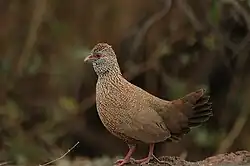 | |
| Koklass pheasant | Pucrasia macrolopha | unknown[287] | LC[287] | [287] |
 | |
| Grey-winged francolin | Scleroptila afra | unknown[288] | LC[288] | [288] |
 | |
| Elgon francolin | Scleroptila elgonensis | unknown[289] | LC[289] | [289] |
 | |
| Finsch's francolin | Scleroptila finschi | unknown[290] | LC[290] | [290] |
||
| Orange River francolin | Scleroptila gutturalis | unknown[291] | LC[291] | [291] |
 | |
| Red-winged francolin | Scleroptila levaillantii | unknown[292] | LC[292] | [292] |
 | |
| Shelley's francolin | Scleroptila shelleyi | unknown[293] | LC[293] | [293] |
 | |
| Ring-necked francolin | Scleroptila streptophora | unknown[294] | LC[294] | [294] |  | |
| Whyte's francolin | Scleroptila whytei | unknown[295] | LC[295] | [295] |
||
| African blue quail
(Blue quail) |
Synoicus adansonii | unknown[296] | LC[296] | [296] |
 | |
| Asian blue quail
(King quail) |
Synoicus chinensis | unknown[297] | LC[297] | [297] |
 | |
| Snow Mountain quail | Synoicus monorthonyx | unknown[298] | LC[298] | [298] |
IUCN/BirdLife International place this species in genus Anurophasis. |  |
| Brown quail | Synoicus ypsilophorus | unknown[299] | LC[299] | [299] |
 | |
| Red-billed brushturkey | Talegalla cuvieri | unknown[300] | LC[300] | [300] |
 | |
| Black-billed capercaillie | Tetrao urogalloides | unknown[301] | LC[301] | [301] |
 | |
| Altai snowcock | Tetraogallus altaicus | unknown[302] | LC[302] | [302] |
 | |
| Himalayan snowcock | Tetraogallus himalayensis | unknown[303] | LC[303] | [303] |
 | |
| Tibetan snowcock | Tetraogallus tibetanus | unknown[304] | LC[304] | [304] |
 | |
| Chestnut-throated partridge
(Chestnut-throated monal-partridge) |
Tetraophasis obscurus | unknown[305] | LC[305] | [305] |
 | |
| Buff-throated partridge
(Buff-throated monal-partridge) |
Tetraophasis szechenyii | unknown[306] | LC[306] | [306] |
 | |
| Satyr tragopan | Tragopan satyra | unknown[307] | LC[307] | [307] | Population is "possibly in the tens, if not hundreds, of thousands," but given the lack of monitoring data, population is considered unknown.[307] |  |
| Green-legged partridge | Tropicoperdix chloropus | unknown[308] | LC[308] | [308] |
 | |
Populations of domestic Galliformes
Note that domestic subspecies are not evaluated by the IUCN.
| Common name | Binomial name | Population | Status | Trend | Notes | Image |
|---|---|---|---|---|---|---|
| Domestic guinea fowl | Numidia meleagris domesticus | ? | NE | NA | Domestic geese (Anseriformes) and guinea fowl together amounted to 364 million birds in 2020.[309] However, the FAO database reports over 375 million domestic geese alone for 2020[310], so it is difficult to infer this population value. |  |
| Domestic turkey | Meleagris gallopavo domesticus | 450,000,000[310] | NE | NA | Subspecies of wild turkey. |  |
| Chicken | Gallus gallus domesticus
(sometimes, G. domesticus)[311] |
33,000,000,000[310] | NE | NA | This is a subspecies of red junglefowl with attributes of other species. |  |
See also
References
- 1 2 3 "Megapodes, guans, guineafowl, New World quail – IOC World Bird List". www.worldbirdnames.org. Retrieved 2026-01-11.
- 1 2 3 4 "Pheasants, partridges, francolins – IOC World Bird List". www.worldbirdnames.org. Retrieved 2026-01-11.
- ↑ BirdLife International (2023). "Coturnix novaezelandiae". IUCN Red List of Threatened Species. 2023 e.T22678955A227794604. doi:10.2305/IUCN.UK.2023-1.RLTS.T22678955A227794604.en.
- 1 2 3 4 BirdLife International (2024). "Lophura edwardsi". IUCN Red List of Threatened Species. 2024 e.T45354985A249120158. doi:10.2305/IUCN.UK.2024-2.RLTS.T45354985A249120158.en.
- 1 2 3 4 5 Handbook of the Birds of the World and BirdLife International Digital Checklist of the Birds of the World: Version 10. BirdLife International. 2025.
- 1 2 3 BirdLife International (2018). "Ophrysia superciliosa". IUCN Red List of Threatened Species. 2018 e.T22679141A132051220. doi:10.2305/IUCN.UK.2018-2.RLTS.T22679141A132051220.en.
- 1 2 3 4 BirdLife International (2024). "Perdicula manipurensis". IUCN Red List of Threatened Species. 2024 e.T22679012A218880247. doi:10.2305/IUCN.UK.2024-2.RLTS.T22679012A218880247.en.
- 1 2 3 4 BirdLife International (2025). "Pauxi koepckeae". IUCN Red List of Threatened Species. 2025 e.T45090459A281387508. doi:10.2305/IUCN.UK.2025-2.RLTS.T45090459A281387508.en.
- 1 2 3 BirdLife International (2018). "Mitu mitu". IUCN Red List of Threatened Species. 2018 e.T22678486A132315266. doi:10.2305/IUCN.UK.2018-2.RLTS.T22678486A132315266.en.
- 1 2 3 4 BirdLife International (2020). "Pipile pipile". IUCN Red List of Threatened Species. 2020 e.T22678401A177972653. doi:10.2305/IUCN.UK.2020-3.RLTS.T22678401A177972653.en.
- 1 2 3 4 BirdLife International (2018). "Penelope albipennis". IUCN Red List of Threatened Species. 2018 e.T22678382A131447454. doi:10.2305/IUCN.UK.2018-2.RLTS.T22678382A131447454.en.
- 1 2 3 4 BirdLife International (2018). "Pternistis ochropectus". IUCN Red List of Threatened Species. 2018 e.T22678869A130519228. doi:10.2305/IUCN.UK.2018-2.RLTS.T22678869A130519228.en.
- 1 2 3 "Megapodius pritchardii". IUCN Red List of Threatened Species. 2019. IUCN. 2019. doi:10.2305/IUCN.UK.2019-3.RLTS.T22678625A156113936.en.
- 1 2 3 BirdLife International (2023). "Crax blumenbachii". IUCN Red List of Threatened Species. 2023 e.T22678544A221464106. doi:10.2305/IUCN.UK.2023-1.RLTS.T22678544A221464106.en.
- 1 2 3 4 BirdLife International (2020). "Oreophasis derbianus". IUCN Red List of Threatened Species. 2020 e.T22678453A177970135. doi:10.2305/IUCN.UK.2020-3.RLTS.T22678453A177970135.en.
- 1 2 3 4 BirdLife International (2019). "Megapodius tenimberensis". IUCN Red List of Threatened Species. 2019 e.T22732420A156285707. doi:10.2305/IUCN.UK.2019-3.RLTS.T22732420A156285707.en.
- 1 2 3 4 BirdLife International (2022). "Pternistis camerunensis". IUCN Red List of Threatened Species. 2022 e.T22678891A208345853. doi:10.2305/IUCN.UK.2022-1.RLTS.T22678891A208345853.en.
- 1 2 3 BirdLife International (2021). "Megapodius nicobariensis". IUCN Red List of Threatened Species. 2021 e.T22678583A195335202. doi:10.2305/IUCN.UK.2021-3.RLTS.T22678583A195335202.en.
- 1 2 3 4 BirdLife International (2022). "Polyplectron katsumatae". IUCN Red List of Threatened Species. 2022 e.T22734897A207341783. doi:10.2305/IUCN.UK.2022-2.RLTS.T22734897A207341783.en.
- 1 2 3 4 BirdLife International (2021). "Rheinardia nigrescens". IUCN Red List of Threatened Species. 2021 e.T200032742A200036466. doi:10.2305/IUCN.UK.2021-3.RLTS.T200032742A200036466.en.
- 1 2 3 4 BirdLife International (2021). "Aepypodius bruijnii". IUCN Red List of Threatened Species. 2021 e.T22678559A188436669. doi:10.2305/IUCN.UK.2021-3.RLTS.T22678559A188436669.en.
- 1 2 3 4 BirdLife International (2023). "Crax globulosa". IUCN Red List of Threatened Species. 2023 e.T22678537A221386350. doi:10.2305/IUCN.UK.2023-1.RLTS.T22678537A221386350.en.
- 1 2 3 BirdLife International (2021). "Penelope perspicax". IUCN Red List of Threatened Species. 2021 e.T22678379A188319595. doi:10.2305/IUCN.UK.2021-3.RLTS.T22678379A188319595.en.
- 1 2 3 BirdLife International (2023). "Pternistis swierstrai". IUCN Red List of Threatened Species. 2023 e.T22678896A213097155. doi:10.2305/IUCN.UK.2023-1.RLTS.T22678896A213097155.en.
- 1 2 3 BirdLife International (2025). "Pauxi unicornis". IUCN Red List of Threatened Species. 2025 e.T45090397A276887920. doi:10.2305/IUCN.UK.2025-2.RLTS.T45090397A276887920.en.
- 1 2 3 4 BirdLife International (2025). "Crax alberti". IUCN Red List of Threatened Species. 2025 e.T22678525A265023587. doi:10.2305/IUCN.UK.2025-2.RLTS.T22678525A265023587.en.
- 1 2 3 4 BirdLife International (2021). "Penelope ochrogaster". IUCN Red List of Threatened Species. 2021 e.T22678395A193448118. doi:10.2305/IUCN.UK.2021-3.RLTS.T22678395A193448118.en.
- 1 2 3 4 BirdLife International (2021). "Odontophorus dialeucos". IUCN Red List of Threatened Species. 2021 e.T22679673A178115480. doi:10.2305/IUCN.UK.2021-3.RLTS.T22679673A178115480.en.
- 1 2 3 4 BirdLife International (2018). "Pipile jacutinga". IUCN Red List of Threatened Species. 2018 e.T22678429A132049346. doi:10.2305/IUCN.UK.2018-2.RLTS.T22678429A132049346.en.
- 1 2 3 4 BirdLife International (2020). "Cyrtonyx ocellatus". IUCN Red List of Threatened Species. 2020 e.T22679717A178132513. doi:10.2305/IUCN.UK.2020-3.RLTS.T22679717A178132513.en.
- 1 2 3 4 BirdLife International (2018). "Ortalis erythroptera". IUCN Red List of Threatened Species. 2018 e.T22678318A131519956. doi:10.2305/IUCN.UK.2018-2.RLTS.T22678318A131519956.en.
- 1 2 3 BirdLife International (2020). "Centrocercus minimus". IUCN Red List of Threatened Species. 2020 e.T22728472A152508115. doi:10.2305/IUCN.UK.2020-3.RLTS.T22728472A152508115.en.
- 1 2 3 4 BirdLife International (2019). "Penelope barbata". IUCN Red List of Threatened Species. 2019 e.T22678357A136646577. doi:10.2305/IUCN.UK.2019-3.RLTS.T22678357A136646577.en.
- 1 2 3 4 BirdLife International (2022). "Xenoperdix udzungwensis". IUCN Red List of Threatened Species. 2022 e.T22678901A208298953. doi:10.2305/IUCN.UK.2022-1.RLTS.T22678901A208298953.en.
- 1 2 3 4 BirdLife International (2022). "Polyplectron malacense". IUCN Red List of Threatened Species. 2022 e.T22679385A137837773. doi:10.2305/IUCN.UK.2022-1.RLTS.T22679385A137837773.en.
- 1 2 3 BirdLife International (2024). "Arborophila ardens". IUCN Red List of Threatened Species. 2024 e.T22679063A249693124. doi:10.2305/IUCN.UK.2024-2.RLTS.T22679063A249693124.en.
- 1 2 3 BirdLife International (2024). "Arborophila rufipectus". IUCN Red List of Threatened Species. 2024 e.T22679035A254169870. doi:10.2305/IUCN.UK.2024-2.RLTS.T22679035A254169870.en.
- 1 2 3 BirdLife International (2022). "Catreus wallichii". IUCN Red List of Threatened Species. 2022 e.T22679312A218835395. doi:10.2305/IUCN.UK.2022-2.RLTS.T22679312A218835395.en.
- 1 2 3 4 BirdLife International (2019) [amended version of 2018 assessment]. "Odontophorus strophium". IUCN Red List of Threatened Species. 2019 e.T22679678A155450500. doi:10.2305/IUCN.UK.2018-2.RLTS.T22679678A155450500.en.
- 1 2 3 4 BirdLife International (2023). "Syrmaticus humiae". IUCN Red List of Threatened Species. 2023 e.T22679330A218986656. doi:10.2305/IUCN.UK.2023-1.RLTS.T22679330A218986656.en.
- 1 2 3 4 BirdLife International (2018). "Syrmaticus reevesii". IUCN Red List of Threatened Species. 2018 e.T22679346A131873938. doi:10.2305/IUCN.UK.2018-2.RLTS.T22679346A131873938.en.
- 1 2 3 4 BirdLife International (2020). "Tragopan blythii". IUCN Red List of Threatened Species. 2020 e.T22679163A177682428. doi:10.2305/IUCN.UK.2020-3.RLTS.T22679163A177682428.en.
- 1 2 3 4 BirdLife International (2020). "Tragopan caboti". IUCN Red List of Threatened Species. 2020 e.T22679172A177687593. doi:10.2305/IUCN.UK.2020-3.RLTS.T22679172A177687593.en.
- 1 2 3 4 BirdLife International (2022). "Afropavo congensis". IUCN Red List of Threatened Species. 2022 e.T22679430A208189646. doi:10.2305/IUCN.UK.2022-1.RLTS.T22679430A208189646.en.
- 1 2 3 4 BirdLife International (2022). "Megapodius geelvinkianus". IUCN Red List of Threatened Species. 2022 e.T22728514A216249241.
- 1 2 3 4 BirdLife International (2019). "Arborophila davidi". IUCN Red List of Threatened Species. 2019 e.T22679054A136669497. doi:10.2305/IUCN.UK.2019-3.RLTS.T22679054A136669497.en.
- 1 2 3 4 BirdLife International (2023). "Polyplectron inopinatum". IUCN Red List of Threatened Species. 2023 e.T22679365A218821910. doi:10.2305/IUCN.UK.2023-1.RLTS.T22679365A218821910.en.
- 1 2 3 BirdLife International (2022) [amended version of 2021 assessment]. "Megapodius laperouse". IUCN Red List of Threatened Species. 2022 e.T22678620A216251541.
- 1 2 3 BirdLife International (2025). "Tragopan melanocephalus". IUCN Red List of Threatened Species. 2025 e.T22679147A177694929. doi:10.2305/IUCN.UK.2025-2.RLTS.T22679147A177694929.en.
- 1 2 3 4 BirdLife International (2019). "Lophura swinhoii". IUCN Red List of Threatened Species. 2019 e.T22679241A136677351. doi:10.2305/IUCN.UK.2019-3.RLTS.T22679241A136677351.en.
- 1 2 3 BirdLife International (2025). "Arborophila cambodiana". IUCN Red List of Threatened Species. 2025 e.T22679057A275415056. doi:10.2305/IUCN.UK.2025-2.RLTS.T22679057A275415056.en.
- 1 2 3 BirdLife International (2023). "Pauxi pauxi". IUCN Red List of Threatened Species. 2023 e.T22678497A221428227. doi:10.2305/IUCN.UK.2023-1.RLTS.T22678497A221428227.en.
- 1 2 3 4 BirdLife International (2020). "Dendrortyx barbatus". IUCN Red List of Threatened Species. 2020 e.T22679576A178090964. doi:10.2305/IUCN.UK.2020-3.RLTS.T22679576A178090964.en.
- 1 2 3 4 BirdLife International (2024). "Arborophila orientalis". IUCN Red List of Threatened Species. 2024 e.T22679038A246271035. doi:10.2305/IUCN.UK.2024-2.RLTS.T22679038A246271035.en.
- 1 2 3 BirdLife International (2024). "Crossoptilon mantchuricum". IUCN Red List of Threatened Species. 2024 e.T22679299A254340969. doi:10.2305/IUCN.UK.2024-2.RLTS.T22679299A254340969.en.
- 1 2 3 BirdLife International (2024). "Megapodius layardi". IUCN Red List of Threatened Species. 2024 e.T22678615A190450003. doi:10.2305/IUCN.UK.2024-2.RLTS.T22678615A190450003.en.
- 1 2 3 BirdLife International (2024). "Polyplectron schleiermacheri". IUCN Red List of Threatened Species. 2024 e.T22679393A262327449. doi:10.2305/IUCN.UK.2024-2.RLTS.T22679393A262327449.en.
- 1 2 3 4 BirdLife International (2021). "Megapodius freycinet". IUCN Red List of Threatened Species. 2021 e.T22678602A196317346. doi:10.2305/IUCN.UK.2021-3.RLTS.T22678602A196317346.en.
- 1 2 3 4 BirdLife International (2023). "Polyplectron germaini". IUCN Red List of Threatened Species. 2023 e.T22679372A218732296. doi:10.2305/IUCN.UK.2023-1.RLTS.T22679372A218732296.en.
- 1 2 3 4 BirdLife International (2022). "Lophophorus lhuysii". IUCN Red List of Threatened Species. 2022 e.T22679192A219003994. doi:10.2305/IUCN.UK.2022-2.RLTS.T22679192A219003994.en.
- 1 2 3 4 BirdLife International (2018). "Pternistis harwoodi". IUCN Red List of Threatened Species. 2018 e.T22678815A131514381. doi:10.2305/IUCN.UK.2018-2.RLTS.T22678815A131514381.en.
- 1 2 3 4 BirdLife International (2022). "Guttera plumifera". IUCN Red List of Threatened Species. 2022 e.T22679560A208800107. doi:10.2305/IUCN.UK.2022-1.RLTS.T22679560A208800107.en.
- 1 2 3 BirdLife International (2024). "Aepypodius arfakianus". IUCN Red List of Threatened Species. 2024 e.T22678555A264027910. doi:10.2305/IUCN.UK.2024-2.RLTS.T22678555A264027910.en.
- 1 2 3 BirdLife International (2024). "Megapodius decollatus". IUCN Red List of Threatened Species. 2024 e.T22678607A264019233. doi:10.2305/IUCN.UK.2024-2.RLTS.T22678607A264019233.en.
- 1 2 3 BirdLife International (2018). "Megapodius eremita". IUCN Red List of Threatened Species. 2018 e.T22678611A132049670. doi:10.2305/IUCN.UK.2018-2.RLTS.T22678611A132049670.en.
- 1 2 3 BirdLife International (2024). "Talegalla fuscirostris". IUCN Red List of Threatened Species. 2024 e.T22678568A264012463. doi:10.2305/IUCN.UK.2024-2.RLTS.T22678568A264012463.en.
- 1 2 3 BirdLife International (2024). "Talegalla jobiensis". IUCN Red List of Threatened Species. 2024 e.T22678572A264011160. doi:10.2305/IUCN.UK.2024-2.RLTS.T22678572A264011160.en.
- 1 2 3 4 BirdLife International (2019). "Penelope ortoni". IUCN Red List of Threatened Species. 2019 e.T22678360A136649810. doi:10.2305/IUCN.UK.2019-3.RLTS.T22678360A136649810.en.
- 1 2 3 IUCN (2017). "Tetrastes sewerzowi". IUCN Red List of Threatened Species. 2017. doi:10.2305/IUCN.UK.2017-3.RLTS.T22679497A119421341.en.
- 1 2 3 BirdLife International (2024). "Ortygornis gularis". IUCN Red List of Threatened Species. 2024 e.T22678733A250119497. doi:10.2305/IUCN.UK.2024-2.RLTS.T22678733A250119497.en.
- 1 2 3 BirdLife International (2024). "Pternistis griseostriatus". IUCN Red List of Threatened Species. 2024 e.T22678843A263954951. doi:10.2305/IUCN.UK.2024-2.RLTS.T22678843A263954951.en.
- 1 2 3 BirdLife International (2021). "Macrocephalon maleo". IUCN Red List of Threatened Species. 2021 e.T22678576A194673255. doi:10.2305/IUCN.UK.2021-3.RLTS.T22678576A194673255.en.
- 1 2 3 BirdLife International (2023). "Odontophorus melanonotus". IUCN Red List of Threatened Species. 2023 e.T22679663A221559612. doi:10.2305/IUCN.UK.2023-1.RLTS.T22679663A221559612.en.
- 1 2 3 4 BirdLife International (2021). "Tropicoperdix charltonii". IUCN Red List of Threatened Species. 2021 e.T22727395A199246963. doi:10.2305/IUCN.UK.2021-3.RLTS.T22727395A199246963.en.
- 1 2 3 4 BirdLife International (2024). "Crax daubentoni". IUCN Red List of Threatened Species. 2024 e.T22678530A245700462. doi:10.2305/IUCN.UK.2024-2.RLTS.T22678530A245700462.en.
- 1 2 3 4 BirdLife International (2024). "Crossoptilon harmani". IUCN Red List of Threatened Species. 2024 e.T22679287A254340662. doi:10.2305/IUCN.UK.2024-2.RLTS.T22679287A254340662.en.
- 1 2 3 4 BirdLife International (2018). "Pavo muticus". IUCN Red List of Threatened Species. 2018 e.T22679440A131749282. doi:10.2305/IUCN.UK.2018-2.RLTS.T22679440A131749282.en.
- 1 2 3 4 BirdLife International (2021). "Megapodius bernsteinii". IUCN Red List of Threatened Species. 2021 e.T22678593A195438398. doi:10.2305/IUCN.UK.2021-3.RLTS.T22678593A195438398.en.
- 1 2 3 4 BirdLife International (2021). "Melanoperdix niger". IUCN Red List of Threatened Species. 2021 e.T22678934A203830000. doi:10.2305/IUCN.UK.2021-3.RLTS.T22678934A203830000.en.
- 1 2 3 BirdLife International (2025). "Tetraogallus caucasicus". IUCN Red List of Threatened Species. 2025 e.T22678661A281040805. doi:10.2305/IUCN.UK.2025-2.RLTS.T22678661A281040805.en.
- 1 2 3 4 BirdLife International (2025). "Lophura diardi". IUCN Red List of Threatened Species. 2025 e.T22679274A274693356. doi:10.2305/IUCN.UK.2025-2.RLTS.T22679274A274693356.en.
- 1 2 3 4 BirdLife International (2025). "Tetraogallus caspius". IUCN Red List of Threatened Species. 2025 e.T22678664A281472099. doi:10.2305/IUCN.UK.2025-2.RLTS.T22678664A281472099.en.
- 1 2 3 4 BirdLife International (2022). "Leipoa ocellata". IUCN Red List of Threatened Species. 2022 e.T22678646A212766400. doi:10.2305/IUCN.UK.2022-1.RLTS.T22678646A212766400.en.
- 1 2 3 BirdLife International (2021). "Eulipoa wallacei". IUCN Red List of Threatened Species. 2021 e.T22678632A195133155. doi:10.2305/IUCN.UK.2021-3.RLTS.T22678632A195133155.en.
- 1 2 3 BirdLife International (2020). "Penelopina nigra". IUCN Red List of Threatened Species. 2020 e.T22678449A177946411. doi:10.2305/IUCN.UK.2020-3.RLTS.T22678449A177946411.en.
- 1 2 3 BirdLife International (2018). "Polyplectron napoleonis". IUCN Red List of Threatened Species. 2018 e.T22679398A132051467. doi:10.2305/IUCN.UK.2018-2.RLTS.T22679398A132051467.en.
- 1 2 3 4 BirdLife International (2025). "Arborophila crudigularis". IUCN Red List of Threatened Species. 2025 e.T22679026A154694813. doi:10.2305/IUCN.UK.2025-2.RLTS.T22679026A154694813.en.
- 1 2 3 BirdLife International (2020). "Meleagris ocellata". IUCN Red List of Threatened Species. 2020 e.T22679529A178204994. doi:10.2305/IUCN.UK.2020-3.RLTS.T22679529A178204994.en.
- 1 2 3 BirdLife International (2022). "Dendrortyx macroura". IUCN Red List of Threatened Species. 2022 e.T22679581A137789983. doi:10.2305/IUCN.UK.2022-1.RLTS.T22679581A137789983.en.
- 1 2 3 BirdLife International (2023). "Syrmaticus ellioti". IUCN Red List of Threatened Species. 2023 e.T22679325A219030820. doi:10.2305/IUCN.UK.2023-1.RLTS.T22679325A219030820.en.
- 1 2 3 BirdLife International (2023). "Syrmaticus mikado". IUCN Red List of Threatened Species. 2023 e.T22679336A219037214. doi:10.2305/IUCN.UK.2023-1.RLTS.T22679336A219037214.en.
- 1 2 3 4 BirdLife International (2018). "Tympanuchus pallidicinctus". IUCN Red List of Threatened Species. 2018 e.T22679519A131795740. doi:10.2305/IUCN.UK.2018-2.RLTS.T22679519A131795740.en.
- 1 2 3 4 BirdLife International (2023). "Lyrurus mlokosiewiczi". IUCN Red List of Threatened Species. 2023 e.T22679483A205025000. doi:10.2305/IUCN.UK.2023-1.RLTS.T22679483A205025000.en.
- 1 2 3 4 BirdLife International (2024). "Mitu salvini". IUCN Red List of Threatened Species. 2024 e.T22678472A264100361. doi:10.2305/IUCN.UK.2024-2.RLTS.T22678472A264100361.en.
- 1 2 3 4 BirdLife International (2021). "Agelastes meleagrides". IUCN Red List of Threatened Species. 2021 e.T22679545A193895625. doi:10.2305/IUCN.UK.2021-3.RLTS.T22679545A193895625.en.
- 1 2 3 4 BirdLife International (2020). "Crax rubra". IUCN Red List of Threatened Species. 2020 e.T22678521A178001922. doi:10.2305/IUCN.UK.2020-3.RLTS.T22678521A178001922.en.
- 1 2 3 4 BirdLife International (2023). "Penelope argyrotis". IUCN Red List of Threatened Species. 2023 e.T22678354A226875384. doi:10.2305/IUCN.UK.2023-1.RLTS.T22678354A226875384.en.
- 1 2 3 4 BirdLife International (2017). "Ptilopachus nahani". IUCN Red List of Threatened Species. 2017 e.T22678795A118416398. doi:10.2305/IUCN.UK.2017-3.RLTS.T22678795A118416398.en.
- 1 2 3 4 BirdLife International (2023). "Odontophorus atrifrons". IUCN Red List of Threatened Species. 2023 e.T22679650A221543804. doi:10.2305/IUCN.UK.2023-1.RLTS.T22679650A221543804.en.
- 1 2 3 BirdLife International (2024). "Arborophila gingica". IUCN Red List of Threatened Species. 2024 e.T22679050A254194790. doi:10.2305/IUCN.UK.2024-2.RLTS.T22679050A254194790.en.
- 1 2 3 BirdLife International (2025). "Syrmaticus soemmerringii". IUCN Red List of Threatened Species. 2025 e.T22679340A218833987. doi:10.2305/IUCN.UK.2025-2.RLTS.T22679340A218833987.en.
- 1 2 3 BirdLife International (2022). "Odontophorus melanotis". IUCN Red List of Threatened Species. 2022 e.T22679640A137790951. doi:10.2305/IUCN.UK.2022-1.RLTS.T22679640A137790951.en.
- 1 2 3 BirdLife International (2021). "Penelope purpurascens". IUCN Red List of Threatened Species. 2021 e.T22678376A137687015. doi:10.2305/IUCN.UK.2021-3.RLTS.T22678376A137687015.en.
- 1 2 3 BirdLife International (2022). "Rhynchortyx cinctus". IUCN Red List of Threatened Species. 2022 e.T22679720A137690102. doi:10.2305/IUCN.UK.2022-1.RLTS.T22679720A137690102.en.
- 1 2 3 BirdLife International (2021). "Chamaepetes unicolor". IUCN Red List of Threatened Species. 2021 e.T22678443A163464474. doi:10.2305/IUCN.UK.2021-3.RLTS.T22678443A163464474.en.
- 1 2 3 BirdLife International (2021). "Colinus nigrogularis". IUCN Red List of Threatened Species. 2021 e.T22679623A137749426. doi:10.2305/IUCN.UK.2021-3.RLTS.T22679623A137749426.en.
- 1 2 3 BirdLife International (2021). "Dendrortyx leucophrys". IUCN Red List of Threatened Species. 2021 e.T22679586A137726095. doi:10.2305/IUCN.UK.2021-3.RLTS.T22679586A137726095.en.
- 1 2 3 BirdLife International (2021). "Dactylortyx thoracicus". IUCN Red List of Threatened Species. 2021 e.T22679708A137780557. doi:10.2305/IUCN.UK.2021-3.RLTS.T22679708A137780557.en.
- 1 2 3 BirdLife International (2021). "Odontophorus guttatus". IUCN Red List of Threatened Species. 2021 e.T22679703A137898996. doi:10.2305/IUCN.UK.2021-3.RLTS.T22679703A137898996.en.
- 1 2 3 BirdLife International (2022). "Odontophorus leucolaemus". IUCN Red List of Threatened Species. 2022 e.T22679688A137811689. doi:10.2305/IUCN.UK.2022-1.RLTS.T22679688A137811689.en.
- 1 2 3 BirdLife International (2021). "Philortyx fasciatus". IUCN Red List of Threatened Species. 2021 e.T22679615A137728002. doi:10.2305/IUCN.UK.2021-3.RLTS.T22679615A137728002.en.
- 1 2 3 BirdLife International (2021). "Ortalis poliocephala". IUCN Red List of Threatened Species. 2021 e.T22678325A137034562. doi:10.2305/IUCN.UK.2021-3.RLTS.T22678325A137034562.en.
- 1 2 3 BirdLife International (2021). "Ortalis wagleri". IUCN Red List of Threatened Species. 2021 e.T22678322A137032775. doi:10.2305/IUCN.UK.2021-3.RLTS.T22678322A137032775.en.
- 1 2 3 4 BirdLife International (2025). "Falcipennis falcipennis". IUCN Red List of Threatened Species. 2025 e.T22679446A269897500. doi:10.2305/IUCN.UK.2025-2.RLTS.T22679446A269897500.en.
- 1 2 3 BirdLife International (2024). "Tragopan temminckii". IUCN Red List of Threatened Species. 2024 e.T22679169A264164899. doi:10.2305/IUCN.UK.2024-2.RLTS.T22679169A264164899.en.
- 1 2 3 BirdLife International (2020). "Alectoris graeca". IUCN Red List of Threatened Species. 2020 e.T22678684A183062253. doi:10.2305/IUCN.UK.2020-3.RLTS.T22678684A183062253.en.
- 1 2 3 BirdLife International (2022). "Arborophila mandellii". IUCN Red List of Threatened Species. 2022 e.T22679029A202510425. doi:10.2305/IUCN.UK.2022-1.RLTS.T22679029A202510425.en.
- 1 2 3 4 BirdLife International (2020). "Argusianus argus". IUCN Red List of Threatened Species. 2020 e.T22725006A183255774. doi:10.2305/IUCN.UK.2020-3.RLTS.T22725006A183255774.en.
- 1 2 3 BirdLife International (2021). "Colinus leucopogon". IUCN Red List of Threatened Species. 2021 e.T45093155A137750409. doi:10.2305/IUCN.UK.2021-3.RLTS.T45093155A137750409.en.
- 1 2 3 BirdLife International (2022). "Odontophorus speciosus". IUCN Red List of Threatened Species. 2022 e.T22679668A210710338. doi:10.2305/IUCN.UK.2022-1.RLTS.T22679668A210710338.en.
- 1 2 3 BirdLife International (2024). "Ortalis superciliaris". IUCN Red List of Threatened Species. 2024 e.T22678348A263677174. doi:10.2305/IUCN.UK.2024-2.RLTS.T22678348A263677174.en.
- 1 2 3 4 BirdLife International (2022). "Agelastes niger". IUCN Red List of Threatened Species. 2022 e.T22679551A213909884. doi:10.2305/IUCN.UK.2022-1.RLTS.T22679551A213909884.en.
- 1 2 3 BirdLife International (2024). "Megapodius reinwardt". IUCN Red List of Threatened Species. 2024 e.T22734302A263984408. doi:10.2305/IUCN.UK.2024-2.RLTS.T22734302A263984408.en.
- 1 2 3 BirdLife International (2025). "Ammoperdix griseogularis". IUCN Red List of Threatened Species. 2025 e.T22678652A281032492. doi:10.2305/IUCN.UK.2025-2.RLTS.T22678652A281032492.en.
- 1 2 3 BirdLife International (2020). "Odontophorus hyperythrus". IUCN Red List of Threatened Species. 2020 e.T22679655A136678215. doi:10.2305/IUCN.UK.2020-3.RLTS.T22679655A136678215.en.
- 1 2 3 4 BirdLife International (2023). "Mitu tomentosum". IUCN Red List of Threatened Species. 2023 e.T22678464A221530049. doi:10.2305/IUCN.UK.2023-1.RLTS.T22678464A221530049.en.
- 1 2 3 BirdLife International (2021). "Dendragapus obscurus". IUCN Red List of Threatened Species. 2021 e.T22734690A137936714. doi:10.2305/IUCN.UK.2021-3.RLTS.T22734690A137936714.en.
- 1 2 3 BirdLife International (2021). "Oreortyx pictus". IUCN Red List of Threatened Species. 2021 e.T22679591A139204160. doi:10.2305/IUCN.UK.2021-3.RLTS.T22679591A139204160.en.
- 1 2 3 4 BirdLife International (2025). "Centrocercus urophasianus". IUCN Red List of Threatened Species. 2025 e.T22679503A277362011. doi:10.2305/IUCN.UK.2025-2.RLTS.T22679503A277362011.en.
- 1 2 3 BirdLife International (2018). "Francolinus francolinus". IUCN Red List of Threatened Species. 2018 e.T22678719A131903818. doi:10.2305/IUCN.UK.2018-2.RLTS.T22678719A131903818.en.
- 1 2 3 4 BirdLife International (2021). "Mitu tuberosum". IUCN Red List of Threatened Species. 2021 e.T22678478A195350112. doi:10.2305/IUCN.UK.2021-3.RLTS.T22678478A195350112.en.
- 1 2 3 BirdLife International (2020). "Tympanuchus cupido". IUCN Red List of Threatened Species. 2020 e.T22679514A177901079. doi:10.2305/IUCN.UK.2020-3.RLTS.T22679514A177901079.en.
- 1 2 3 BirdLife International (2021). "Callipepla douglasii". IUCN Red List of Threatened Species. 2021 e.T22679597A138933366. doi:10.2305/IUCN.UK.2021-3.RLTS.T22679597A138933366.en.
- 1 2 3 BirdLife International (2021). "Ortalis cinereiceps". IUCN Red List of Threatened Species. 2021 e.T22678308A137030492. doi:10.2305/IUCN.UK.2021-3.RLTS.T22678308A137030492.en.
- 1 2 3 BirdLife International (2021). "Tympanuchus phasianellus". IUCN Red List of Threatened Species. 2021 e.T22679511A138099395. doi:10.2305/IUCN.UK.2021-3.RLTS.T22679511A138099395.en.
- 1 2 3 BirdLife International (2021). "Dendragapus fuliginosus". IUCN Red List of Threatened Species. 2021 e.T22734695A139211659. doi:10.2305/IUCN.UK.2021-3.RLTS.T22734695A139211659.en.
- 1 2 3 BirdLife International (2021). "Lagopus leucura". IUCN Red List of Threatened Species. 2021 e.T22679473A138960091. doi:10.2305/IUCN.UK.2021-3.RLTS.T22679473A138960091.en.
- 1 2 3 BirdLife International (2021). "Ortalis vetula". IUCN Red List of Threatened Species. 2021 e.T22678305A138621104. doi:10.2305/IUCN.UK.2021-3.RLTS.T22678305A138621104.en.
- 1 2 3 4 BirdLife International (2021). "Penelope superciliaris". IUCN Red List of Threatened Species. 2021 e.T22678370A195175974. doi:10.2305/IUCN.UK.2021-3.RLTS.T22678370A195175974.en.
- 1 2 3 BirdLife International (2022). "Perdix perdix". IUCN Red List of Threatened Species. 2022 e.T22678911A154496308. doi:10.2305/IUCN.UK.2022-2.RLTS.T22678911A154496308.en.
- 1 2 3 BirdLife International (2024). "Tetrao urogallus". IUCN Red List of Threatened Species. 2024 e.T22679487A264563031. doi:10.2305/IUCN.UK.2024-2.RLTS.T22679487A264563031.en.
- 1 2 3 BirdLife International (2019). "Alectoris chukar". IUCN Red List of Threatened Species. 2019 e.T22678691A155454429. doi:10.2305/IUCN.UK.2019-3.RLTS.T22678691A155454429.en.
- 1 2 3 BirdLife International (2021). "Colinus cristatus". IUCN Red List of Threatened Species. 2021 e.T45093141A138619491. doi:10.2305/IUCN.UK.2021-3.RLTS.T45093141A138619491.en.
- 1 2 3 BirdLife International (2021). "Callipepla squamata". IUCN Red List of Threatened Species. 2021 e.T22679594A138692407. doi:10.2305/IUCN.UK.2021-3.RLTS.T22679594A138692407.en.
- 1 2 3 BirdLife International (2021). "Colinus virginianus". IUCN Red List of Threatened Species. 2021 e.T22728956A178045540. doi:10.2305/IUCN.UK.2021-3.RLTS.T22728956A178045540.en.
- 1 2 3 BirdLife International (2021). "Callipepla californica". IUCN Red List of Threatened Species. 2021 e.T22679603A138739529. doi:10.2305/IUCN.UK.2021-3.RLTS.T22679603A138739529.en.
- 1 2 3 BirdLife International (2021). "Callipepla gambelii". IUCN Red List of Threatened Species. 2021 e.T22679609A138721794. doi:10.2305/IUCN.UK.2021-3.RLTS.T22679609A138721794.en.
- 1 2 Partners in Flight (2024). "Avian Conservation Assessment and Population Estimates Databases". Bird Conservancy of the Rockies. Retrieved 2026-01-12.
- 1 2 3 BirdLife International (2018). "Meleagris gallopavo". IUCN Red List of Threatened Species. 2018 e.T22679525A132051953. doi:10.2305/IUCN.UK.2018-2.RLTS.T22679525A132051953.en.
- 1 2 3 4 BirdLife International (2024). "Lyrurus tetrix". IUCN Red List of Threatened Species. 2024 e.T22679480A264565319. doi:10.2305/IUCN.UK.2024-2.RLTS.T22679480A264565319.en.
- 1 2 3 BirdLife International (2020). "Alectoris rufa". IUCN Red List of Threatened Species. 2020 e.T22678711A183481909. doi:10.2305/IUCN.UK.2020-3.RLTS.T22678711A183481909.en.
- 1 2 3 BirdLife International (2025). "Canachites canadensis". IUCN Red List of Threatened Species. 2025 e.T61204079A139676569. doi:10.2305/IUCN.UK.2025-2.RLTS.T61204079A139676569.en.
- 1 2 3 BirdLife International (2025). "Lagopus muta". IUCN Red List of Threatened Species. 2025 e.T22679464A281852120. doi:10.2305/IUCN.UK.2025-2.RLTS.T22679464A281852120.en.
- 1 2 3 4 BirdLife International (2024). "Tetrastes bonasia". IUCN Red List of Threatened Species. 2024 e.T22679494A264573522. doi:10.2305/IUCN.UK.2024-2.RLTS.T22679494A264573522.en.
- 1 2 3 4 BirdLife International (2018). "Coturnix coturnix". IUCN Red List of Threatened Species. 2018 e.T22678944A131904485. doi:10.2305/IUCN.UK.2018-2.RLTS.T22678944A131904485.en.
- 1 2 3 BirdLife International (2021). "Bonasa umbellus". IUCN Red List of Threatened Species. 2021 e.T22679500A139379109. doi:10.2305/IUCN.UK.2021-3.RLTS.T22679500A139379109.en.
- 1 2 3 4 BirdLife International (2025). "Lagopus lagopus". IUCN Red List of Threatened Species. 2025 e.T22679460A280924608. doi:10.2305/IUCN.UK.2025-2.RLTS.T22679460A280924608.en.
- 1 2 3 4 BirdLife International (2025). "Phasianus colchicus". IUCN Red List of Threatened Species. 2025 e.T45100023A280926744. doi:10.2305/IUCN.UK.2025-2.RLTS.T45100023A280926744.en.
- 1 2 3 4 BirdLife International (2023). "Rhizothera dulitensis". IUCN Red List of Threatened Species. 2023 e.T22728242A215996508. doi:10.2305/IUCN.UK.2023-1.RLTS.T22728242A215996508.en.
- 1 2 3 BirdLife International (2022). "Lophura erythrophthalma". IUCN Red List of Threatened Species. 2022 e.T22727411A207611465. doi:10.2305/IUCN.UK.2022-1.RLTS.T22727411A207611465.en.
- 1 2 3 4 BirdLife International (2021). "Rheinardia ocellata". IUCN Red List of Threatened Species. 2021 e.T200035703A200035906. doi:10.2305/IUCN.UK.2021-3.RLTS.T200035703A200035906.en.
- 1 2 3 BirdLife International (2022). "Lophura pyronota". IUCN Red List of Threatened Species. 2022 e.T22727425A212049633. doi:10.2305/IUCN.UK.2022-1.RLTS.T22727425A212049633.en.
- 1 2 3 BirdLife International (2021). "Crax fasciolata". IUCN Red List of Threatened Species. 2021 e.T45092100A193978116. doi:10.2305/IUCN.UK.2021-3.RLTS.T45092100A193978116.en.
- 1 2 3 BirdLife International (2022). "Lophura bulweri". IUCN Red List of Threatened Species. 2022 e.T22679278A216484849. doi:10.2305/IUCN.UK.2022-2.RLTS.T22679278A216484849.en.
- 1 2 3 BirdLife International (2020). "Lophura ignita". IUCN Red List of Threatened Species. 2020 e.T22727431A184560985. doi:10.2305/IUCN.UK.2020-3.RLTS.T22727431A184560985.en.
- 1 2 3 BirdLife International (2020). "Lophura rufa". IUCN Red List of Threatened Species. 2020 e.T22727445A184588512. doi:10.2305/IUCN.UK.2020-3.RLTS.T22727445A184588512.en.
- 1 2 3 BirdLife International (2023). "Penelope jacucaca". IUCN Red List of Threatened Species. 2023 e.T22678398A221510432. doi:10.2305/IUCN.UK.2023-1.RLTS.T22678398A221510432.en.
- 1 2 3 BirdLife International (2021). "Penelope pileata". IUCN Red List of Threatened Species. 2021 e.T22678392A192636909. doi:10.2305/IUCN.UK.2021-3.RLTS.T22678392A192636909.en.
- 1 2 3 BirdLife International (2021). "Pipile cujubi". IUCN Red List of Threatened Species. 2021 e.T22678422A194242016. doi:10.2305/IUCN.UK.2021-3.RLTS.T22678422A194242016.en.
- 1 2 3 BirdLife International (2021). "Rollulus rouloul". IUCN Red List of Threatened Species. 2021 e.T22679106A196436384. doi:10.2305/IUCN.UK.2021-3.RLTS.T22679106A196436384.en.
- 1 2 3 BirdLife International (2024). "Caloperdix oculeus". IUCN Red List of Threatened Species. 2024 e.T22679094A257607662. doi:10.2305/IUCN.UK.2024-2.RLTS.T22679094A257607662.en.
- 1 2 3 BirdLife International (2025). "Coturnix japonica". IUCN Red List of Threatened Species. 2025 e.T22678949A218902058. doi:10.2305/IUCN.UK.2025-2.RLTS.T22678949A218902058.en.
- 1 2 3 BirdLife International (2023). "Lophura inornata". IUCN Red List of Threatened Species. 2023 e.T45355372A225163175. doi:10.2305/IUCN.UK.2023-1.RLTS.T45355372A225163175.en.
- 1 2 3 BirdLife International (2023). "Odontophorus columbianus". IUCN Red List of Threatened Species. 2023 e.T22679683A221552275. doi:10.2305/IUCN.UK.2023-1.RLTS.T22679683A221552275.en.
- 1 2 3 BirdLife International (2021). "Pipile grayi". IUCN Red List of Threatened Species. 2021 e.T22727333A197503950. doi:10.2305/IUCN.UK.2021-3.RLTS.T22727333A197503950.en.
- 1 2 3 BirdLife International (2025). "Rhizothera longirostris". IUCN Red List of Threatened Species. 2025 e.T22728238A251951144. doi:10.2305/IUCN.UK.2025-2.RLTS.T22728238A251951144.en.
- 1 2 3 BirdLife International (2024). "Scleroptila psilolaema". IUCN Red List of Threatened Species. 2024 e.T22727339A238102521. doi:10.2305/IUCN.UK.2024-2.RLTS.T22727339A238102521.en.
- 1 2 3 BirdLife International (2021). "Tropicoperdix graydoni". IUCN Red List of Threatened Species. 2021 e.T22727389A199974197. doi:10.2305/IUCN.UK.2021-3.RLTS.T22727389A199974197.en.
- 1 2 3 BirdLife International (2023). "Aburria aburri". IUCN Red List of Threatened Species. 2023 e.T22678440A221519295. doi:10.2305/IUCN.UK.2023-1.RLTS.T22678440A221519295.en.
- 1 2 3 BirdLife International (2024). "Acryllium vulturinum". IUCN Red List of Threatened Species. 2024 e.T22679572A263646126. doi:10.2305/IUCN.UK.2024-2.RLTS.T22679572A263646126.en.
- 1 2 3 4 BirdLife International (2025). "Alectoris barbara". IUCN Red List of Threatened Species. 2025 e.T22678707A280964398. doi:10.2305/IUCN.UK.2025-2.RLTS.T22678707A280964398.en.
- 1 2 3 BirdLife International (2024). "Alectoris magna". IUCN Red List of Threatened Species. 2024 e.T22678703A263651001. doi:10.2305/IUCN.UK.2024-2.RLTS.T22678703A263651001.en.
- 1 2 3 BirdLife International (2024). "Alectoris melanocephala". IUCN Red List of Threatened Species. 2024 e.T22678714A263647978. doi:10.2305/IUCN.UK.2024-2.RLTS.T22678714A263647978.en.
- 1 2 3 BirdLife International (2024). "Alectoris philbyi". IUCN Red List of Threatened Species. 2024 e.T22678698A263650801. doi:10.2305/IUCN.UK.2024-2.RLTS.T22678698A263650801.en.
- 1 2 3 BirdLife International (2018). "Alectura lathami". IUCN Red List of Threatened Species. 2018 e.T22678551A131902671. doi:10.2305/IUCN.UK.2018-2.RLTS.T22678551A131902671.en.
- 1 2 3 BirdLife International (2024). "Ammoperdix heyi". IUCN Red List of Threatened Species. 2024 e.T22678657A263673000. doi:10.2305/IUCN.UK.2024-2.RLTS.T22678657A263673000.en.
- 1 2 3 BirdLife International (2023). "Arborophila atrogularis". IUCN Red List of Threatened Species. 2023 e.T22679023A218986253. doi:10.2305/IUCN.UK.2023-1.RLTS.T22679023A218986253.en.
- 1 2 3 BirdLife International (2025). "Arborophila brunneopectus". IUCN Red List of Threatened Species. 2025 e.T22679032A280955082. doi:10.2305/IUCN.UK.2025-2.RLTS.T22679032A280955082.en.
- 1 2 3 BirdLife International (2024). "Arborophila campbelli". IUCN Red List of Threatened Species. 2024 e.T22734742A264109382. doi:10.2305/IUCN.UK.2024-2.RLTS.T22734742A264109382.en.
- 1 2 3 BirdLife International (2024). "Arborophila hyperythra". IUCN Red List of Threatened Species. 2024 e.T22679047A264138278. doi:10.2305/IUCN.UK.2024-2.RLTS.T22679047A264138278.en.
- 1 2 3 BirdLife International (2024). "Arborophila javanica". IUCN Red List of Threatened Species. 2024 e.T22679044A246299602. doi:10.2305/IUCN.UK.2024-2.RLTS.T22679044A246299602.en.
- 1 2 3 BirdLife International (2024). "Arborophila rolli". IUCN Red List of Threatened Species. 2024 e.T22732183A264000830. doi:10.2305/IUCN.UK.2024-2.RLTS.T22732183A264000830.en.
- 1 2 3 BirdLife International (2018). "Arborophila rubrirostris". IUCN Red List of Threatened Species. 2018 e.T22679060A130024385. doi:10.2305/IUCN.UK.2018-2.RLTS.T22679060A130024385.en.
- 1 2 3 BirdLife International (2024). "Arborophila rufogularis". IUCN Red List of Threatened Species. 2024 e.T22679020A264131456. doi:10.2305/IUCN.UK.2024-2.RLTS.T22679020A264131456.en.
- 1 2 3 BirdLife International (2024). "Arborophila sumatrana". IUCN Red List of Threatened Species. 2024 e.T22729814A264017446. doi:10.2305/IUCN.UK.2024-2.RLTS.T22729814A264017446.en.
- 1 2 3 BirdLife International (2018). "Arborophila torqueola". IUCN Red List of Threatened Species. 2018 e.T22679017A130023972. doi:10.2305/IUCN.UK.2018-2.RLTS.T22679017A130023972.en.
- 1 2 3 BirdLife International (2024). "Bambusicola fytchii". IUCN Red List of Threatened Species. 2024 e.T22679114A263704002. doi:10.2305/IUCN.UK.2024-2.RLTS.T22679114A263704002.en.
- 1 2 3 BirdLife International (2024). "Bambusicola sonorivox". IUCN Red List of Threatened Species. 2024 e.T22725205A263703122. doi:10.2305/IUCN.UK.2024-2.RLTS.T22725205A263703122.en.
- 1 2 3 BirdLife International (2024). "Bambusicola thoracicus". IUCN Red List of Threatened Species. 2024 e.T22725191A263704993. doi:10.2305/IUCN.UK.2024-2.RLTS.T22725191A263704993.en.
- 1 2 3 BirdLife International (2024). "Campocolinus albogularis". IUCN Red List of Threatened Species. 2024 e.T22678740A263654503. doi:10.2305/IUCN.UK.2024-2.RLTS.T22678740A263654503.en.
- 1 2 3 BirdLife International (2024). "Campocolinus coqui". IUCN Red List of Threatened Species. 2024 e.T22678736A263656456. doi:10.2305/IUCN.UK.2024-2.RLTS.T22678736A263656456.en.
- 1 2 3 BirdLife International (2024). "Campocolinus schlegelii". IUCN Red List of Threatened Species. 2024 e.T22678744A263655422. doi:10.2305/IUCN.UK.2024-2.RLTS.T22678744A263655422.en.
- 1 2 3 BirdLife International (2024). "Chamaepetes goudotii". IUCN Red List of Threatened Species. 2024 e.T22678446A264093709. doi:10.2305/IUCN.UK.2024-2.RLTS.T22678446A264093709.en.
- 1 2 3 BirdLife International (2018). "Chrysolophus amherstiae". IUCN Red List of Threatened Species. 2018 e.T22679358A131905673. doi:10.2305/IUCN.UK.2018-2.RLTS.T22679358A131905673.en.
- 1 2 3 BirdLife International (2018). "Chrysolophus pictus". IUCN Red List of Threatened Species. 2018 e.T22679355A131874282. doi:10.2305/IUCN.UK.2018-2.RLTS.T22679355A131874282.en.
- 1 2 3 BirdLife International (2024). "Crossoptilon auritum". IUCN Red List of Threatened Species. 2024 e.T22679307A254342455. doi:10.2305/IUCN.UK.2024-2.RLTS.T22679307A254342455.en.
- 1 2 3 BirdLife International (2024). "Coturnix coromandelica". IUCN Red List of Threatened Species. 2024 e.T22678958A263618856. doi:10.2305/IUCN.UK.2024-2.RLTS.T22678958A263618856.en.
- 1 2 3 BirdLife International (2024). "Coturnix delegorguei". IUCN Red List of Threatened Species. 2024 e.T22678961A263616881. doi:10.2305/IUCN.UK.2024-2.RLTS.T22678961A263616881.en.
- 1 2 3 BirdLife International (2024). "Coturnix pectoralis". IUCN Red List of Threatened Species. 2024 e.T22678952A253988115. doi:10.2305/IUCN.UK.2024-2.RLTS.T22678952A253988115.en.
- 1 2 3 BirdLife International (2021). "Crax alector". IUCN Red List of Threatened Species. 2021 e.T22678534A193911793. doi:10.2305/IUCN.UK.2021-3.RLTS.T22678534A193911793.en.
- 1 2 3 BirdLife International (2024). "Crossoptilon crossoptilon". IUCN Red List of Threatened Species. 2024 e.T22679292A254209795. doi:10.2305/IUCN.UK.2024-2.RLTS.T22679292A254209795.en.
- 1 2 3 BirdLife International (2021). "Cyrtonyx montezumae". IUCN Red List of Threatened Species. 2021 e.T22728212A137904353. doi:10.2305/IUCN.UK.2021-3.RLTS.T22728212A137904353.en.
- 1 2 3 BirdLife International (2024). "Francolinus pictus". IUCN Red List of Threatened Species. 2024 e.T22678722A263657688. doi:10.2305/IUCN.UK.2024-2.RLTS.T22678722A263657688.en.
- 1 2 3 BirdLife International (2024). "Francolinus pintadeanus". IUCN Red List of Threatened Species. 2024 e.T22678725A263658131. doi:10.2305/IUCN.UK.2024-2.RLTS.T22678725A263658131.en.
- 1 2 3 BirdLife International (2024). "Galloperdix bicalcarata". IUCN Red List of Threatened Species. 2024 e.T22679137A264158018. doi:10.2305/IUCN.UK.2024-2.RLTS.T22679137A264158018.en.
- 1 2 3 BirdLife International (2024). "Galloperdix lunulata". IUCN Red List of Threatened Species. 2024 e.T22679134A263702734. doi:10.2305/IUCN.UK.2024-2.RLTS.T22679134A263702734.en.
- 1 2 3 BirdLife International (2024). "Galloperdix spadicea". IUCN Red List of Threatened Species. 2024 e.T22679131A263699457. doi:10.2305/IUCN.UK.2024-2.RLTS.T22679131A263699457.en.
- 1 2 3 BirdLife International (2024). "Gallus gallus". IUCN Red List of Threatened Species. 2024 e.T22679199A263732457. doi:10.2305/IUCN.UK.2024-2.RLTS.T22679199A263732457.en.
- 1 2 3 BirdLife International (2024). "Gallus lafayettii". IUCN Red List of Threatened Species. 2024 e.T22679209A263719596. doi:10.2305/IUCN.UK.2024-2.RLTS.T22679209A263719596.en.
- 1 2 3 BirdLife International (2024). "Gallus sonneratii". IUCN Red List of Threatened Species. 2024 e.T22679203A263721096. doi:10.2305/IUCN.UK.2024-2.RLTS.T22679203A263721096.en.
- 1 2 3 BirdLife International (2018). "Gallus varius". IUCN Red List of Threatened Species. 2018 e.T22679213A131905483. doi:10.2305/IUCN.UK.2018-2.RLTS.T22679213A131905483.en.
- 1 2 3 BirdLife International (2025). "Guttera edouardi". IUCN Red List of Threatened Species. 2025 e.T22725223A280977839. doi:10.2305/IUCN.UK.2025-2.RLTS.T22725223A280977839.en.
- 1 2 3 BirdLife International (2025). "Guttera pucherani". IUCN Red List of Threatened Species. 2025 e.T22725212A280948567. doi:10.2305/IUCN.UK.2025-2.RLTS.T22725212A280948567.en.
- 1 2 3 BirdLife International (2025). "Guttera verreauxi". IUCN Red List of Threatened Species. 2025 e.T45479083A280918595. doi:10.2305/IUCN.UK.2025-2.RLTS.T45479083A280918595.en.
- 1 2 3 BirdLife International (2025). "Haematortyx sanguiniceps". IUCN Red List of Threatened Species. 2025 e.T22679103A280944051. doi:10.2305/IUCN.UK.2025-2.RLTS.T22679103A280944051.en.
- 1 2 3 BirdLife International (2024). "Ithaginis cruentus". IUCN Red List of Threatened Species. 2024 e.T22679144A263730490. doi:10.2305/IUCN.UK.2024-2.RLTS.T22679144A263730490.en.
- 1 2 3 BirdLife International (2024). "Lerwa lerwa". IUCN Red List of Threatened Species. 2024 e.T22678649A263659149. doi:10.2305/IUCN.UK.2024-2.RLTS.T22678649A263659149.en.
- 1 2 3 BirdLife International (2024). "Lophophorus impejanus". IUCN Red List of Threatened Species. 2024 e.T22679182A264164432. doi:10.2305/IUCN.UK.2024-2.RLTS.T22679182A264164432.en.
- 1 2 3 BirdLife International (2024). "Lophura leucomelanos". IUCN Red List of Threatened Species. 2024 e.T22679217A264141273. doi:10.2305/IUCN.UK.2024-2.RLTS.T22679217A264141273.en.
- 1 2 3 BirdLife International (2025). "Lophura nycthemera". IUCN Red List of Threatened Species. 2025 e.T22679220A280964662. doi:10.2305/IUCN.UK.2025-2.RLTS.T22679220A280964662.en.
- 1 2 3 BirdLife International (2023). "Lophophorus sclateri". IUCN Red List of Threatened Species. 2023 e.T22679185A218881319. doi:10.2305/IUCN.UK.2023-1.RLTS.T22679185A218881319.en.
- 1 2 3 BirdLife International (2018). "Margaroperdix madagarensis". IUCN Red List of Threatened Species. 2018 e.T22678927A132051022. doi:10.2305/IUCN.UK.2018-2.RLTS.T22678927A132051022.en.
- 1 2 3 BirdLife International (2021). "Megapodius cumingii". IUCN Red List of Threatened Species. 2021 e.T22678588A195820544. doi:10.2305/IUCN.UK.2021-3.RLTS.T22678588A195820544.en.
- 1 2 3 BirdLife International (2024). "Nothocrax urumutum". IUCN Red List of Threatened Species. 2024 e.T22678461A264090594. doi:10.2305/IUCN.UK.2024-2.RLTS.T22678461A264090594.en.
- 1 2 3 BirdLife International (2018). "Numida meleagris". IUCN Red List of Threatened Species. 2018 e.T22679555A132052202. doi:10.2305/IUCN.UK.2018-2.RLTS.T22679555A132052202.en.
- 1 2 3 BirdLife International (2024). "Odontophorus balliviani". IUCN Red List of Threatened Species. 2024 e.T22679693A264062231. doi:10.2305/IUCN.UK.2024-2.RLTS.T22679693A264062231.en.
- 1 2 3 BirdLife International (2024). "Odontophorus capueira". IUCN Red List of Threatened Species. 2024 e.T22679635A264016680. doi:10.2305/IUCN.UK.2024-2.RLTS.T22679635A264016680.en.
- 1 2 3 BirdLife International (2024). "Odontophorus erythrops". IUCN Red List of Threatened Species. 2024 e.T22679645A264015267. doi:10.2305/IUCN.UK.2024-2.RLTS.T22679645A264015267.en.
- 1 2 3 BirdLife International (2021). "Odontophorus gujanensis". IUCN Red List of Threatened Species. 2021 e.T22679630A194056237. doi:10.2305/IUCN.UK.2021-3.RLTS.T22679630A194056237.en.
- 1 2 3 BirdLife International (2024). "Odontophorus stellatus". IUCN Red List of Threatened Species. 2024 e.T22679698A264059663. doi:10.2305/IUCN.UK.2024-2.RLTS.T22679698A264059663.en.
- 1 2 3 BirdLife International (2024). "Ortalis araucuan". IUCN Red List of Threatened Species. 2024 e.T22731569A264066475. doi:10.2305/IUCN.UK.2024-2.RLTS.T22731569A264066475.en.
- 1 2 3 BirdLife International (2024). "Ortalis canicollis". IUCN Red List of Threatened Species. 2024 e.T22678328A264068076. doi:10.2305/IUCN.UK.2024-2.RLTS.T22678328A264068076.en.
- 1 2 3 BirdLife International (2024). "Ortalis columbiana". IUCN Red List of Threatened Species. 2024 e.T22728519A263678024. doi:10.2305/IUCN.UK.2024-2.RLTS.T22728519A263678024.en.
- 1 2 3 BirdLife International (2024). "Ortalis garrula". IUCN Red List of Threatened Species. 2024 e.T22678312A263676193. doi:10.2305/IUCN.UK.2024-2.RLTS.T22678312A263676193.en.
- 1 2 3 BirdLife International (2019). "Ortalis guttata". IUCN Red List of Threatened Species. 2019 e.T155238855A156078461. doi:10.2305/IUCN.UK.2019-3.RLTS.T155238855A156078461.en.
- 1 2 3 BirdLife International (2024). "Erpornis zantholeuca". IUCN Red List of Threatened Species. 2024 e.T22716753A264280390. doi:10.2305/IUCN.UK.2024-2.RLTS.T22716753A264280390.en.
- 1 2 3 BirdLife International (2025). "Ortalis motmot". IUCN Red List of Threatened Species. 2025 e.T22678342A280992450. doi:10.2305/IUCN.UK.2025-2.RLTS.T22678342A280992450.en.
- 1 2 3 BirdLife International (2023). "Ortalis ruficauda". IUCN Red List of Threatened Species. 2023 e.T22678315A234028245. doi:10.2305/IUCN.UK.2023-1.RLTS.T22678315A234028245.en.
- 1 2 3 BirdLife International (2019). "Ortalis squamata". IUCN Red List of Threatened Species. 2019 e.T155246763A155636123. doi:10.2305/IUCN.UK.2019-3.RLTS.T155246763A155636123.en.
- 1 2 3 BirdLife International (2018). "Ortygornis pondicerianus". IUCN Red List of Threatened Species. 2018 e.T22678728A131904182. doi:10.2305/IUCN.UK.2018-2.RLTS.T22678728A131904182.en.
- 1 2 3 BirdLife International (2024). "Ortygornis sephaena". IUCN Red List of Threatened Species. 2024 e.T22678752A263653531. doi:10.2305/IUCN.UK.2024-2.RLTS.T22678752A263653531.en.
- 1 2 3 BirdLife International (2025). "Pavo cristatus". IUCN Red List of Threatened Species. 2025 e.T22679435A154429562. doi:10.2305/IUCN.UK.2025-2.RLTS.T22679435A154429562.en.
- 1 2 3 BirdLife International (2024). "Peliperdix lathami". IUCN Red List of Threatened Species. 2024 e.T22678748A264040765. doi:10.2305/IUCN.UK.2024-2.RLTS.T22678748A264040765.en.
- 1 2 3 BirdLife International (2025). "Penelope dabbenei". IUCN Red List of Threatened Species. 2025 e.T22678373A281007912. doi:10.2305/IUCN.UK.2025-2.RLTS.T22678373A281007912.en.
- 1 2 3 BirdLife International (2024). "Penelope jacquacu". IUCN Red List of Threatened Species. 2024 e.T22678386A264103000. doi:10.2305/IUCN.UK.2024-2.RLTS.T22678386A264103000.en.
- 1 2 3 BirdLife International (2024). "Penelope marail". IUCN Red List of Threatened Species. 2024 e.T22678367A264073475. doi:10.2305/IUCN.UK.2024-2.RLTS.T22678367A264073475.en.
- 1 2 3 BirdLife International (2024). "Penelope montagnii". IUCN Red List of Threatened Species. 2024 e.T22678364A264073050. doi:10.2305/IUCN.UK.2024-2.RLTS.T22678364A264073050.en.
- 1 2 3 BirdLife International (2024). "Penelope obscura". IUCN Red List of Threatened Species. 2024 e.T22678389A263690013. doi:10.2305/IUCN.UK.2024-2.RLTS.T22678389A263690013.en.
- 1 2 3 BirdLife International (2024). "Perdicula argoondah". IUCN Red List of Threatened Species. 2024 e.T22679002A263620646. doi:10.2305/IUCN.UK.2024-2.RLTS.T22679002A263620646.en.
- 1 2 3 BirdLife International (2018). "Perdicula asiatica". IUCN Red List of Threatened Species. 2018 e.T22678997A131873750. doi:10.2305/IUCN.UK.2018-2.RLTS.T22678997A131873750.en.
- 1 2 3 BirdLife International (2024). "Perdicula erythrorhyncha". IUCN Red List of Threatened Species. 2024 e.T22679007A263620820. doi:10.2305/IUCN.UK.2024-2.RLTS.T22679007A263620820.en.
- 1 2 3 BirdLife International (2024). "Perdix dauurica". IUCN Red List of Threatened Species. 2024 e.T22678916A263632385. doi:10.2305/IUCN.UK.2024-2.RLTS.T22678916A263632385.en.
- 1 2 3 BirdLife International (2024). "Perdix hodgsoniae". IUCN Red List of Threatened Species. 2024 e.T22678919A263632620. doi:10.2305/IUCN.UK.2024-2.RLTS.T22678919A263632620.en.
- 1 2 3 BirdLife International (2025). "Phasianus versicolor". IUCN Red List of Threatened Species. 2025 e.T22732650A280936637. doi:10.2305/IUCN.UK.2025-2.RLTS.T22732650A280936637.en.
- 1 2 3 BirdLife International (2024). "Pipile cumanensis". IUCN Red List of Threatened Species. 2024 e.T22727323A264160403. doi:10.2305/IUCN.UK.2024-2.RLTS.T22727323A264160403.en.
- 1 2 3 BirdLife International (2024). "Polyplectron bicalcaratum". IUCN Red List of Threatened Species. 2024 e.T22736199A263601893. doi:10.2305/IUCN.UK.2024-2.RLTS.T22736199A263601893.en.
- 1 2 3 BirdLife International (2024). "Polyplectron chalcurum". IUCN Red List of Threatened Species. 2024 e.T22679361A264079800. doi:10.2305/IUCN.UK.2024-2.RLTS.T22679361A264079800.en.
- 1 2 3 BirdLife International (2024). "Pternistis adspersus". IUCN Red List of Threatened Species. 2024 e.T22678819A263597855. doi:10.2305/IUCN.UK.2024-2.RLTS.T22678819A263597855.en.
- 1 2 3 BirdLife International (2018). "Pternistis afer". IUCN Red List of Threatened Species. 2018 e.T22678855A132050529. doi:10.2305/IUCN.UK.2018-2.RLTS.T22678855A132050529.en.
- 1 2 3 BirdLife International (2025). "Pternistis ahantensis". IUCN Red List of Threatened Species. 2025 e.T22678835A280896525. doi:10.2305/IUCN.UK.2025-2.RLTS.T22678835A280896525.en.
- 1 2 3 BirdLife International (2024). "Pternistis bicalcaratus". IUCN Red List of Threatened Species. 2024 e.T22678803A263611329. doi:10.2305/IUCN.UK.2024-2.RLTS.T22678803A263611329.en.
- 1 2 3 BirdLife International (2018). "Pternistis capensis". IUCN Red List of Threatened Species. 2018 e.T22678823A132050110. doi:10.2305/IUCN.UK.2018-2.RLTS.T22678823A132050110.en.
- 1 2 3 BirdLife International (2024). "Pternistis castaneicollis". IUCN Red List of Threatened Species. 2024 e.T22728231A264120591. doi:10.2305/IUCN.UK.2024-2.RLTS.T22728231A264120591.en.
- 1 2 3 BirdLife International (2024). "Pternistis clappertoni". IUCN Red List of Threatened Species. 2024 e.T22678807A263612107. doi:10.2305/IUCN.UK.2024-2.RLTS.T22678807A263612107.en.
- 1 2 3 BirdLife International (2018). "Pternistis erckelii". IUCN Red List of Threatened Species. 2018 e.T22678865A132050815. doi:10.2305/IUCN.UK.2018-2.RLTS.T22678865A132050815.en.
- 1 2 3 BirdLife International (2024). "Pternistis hartlaubi". IUCN Red List of Threatened Species. 2024 e.T22678799A263613575. doi:10.2305/IUCN.UK.2024-2.RLTS.T22678799A263613575.en.
- 1 2 3 BirdLife International (2018). "Pternistis hildebrandti". IUCN Red List of Threatened Species. 2018 e.T22678827A132050308. doi:10.2305/IUCN.UK.2018-2.RLTS.T22678827A132050308.en.
- 1 2 3 BirdLife International (2024). "Pternistis icterorhynchus". IUCN Red List of Threatened Species. 2024 e.T22678811A263608325. doi:10.2305/IUCN.UK.2024-2.RLTS.T22678811A263608325.en.
- 1 2 3 BirdLife International (2022). "Pternistis jacksoni". IUCN Red List of Threatened Species. 2022 e.T22678887A208803783. doi:10.2305/IUCN.UK.2022-1.RLTS.T22678887A208803783.en.
- 1 2 3 BirdLife International (2024). "Pternistis leucoscepus". IUCN Red List of Threatened Species. 2024 e.T22678847A263595700. doi:10.2305/IUCN.UK.2024-2.RLTS.T22678847A263595700.en.
- 1 2 3 BirdLife International (2024). "Pternistis natalensis". IUCN Red List of Threatened Species. 2024 e.T22678831A263597440. doi:10.2305/IUCN.UK.2024-2.RLTS.T22678831A263597440.en.
- 1 2 3 BirdLife International (2018). "Pternistis nobilis". IUCN Red List of Threatened Species. 2018 e.T22678883A130023191. doi:10.2305/IUCN.UK.2018-2.RLTS.T22678883A130023191.en.
- 1 2 3 BirdLife International (2024). "Pternistis rufopictus". IUCN Red List of Threatened Species. 2024 e.T22678851A263601553. doi:10.2305/IUCN.UK.2024-2.RLTS.T22678851A263601553.en.
- 1 2 3 BirdLife International (2024). "Pternistis squamatus". IUCN Red List of Threatened Species. 2024 e.T22678839A263956614. doi:10.2305/IUCN.UK.2024-2.RLTS.T22678839A263956614.en.
- 1 2 3 BirdLife International (2024). "Pternistis swainsonii". IUCN Red List of Threatened Species. 2024 e.T22678860A263600672. doi:10.2305/IUCN.UK.2024-2.RLTS.T22678860A263600672.en.
- 1 2 3 BirdLife International (2024). "Ptilopachus petrosus". IUCN Red List of Threatened Species. 2024 e.T22679110A263706097. doi:10.2305/IUCN.UK.2024-2.RLTS.T22679110A263706097.en.
- 1 2 3 BirdLife International (2024). "Pucrasia macrolopha". IUCN Red List of Threatened Species. 2024 e.T22679179A264162844. doi:10.2305/IUCN.UK.2024-2.RLTS.T22679179A264162844.en.
- 1 2 3 BirdLife International (2024). "Scleroptila afra". IUCN Red List of Threatened Species. 2024 e.T22678764A263605603. doi:10.2305/IUCN.UK.2024-2.RLTS.T22678764A263605603.en.
- 1 2 3 BirdLife International (2024). "Scleroptila elgonensis". IUCN Red List of Threatened Species. 2024 e.T22727349A238230887. doi:10.2305/IUCN.UK.2024-2.RLTS.T22727349A238230887.en.
- 1 2 3 BirdLife International (2024). "Scleroptila finschi". IUCN Red List of Threatened Species. 2024 e.T22678760A263970941. doi:10.2305/IUCN.UK.2024-2.RLTS.T22678760A263970941.en.
- 1 2 3 BirdLife International (2024). "Scleroptila gutturalis". IUCN Red List of Threatened Species. 2024 e.T22678790A263615304. doi:10.2305/IUCN.UK.2024-2.RLTS.T22678790A263615304.en.
- 1 2 3 BirdLife International (2024). "Scleroptila levaillantii". IUCN Red List of Threatened Species. 2024 e.T22678769A263604065. doi:10.2305/IUCN.UK.2024-2.RLTS.T22678769A263604065.en.
- 1 2 3 BirdLife International (2024). "Scleroptila shelleyi". IUCN Red List of Threatened Species. 2024 e.T22728223A263712313. doi:10.2305/IUCN.UK.2024-2.RLTS.T22728223A263712313.en.
- 1 2 3 BirdLife International (2024). "Scleroptila streptophora". IUCN Red List of Threatened Species. 2024 e.T22678756A237603769. doi:10.2305/IUCN.UK.2024-2.RLTS.T22678756A237603769.en.
- 1 2 3 BirdLife International (2024). "Scleroptila whytei". IUCN Red List of Threatened Species. 2024 e.T22728215A263713643. doi:10.2305/IUCN.UK.2024-2.RLTS.T22728215A263713643.en.
- 1 2 3 BirdLife International (2024). "Synoicus adansonii". IUCN Red List of Threatened Species. 2024 e.T22678971A263615543. doi:10.2305/IUCN.UK.2024-2.RLTS.T22678971A263615543.en.
- 1 2 3 BirdLife International (2025). "Synoicus chinensis". IUCN Red List of Threatened Species. 2025 e.T22678979A280930572. doi:10.2305/IUCN.UK.2025-2.RLTS.T22678979A280930572.en.
- 1 2 3 BirdLife International (2023). "Anurophasis monorthonyx". IUCN Red List of Threatened Species. 2023 e.T22678993A218829948. doi:10.2305/IUCN.UK.2023-1.RLTS.T22678993A218829948.en.
- 1 2 3 BirdLife International (2024). "Synoicus ypsilophorus". IUCN Red List of Threatened Species. 2024 e.T22678965A263618243. doi:10.2305/IUCN.UK.2024-2.RLTS.T22678965A263618243.en.
- 1 2 3 BirdLife International (2021). "Talegalla cuvieri". IUCN Red List of Threatened Species. 2021 e.T22678564A192450192. doi:10.2305/IUCN.UK.2021-3.RLTS.T22678564A192450192.en.
- 1 2 3 BirdLife International (2025). "Tetrao urogalloides". IUCN Red List of Threatened Species. 2025 e.T22679491A280930365. doi:10.2305/IUCN.UK.2025-2.RLTS.T22679491A280930365.en.
- 1 2 3 BirdLife International (2024). "Tetraogallus altaicus". IUCN Red List of Threatened Species. 2024 e.T22678670A263672008. doi:10.2305/IUCN.UK.2024-2.RLTS.T22678670A263672008.en.
- 1 2 3 BirdLife International (2018). "Tetraogallus himalayensis". IUCN Red List of Threatened Species. 2018 e.T22678673A132049858. doi:10.2305/IUCN.UK.2018-2.RLTS.T22678673A132049858.en.
- 1 2 3 BirdLife International (2024). "Tetraogallus tibetanus". IUCN Red List of Threatened Species. 2024 e.T22678667A263670335. doi:10.2305/IUCN.UK.2024-2.RLTS.T22678667A263670335.en.
- 1 2 3 BirdLife International (2024). "Tetraophasis obscurus". IUCN Red List of Threatened Species. 2024 e.T22678676A263668804. doi:10.2305/IUCN.UK.2024-2.RLTS.T22678676A263668804.en.
- 1 2 3 BirdLife International (2024). "Tetraophasis szechenyii". IUCN Red List of Threatened Species. 2024 e.T22678680A264060420. doi:10.2305/IUCN.UK.2024-2.RLTS.T22678680A264060420.en.
- 1 2 3 4 BirdLife International (2024). "Tragopan satyra". IUCN Red List of Threatened Species. 2024 e.T22679157A254103308. doi:10.2305/IUCN.UK.2024-2.RLTS.T22679157A254103308.en.
- 1 2 3 BirdLife International (2021). "Tropicoperdix chloropus". IUCN Red List of Threatened Species. 2021 e.T22731882A198955126. doi:10.2305/IUCN.UK.2021-3.RLTS.T22731882A198955126.en.
- ↑ "Other poultry | Gateway to poultry production and products | FAO". PoultryProduction. Retrieved 2026-01-11.
- 1 2 3 "Production/Crops and Livestock Products: Regions-World, Items-Live Animals". FAOSTAT. 2020. Retrieved 2022-05-28.
- ↑ Eda, Masaki (2021). "Origin of the domestic chicken from modern biological and zooarchaeological approaches". Animal Frontiers. 11 (3): 52–61.