List of Passeriformes by population
| The population of birds |
|---|
 |

This is a list of Passeriforme species by global population. While numbers are estimates, they have been made by the experts in their fields.
Passeriformes is the taxonomic order to which the perching birds belong.
Species by global population
| Common name | Binomial name | Population | Status | Trend | Notes | Image |
|---|---|---|---|---|---|---|
| Banded cotinga | Cotinga maculata | 50 - 249[1] | CR[1] |  [1] |  | |
| Chestnut-capped piha | Lipaugus weberi | 50 - 249[2] | CR[2] | [2] | Total population may range anywhere from 250 -2,500 individuals. Mature individuals placed in lower band out of caution.[2] | 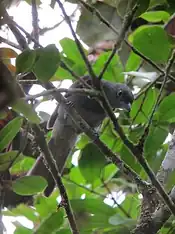 |
| Hawaiian Crow | Corvus hawaiiensis | 111[3] | EW[3] | N/A | Last known wild individuals seen in 2002. 64 males, 40 females, 7 unsexed individuals are currently held in captivity.[3] |  |
| 'Akikiki | Oreomystis bairdi | 150 - 610[4] | CR[4] | [4] | Total population is estimated to be 231-916 individuals.[4] |  |
| Araripe manakin | Antilophia bokermanni | 150 - 700[5] | CR[5] | [5] | Total population is estimated to be 779 individuals.[5] |  |
| Socorro mockingbird | Mimus graysoni | 190 - 280[6] | CR[6] |  [6] | Total population is estimated to be 287-419 individuals.[6] |  |
| Raso lark | Alauda razae | 250 - 999[7] | CR[7] | [7] | Total population was estimated to be 855 individuals in 2015.[7] |  |
| Superb pitta | Pitta superba | 250 - 999[8] | EN[8] | [8] |  | |
| Grey-winged cotinga | Lipaugus conditus | 250 - 999[9] | VU[9] | [9] | Total population is estimated to be 1,000 individuals.[9] |  |
| Atlantic royal flycatcher | Onychorhynchus swainsoni | 600 - 1,700[10] | VU[10] | [10] | Total population is estimated to be 1,000-2,499 individuals.[10] |  |
| Gurney's pitta | Hydrornis gurneyi | 1,000 - 2,500[11] | CR[11] | [11] |  | |
| Turquoise cotinga | Cotinga ridgwayi | 1,250 - 2,820[12] | VU[12] | [12] | Total population is estimated to be 1,880-4,230 individuals, assuming 10% of range is occupied.[12] |  |
| New Zealand rock wren | Xenicus gilviventris | 1,250 - 6,000[13] | EN[13] | [13] | Best estimate for number of mature individuals is 5,000.[13] |  |
| Bare-necked umbrellabird | Cephalopterus glabricollis | 1,900 - 7,100[14] | EN[14] | [14] | Values given are estimated population of mature individuals, assuming extrapolating from Panamanian population.[14] |  |
| Grauer's broadbill | Pseudocalyptomena graueri | 2,500 - 9,999[15] | VU[15] | [15] |  | |
| Mindanao wattled broadbill
(Wattled broadbill) |
Sarcophanops steerii | 2,500 - 9,999[16] | VU[16] | [16] |  | |
| Black-headed berryeater | Carpornis melanocephala | 2,500 - 9,999[17] | NT[17] | [17] |  | |
| White-cheeked cotinga | Zaratornis stresemanni | 2,500 - 9,999[18] | NT[18] | [18] |  | |
| Black-faced pitta | Pitta anerythra | 2,500 - 10,000[19] | VU[19] | [19] | Best estimate for number of mature individuals in 6,500.[19] |  |
| North Island kōkako | Callaeas wilsoni | 3,000 - 6,000[20] | LC[20] |  [20] | Best estimate for number of mature individuals is 5,000.[20] |  |
| Three-wattled bellbird | Procnias tricarunculatus | 3,600 - 14,000[21] | VU[21] | [21] | Total population is estimated to be 5,400-21,000 individuals.[21] |  |
| Banda Sea pitta | Pitta vigorsii | 5,000 - 9,999[22] | LC[22] | [22] | Total population is estimated to be 8,300-14,500 individuals.[22] |  |
| Long-wattled umbrellabird | Cephalopterus penduliger | 7,500-15,000[23] | VU[23] | [23] | Total population is estimated to be 11,200-22,400 individuals.[23] |  |
| Graceful pitta | Erythropitta venusta | >10,000[24] | LC[24] | [24] | No data on population size exist; however, "it is considered highly unlikely that the number of mature individuals is fewer than 10,000."[24] |  |
| Schneider's pitta | Hydrornis schneideri | >10,000[25] | LC[25] | [25] | No data on population size exist; however, "it is considered highly unlikely that the number of mature individuals is fewer than 10,000."[25] |  |
| Yellow-bellied sunbird-asity | Neodrepanis hypoxantha | 10,000 - 19,999[26] | VU[26] | [26] | Total population is estimated to be 15,000-30,000 individuals.[26] |  |
| Blue-rumped manakin | Lepidothrix isidorei | 10,000 - 19,999[27] | LC[27] | [27] |  | |
| Elegant pitta | Pitta elegans | 15,000 - 25,000[28] | LC[28] | [28] | Total population is estimated to be 20,000-35,000 individuals.[28] |  |
| Golden-crowned manakin | Lepidothrix vilasboasi | 15,000 - 137,000[29] | LC[29] | [29] | Total population is estimated to be 23,000 - 205,000 individuals.[29] |  |
| Ornate pitta | Pitta concinna | 20,000 - 40,000[30] | LC[30] | [30] | Total population is estimated to be 32,000-64,000 individuals.[30] |  |
| Lovely cotinga | Cotinga amabilis | 20,000 - 49,999[31] | LC[31] | [31] |  | |
| Black-and-gold cotinga | Lipaugus ater | 20,000 - 49,999 [32] | LC[32] | [32] | Best estimate for number of mature individuals is 44,591.[32] |  |
| Swallow-tailed cotinga | Phibalura flavirostris | 20,000 - 49,999[33] | LC[33] | [33] |  | |
| Cinnamon-vented piha | Lipaugus lanioides | 50,000 - 99,999[34] | LC[34] | [34] |  | |
| Blue cotinga | Cotinga nattererii | 50,000 - 499,999[35] | LC[35] | [35] |  | |
| Rufous piha | Lipaugus unirufus | 50,000 - 499,999[36] | LC[36] | [36] |  | |
| Orange-collared manakin | Manacus aurantiacus | 50,000 - 499,999[37] | LC[37] | [37] |  | |
| White-collared manakin | Manacus candei | 50,000 - 499,999[38] | LC[38] | [38] |  | |
| Bare-throated bellbird | Procnias nudicollis | 80,000 - 130,000[39] | NT[39] | [39] | Total population is estimated to be 123,165-193,545 individuals.[39] |  |
| Opal-crowned manakin | Lepidothrix iris | 250,000-1,500,000[40] | VU[40] | [40] | Total population is estimated to be 433,000-2,466,000 individuals.[40] |  |
| Lance-tailed manakin | Chiroxiphia lanceolata | 500,000-4,999,999[41] | LC[41] | [41] |  | |
| Golden-collared manakin | Manacus vitellinus | 500,000-4,999,999[42] | LC[42] | [42] |  | |
| Amazonian royal flycatcher | Onychorhynchus coronatus | 500,000-4,999,999[43] | LC[43] | [43] |  | |
| Purple-throated fruitcrow | Querula purpurata | 5,000,000 - 49,999,999[44] | LC[44] | [44] |  | |
| Common raven | Corvus corax | 21,000,000-26,400,000[45] | LC[45] | [45] |  | |
| Canada jay | Perisoreus canadensis | 26,000,000[46] | LC[46] | [46] |  | |
| American robin | Turdus migratorius | 370,000,000[47] | LC[47] | [47] |  | |
| Barn swallow | Hirundo rustica | 290,000,000 - 487,000,000[48] | LC[48] | [48] |  | |
Species without population estimates
| Common name | Binomial name | Population | Status | Trend | Notes | Image |
|---|---|---|---|---|---|---|
| Blue-headed pitta | Hydrornis baudii | unknown[49] | VU[49] | [49] |  | |
| Fairy pitta | Pitta nympha | unknown[50] | VU[50] | [50] |  | |
| Azure-breasted pitta | Pitta steerii | unknown[51] | VU[51] | [51] | 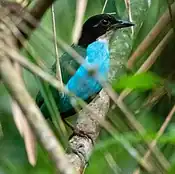 | |
| Whiskered pitta | Erythropitta kochi | unknown[52] | LC[52] | [52] |  | |
| Pompadour cotinga | Xipholena punicea | unknown[53] | LC[53] | [53] | 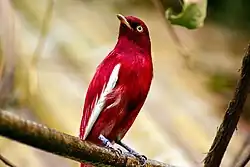 | |
See also
References
- 1 2 3 BirdLife International (2019). "Cotinga maculata". IUCN Red List of Threatened Species. 2019 e.T22700886A155966376. doi:10.2305/IUCN.UK.2019-3.RLTS.T22700886A155966376.en.
- 1 2 3 4 BirdLife International (2018). "Lipaugus weberi". IUCN Red List of Threatened Species. 2018 e.T22729457A130792523. doi:10.2305/IUCN.UK.2018-2.RLTS.T22729457A130792523.en.
- 1 2 3 BirdLife International (2025). "Corvus hawaiiensis". IUCN Red List of Threatened Species. 2025 e.T22706052A261946059. doi:10.2305/IUCN.UK.2025-2.RLTS.T22706052A261946059.en.
- 1 2 3 4 BirdLife International (2018). "Oreomystis bairdi". IUCN Red List of Threatened Species. 2018 e.T22720809A130843089. doi:10.2305/IUCN.UK.2018-2.RLTS.T22720809A130843089.en.
- 1 2 3 4 BirdLife International (2018). "Antilophia bokermanni". IUCN Red List of Threatened Species. 2018 e.T22728410A130774493. doi:10.2305/IUCN.UK.2018-2.RLTS.T22728410A130774493.en.
- 1 2 3 4 BirdLife International (2020). "Mimus graysoni". IUCN Red List of Threatened Species. 2020 e.T22711084A179825007. doi:10.2305/IUCN.UK.2020-3.RLTS.T22711084A179825007.en.
- 1 2 3 4 BirdLife International (2021). "Alauda razae". IUCN Red List of Threatened Species. 2021 e.T22717428A177685745. doi:10.2305/IUCN.UK.2021-3.RLTS.T22717428A177685745.en.
- 1 2 3 BirdLife International (2022). "Pitta superba". IUCN Red List of Threatened Species. 2022 e.T22698640A209885436. doi:10.2305/IUCN.UK.2022-2.RLTS.T22698640A209885436.en.
- 1 2 3 4 BirdLife International (2022). "Lipaugus conditus". IUCN Red List of Threatened Species. 2022 e.T22700721A216939985. doi:10.2305/IUCN.UK.2022-2.RLTS.T22700721A216939985.en.
- 1 2 3 4 BirdLife International (2018). "Onychorhynchus swainsoni". IUCN Red List of Threatened Species. 2018 e.T22699659A131326693. doi:10.2305/IUCN.UK.2018-2.RLTS.T22699659A131326693.en.
- 1 2 3 BirdLife International (2019). "Hydrornis gurneyi". IUCN Red List of Threatened Species. 2019 e.T22698628A157110021. doi:10.2305/IUCN.UK.2019-3.RLTS.T22698628A157110021.en.
- 1 2 3 4 BirdLife International (2022). "Cotinga ridgwayi". IUCN Red List of Threatened Species. 2022 e.T22700874A179425081. doi:10.2305/IUCN.UK.2022-1.RLTS.T22700874A179425081.en.
- 1 2 3 4 BirdLife International (2022). "Xenicus gilviventris". IUCN Red List of Threatened Species. 2022 e.T22698585A214186575. doi:10.2305/IUCN.UK.2022-2.RLTS.T22698585A214186575.en.
- 1 2 3 4 BirdLife International (2021). "Cephalopterus glabricollis". IUCN Red List of Threatened Species. 2021 e.T22700933A182996253. doi:10.2305/IUCN.UK.2021-3.RLTS.T22700933A182996253.en.
- 1 2 3 BirdLife International (2021). "Pseudocalyptomena graueri". IUCN Red List of Threatened Species. 2021 e.T22698719A195225376. doi:10.2305/IUCN.UK.2021-3.RLTS.T22698719A195225376.en.
- 1 2 3 BirdLife International (2017). "Sarcophanops steerii". IUCN Red List of Threatened Species. 2017 e.T22698738A117597507. doi:10.2305/IUCN.UK.2017-3.RLTS.T22698738A117597507.en.
- 1 2 3 BirdLife International (2022). "Carpornis melanocephala". IUCN Red List of Threatened Species. 2022 e.T22700736A216947947. doi:10.2305/IUCN.UK.2022-2.RLTS.T22700736A216947947.en.
- 1 2 3 BirdLife International (2023). "Zaratornis stresemanni". IUCN Red List of Threatened Species. 2023 e.T22700773A222728108. doi:10.2305/IUCN.UK.2023-1.RLTS.T22700773A222728108.en.
- 1 2 3 4 BirdLife International (2023). "Pitta anerythra". IUCN Red List of Threatened Species. 2023 e.T22698703A221398313. doi:10.2305/IUCN.UK.2023-1.RLTS.T22698703A221398313.en.
- 1 2 3 4 BirdLife International (2022). "Callaeas wilsoni". IUCN Red List of Threatened Species. 2022 e.T103730482A216851596. doi:10.2305/IUCN.UK.2022-2.RLTS.T103730482A216851596.en.
- 1 2 3 4 BirdLife International (2021). "Procnias tricarunculatus". IUCN Red List of Threatened Species. 2021 e.T22700946A174535716. doi:10.2305/IUCN.UK.2021-3.RLTS.T22700946A174535716.en.
- 1 2 3 4 BirdLife International (2022). "Pitta vigorsii". IUCN Red List of Threatened Species. 2022 e.T216710483A217035348. doi:10.2305/IUCN.UK.2022-2.RLTS.T216710483A217035348.en.
- 1 2 3 4 BirdLife International (2023). "Cephalopterus penduliger". IUCN Red List of Threatened Species. 2023 e.T22700936A222825005. doi:10.2305/IUCN.UK.2023-1.RLTS.T22700936A222825005.en.
- 1 2 3 4 BirdLife International (2023). "Erythropitta venusta". IUCN Red List of Threatened Species. 2023 e.T22698667A223810888. doi:10.2305/IUCN.UK.2023-1.RLTS.T22698667A223810888.en.
- 1 2 3 4 BirdLife International (2023). "Hydrornis schneideri". IUCN Red List of Threatened Species. 2023 e.T22698611A223802092. doi:10.2305/IUCN.UK.2023-1.RLTS.T22698611A223802092.en.
- 1 2 3 4 BirdLife International (2017). "Neodrepanis hypoxantha". IUCN Red List of Threatened Species. 2017 e.T22698777A118899364. doi:10.2305/IUCN.UK.2017-3.RLTS.T22698777A118899364.en.
- 1 2 3 BirdLife International (2022). "Lepidothrix isidorei". IUCN Red List of Threatened Species. 2022 e.T22701056A210588071. doi:10.2305/IUCN.UK.2022-1.RLTS.T22701056A210588071.en.
- 1 2 3 4 BirdLife International (2022). "Pitta elegans". IUCN Red List of Threatened Species. 2022 e.T216710532A217379957. doi:10.2305/IUCN.UK.2022-2.RLTS.T216710532A217379957.en.
- 1 2 3 4 BirdLife International (2021). "Lepidothrix vilasboasi". IUCN Red List of Threatened Species. 2021 e.T22701040A199965877. doi:10.2305/IUCN.UK.2021-3.RLTS.T22701040A199965877.en.
- 1 2 3 4 BirdLife International (2022). "Pitta concinna". IUCN Red List of Threatened Species. 2022 e.T216710576A217388624. doi:10.2305/IUCN.UK.2022-2.RLTS.T216710576A217388624.en.
- 1 2 3 BirdLife International (2020). "Cotinga amabilis". IUCN Red List of Threatened Species. 2020 e.T22700871A137868916. doi:10.2305/IUCN.UK.2020-3.RLTS.T22700871A137868916.en.
- 1 2 3 4 BirdLife International (2019). "Lipaugus ater". IUCN Red List of Threatened Species. 2019 e.T22700718A156223400. doi:10.2305/IUCN.UK.2019-3.RLTS.T22700718A156223400.en.
- 1 2 3 BirdLife International (2022). "Phibalura flavirostris". IUCN Red List of Threatened Species. 2022 e.T22724773A216858605. doi:10.2305/IUCN.UK.2022-2.RLTS.T22724773A216858605.en.
- 1 2 3 BirdLife International (2022). "Lipaugus lanioides". IUCN Red List of Threatened Species. 2022 e.T22700862A216875716. doi:10.2305/IUCN.UK.2022-2.RLTS.T22700862A216875716.en.
- 1 2 3 BirdLife International (2020). "Cotinga nattererii". IUCN Red List of Threatened Species. 2020 e.T22700877A137868258. doi:10.2305/IUCN.UK.2020-3.RLTS.T22700877A137868258.en.
- 1 2 3 BirdLife International (2020). "Lipaugus unirufus". IUCN Red List of Threatened Species. 2020 e.T22700859A137842114. doi:10.2305/IUCN.UK.2020-3.RLTS.T22700859A137842114.en.
- 1 2 3 BirdLife International (2021). "Manacus aurantiacus". IUCN Red List of Threatened Species. 2021 e.T22701106A137829154. doi:10.2305/IUCN.UK.2021-3.RLTS.T22701106A137829154.en.
- 1 2 3 BirdLife International (2021). "Manacus candei". IUCN Red List of Threatened Species. 2021 e.T22701103A137830108. doi:10.2305/IUCN.UK.2021-3.RLTS.T22701103A137830108.en.
- 1 2 3 4 BirdLife International (2020). "Procnias nudicollis". IUCN Red List of Threatened Species. 2020 e.T22700968A177705453. doi:10.2305/IUCN.UK.2020-3.RLTS.T22700968A177705453.en.
- 1 2 3 4 BirdLife International (2021). "Lepidothrix iris". IUCN Red List of Threatened Species. 2021 e.T22701033A171677370. doi:10.2305/IUCN.UK.2021-3.RLTS.T22701033A171677370.en.
- 1 2 3 BirdLife International (2021). "Chiroxiphia lanceolata". IUCN Red List of Threatened Species. 2021 e.T22701074A137831868. doi:10.2305/IUCN.UK.2021-3.RLTS.T22701074A137831868.en.
- 1 2 3 BirdLife International (2021). "Manacus vitellinus". IUCN Red List of Threatened Species. 2021 e.T22701109A137828191. doi:10.2305/IUCN.UK.2021-3.RLTS.T22701109A137828191.en.
- 1 2 3 BirdLife International (2018). "Onychorhynchus coronatus". IUCN Red List of Threatened Species. 2018 e.T22699647A130205114. doi:10.2305/IUCN.UK.2018-2.RLTS.T22699647A130205114.en.
- 1 2 3 BirdLife International (2020). "Querula purpurata". IUCN Red List of Threatened Species. 2020 e.T22700925A137871053. doi:10.2305/IUCN.UK.2020-3.RLTS.T22700925A137871053.en.
- 1 2 3 BirdLife International (2025). "Corvus corax". IUCN Red List of Threatened Species. 2025 e.T22706068A281841771. doi:10.2305/IUCN.UK.2025-2.RLTS.T22706068A281841771.en.
- 1 2 3 BirdLife International (2018). "Perisoreus canadensis". IUCN Red List of Threatened Species. 2018 e.T22705783A130380194. doi:10.2305/IUCN.UK.2018-2.RLTS.T22705783A130380194.en.
- 1 2 3 BirdLife International (2021). "Turdus migratorius". IUCN Red List of Threatened Species. 2021 e.T103889499A139392811. doi:10.2305/IUCN.UK.2021-3.RLTS.T103889499A139392811.en.
- 1 2 3 BirdLife International (2019). "Hirundo rustica". IUCN Red List of Threatened Species. 2019 e.T22712252A137668645. doi:10.2305/IUCN.UK.2019-3.RLTS.T22712252A137668645.en.
- 1 2 3 BirdLife International (2023). "Hydrornis baudii". IUCN Red List of Threatened Species. 2023 e.T22698631A225432915. doi:10.2305/IUCN.UK.2023-1.RLTS.T22698631A225432915.en.
- 1 2 3 BirdLife International (2025). "Pitta nympha". IUCN Red List of Threatened Species. 2025 e.T22698684A154680023. doi:10.2305/IUCN.UK.2025-2.RLTS.T22698684A154680023.en.
- 1 2 3 BirdLife International (2025). "Pitta steerii". IUCN Red List of Threatened Species. 2025 e.T22698644A231732291. doi:10.2305/IUCN.UK.2025-2.RLTS.T22698644A231732291.en.
- 1 2 3 BirdLife International (2023). "Erythropitta kochi". IUCN Red List of Threatened Species. 2023 e.T22698648A231714639. doi:10.2305/IUCN.UK.2023-1.RLTS.T22698648A231714639.en.
- 1 2 3 BirdLife International (2018). "Xipholena punicea". IUCN Red List of Threatened Species. 2018 e.T22700894A130266486. doi:10.2305/IUCN.UK.2018-2.RLTS.T22700894A130266486.en.
Category: